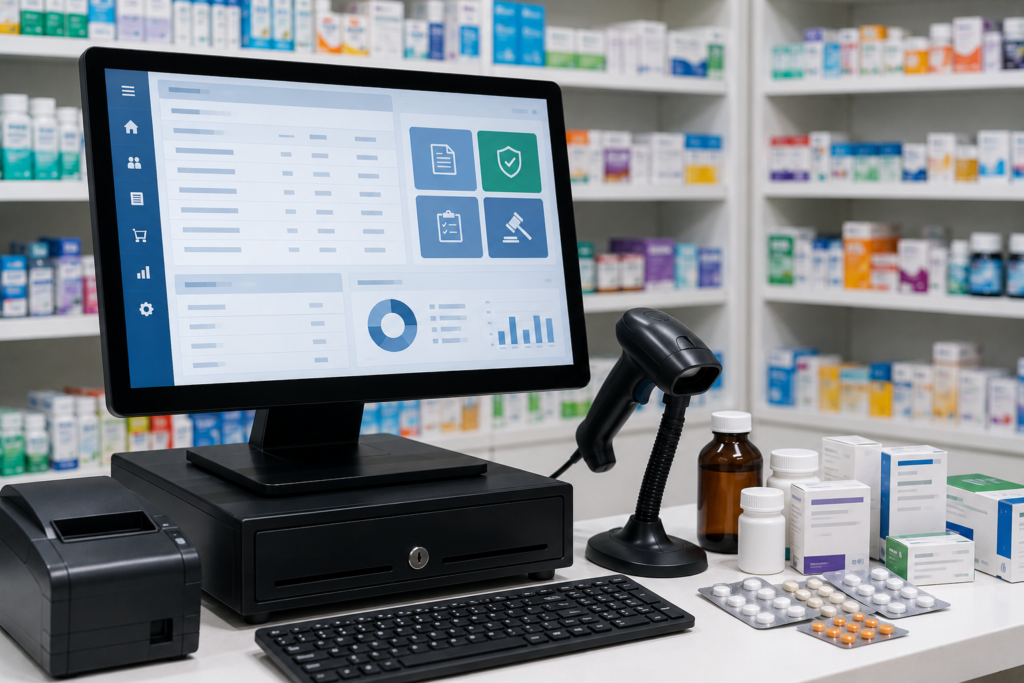
A medical store operates under a level of legal and regulatory scrutiny that most other retail businesses never face. Your billing system doesn’t just process transactions — it generates the records that drug inspectors may inspect, the GST data that tax authorities expect to reconcile, the batch documentation that becomes critical when a drug recall is issued, and the prescription records that determine whether a controlled substance was dispensed legally or not.
In this environment, the word “compliance” isn’t a feature to consider — it’s the baseline requirement. A medical store that processes hundreds of transactions a day using billing software that doesn’t understand batch numbers, Schedule H classifications, expiry dates, or correct pharmaceutical GST rates is generating a compliance gap with every single invoice it produces.
This article takes a precise, practical look at the compliance requirements that medical store billing software must meet — covering GST, the Drugs and Cosmetics Act, Schedule H and H1 drug management, and the record-keeping standards that protect your pharmacy license. If you’re currently evaluating billing software for your medical store, or if you’re questioning whether your current system is actually compliant, this guide gives you the complete framework to assess it clearly.
The Three Compliance Pillars Every Medical Store Must Meet
Understanding the compliance landscape before evaluating software helps you assess whether a vendor’s claims match the actual regulatory requirements your store faces.
Pillar 1: GST Compliance
Every GST-registered medical store must issue compliant invoices, maintain organized purchase and sales records, and file accurate returns. The pharmaceutical category adds complexity because medicines and health products span multiple GST rates, and incorrect rate application creates both under-payment and over-payment risk.
Pillar 2: Drugs and Cosmetics Act Compliance
The Drugs and Cosmetics Act 1940 and its Rules regulate how medicines are stored, dispensed, and documented in India. The Act imposes specific record-keeping requirements for scheduled drugs — requirements that are directly relevant to how your billing and inventory software must function.
Pillar 3: Patient and Prescription Safety
For prescription medicines and controlled substances, the act of dispensing must be documented with sufficient detail that it’s traceable. Software that enables this documentation as a natural part of the billing workflow both protects the patient and protects the pharmacy.
All three pillars require software capabilities that go well beyond what any general retail billing tool provides.
Part 1: GST Compliance in Medical Store Billing
Pharmaceutical GST Rate Structure
The pharmaceutical product range carries one of the most varied GST rate structures of any retail category. Your billing software must apply the correct rate for each product without any manual calculation at the counter.
GST Rates Applicable to Pharmacy Products:
| Product Category | GST Rate | HSN Code Range |
| Life-saving drugs (as notified) | 0% / Nil | 3004 |
| Ayurvedic, Unani, Siddha, Homeopathic medicines | 12% | 3004.90 |
| Diagnostic kits and equipment | 12% | 3822 |
| Branded formulations (most prescription drugs) | 12% | 3004 |
| Surgical instruments and devices | 12% | 9018 |
| Medical consumables (bandages, gloves, syringes) | 12% | 3005, 9018 |
| Cosmetics and beauty products | 18% | 3304–3307 |
| Sanitizers and disinfectants | 18% | 3808 |
| Nutritional supplements (non-prescribed) | 18% | 2106 |
| Baby formula and infant products | 5% | 1901 |
The practical challenge is that a single customer’s purchase might include a prescription medicine at 12%, a sanitizer at 18%, and a baby product at 5% — all on the same invoice. Your billing software must apply the correct rate to each line item automatically based on pre-configured HSN codes, without any manual intervention by the cashier.
GST Invoice Requirements for Medical Stores
Every invoice generated by a pharmacy must meet GST’s mandatory field requirements:
Mandatory invoice fields:
- Pharmacy’s GSTIN and legal name
- Sequential invoice number (resetting at the start of each financial year)
- Invoice date
- Customer name and GSTIN (for institutional buyers — hospitals, clinics, government)
- Batch number for each medicine line item
- HSN code per product
- Quantity and unit
- Taxable value per line item
- Applicable GST rate and tax amount (CGST + SGST or IGST)
- Total invoice value inclusive of tax
- Place of supply (for determining CGST+SGST vs IGST)
What happens without automated compliance: A pharmacist manually verifying GST rates across thirty to forty items on a prescription bill is not practically feasible at the speed a busy counter requires. Software that does this automatically makes compliance a byproduct of normal billing — not an extra step that requires effort.
GSTR-1 and GSTR-3B Filing Support
Your billing software must make GST return filing straightforward, not a manual data compilation exercise:
GSTR-1 requirements:
- Invoice-wise outward supply data for B2B transactions
- Consolidated sales summary for B2C transactions below ₹2.5 lakh per invoice
- HSN-wise summary of goods sold
- Credit notes and debit notes issued during the period
GSTR-3B requirements:
- Total output tax liability (CGST, SGST, IGST) for the period
- Input tax credit claimed on purchases
- Net tax payable after ITC adjustment
Billing software that exports this data in a format directly uploadable to the GST portal — or compatible with your CA’s filing tool — reduces the monthly compliance burden to verification rather than data compilation.
Input Tax Credit (ITC) Tracking
Medical stores purchase medicines from distributors who are GST-registered. The GST paid on these purchases is eligible as Input Tax Credit, reducing the pharmacy’s net tax payable. Capturing this accurately requires:
- Purchase invoice entry with distributor GSTIN
- Tax rate per product on purchase invoices
- Batch-level purchase records linked to purchase tax amounts
- ITC reconciliation against GSTR-2B auto-populated data from the portal
Software that maintains organized purchase records with GSTIN and tax details enables maximum, legally correct ITC claims — which directly reduces your net GST outflow.
E-Invoicing for Pharmacies
As the government progressively lowers the e-invoicing turnover threshold, an increasing number of medical stores are becoming eligible — and eventually mandatorily required — to generate e-invoices through the GST portal’s IRP (Invoice Registration Portal).
E-invoicing requirements:
- Invoice data uploaded to IRP before or at the time of supply
- IRP generates an IRN (Invoice Reference Number) that must appear on the final invoice
- A QR code generated by IRP must be printed on every e-invoice
- E-invoices cannot be cancelled after 24 hours — amendment must be through credit/debit notes
Your medical store billing software should support e-invoice generation natively — even if you’re not currently above the threshold, choosing software with this capability prevents a forced software change when you cross it.
Part 2: Schedule H and Drug Regulatory Compliance
Understanding Drug Schedules in India
India’s Drugs and Cosmetics Act classifies medicines into schedules that define how they may be stored, dispensed, labeled, and documented. The schedules most directly relevant to medical store billing are:
Schedule H: Prescription-only medicines that cannot be dispensed without a valid prescription from a registered medical practitioner. This is the largest category of regulated medicines and includes most antibiotics, antihypertensives, antidiabetics, and psychotropic drugs (other than those in Schedule X).
Key legal requirement: Schedule H medicines must not be sold without a prescription. The prescription should be retained by the pharmacist, and a record of the sale must be maintained.
Schedule H1: A subset of Schedule H covering medicines with higher abuse potential, antimicrobials critical for resistance management, and drugs requiring stricter control. Schedule H1 includes third-generation cephalosporins, carbapenems, fluoroquinolones, and several other antibiotic classes.
Additional H1 requirements: Sale of Schedule H1 drugs must be recorded in a separate register with specific details: name and address of the prescriber, patient name and address, drug name, strength, quantity dispensed, and date.
Schedule X: Habit-forming and psychotropic substances with the highest control requirements. These drugs require a separate stock register maintained in a specific format, with separate records of all receipts and issues.
OTC (Non-Scheduled): Over-the-counter medicines that can be sold without a prescription — paracetamol, antacids, antihistamines, vitamins, etc. These have fewer documentation requirements at the point of sale.
What Medical Store Billing Software Must Do for Schedule Compliance
Schedule H Drug Flagging
When a Schedule H medicine is added to a bill, the billing software must:
- Identify the drug as Schedule H based on its classification in the product master
- Prompt or require prescription reference entry before the line item can be added to the bill
- Record the prescription reference (prescription number or doctor name) against the sale
- Optionally flag recurring prescriptions — if the same patient has filled the same prescription recently, staff should be aware before dispensing again
The software doesn’t replace pharmacist judgment — but it ensures that the documentation supporting that judgment is created automatically as part of the normal workflow.
Schedule H1 Separate Register
For Schedule H1 drugs, the legal requirement is a dedicated register with more detailed records. Your billing software should:
- Identify Schedule H1 drugs distinctly from other Schedule H medicines
- Require capture of prescriber details (name, registration number, contact)
- Require patient name, address, and contact at the time of billing
- Automatically populate the H1 register entries from the billing transaction
- Generate H1 register reports in the format required by drug regulatory authorities
Manually maintaining a handwritten H1 register while operating a computerized billing system is both inefficient and creates a reconciliation gap — software should maintain both simultaneously from a single data entry.
Schedule X Controlled Substance Register
For pharmacies authorized to stock Schedule X substances, the software must maintain a separate controlled substances register tracking every receipt from supplier and every issue to patient, with the details required by the Drugs and Cosmetics Rules. This register must be available for inspection at any time.
Drug Inspector Record Production
Drug inspectors under the Drugs and Cosmetics Act are empowered to inspect pharmacy records at any time — without advance notice. The records they may ask to see include:
- Purchase invoices for regulated medicines
- Sales records for Schedule H, H1, and X medicines
- Current stock of regulated medicines
- Prescription records retained by the pharmacy
What good medical store billing software provides for inspection readiness:
- Complete purchase history by drug and batch, instantly retrievable
- Sales records per drug, per prescription reference, per date range
- Current batch-wise stock position for any drug
- Exported Schedule H1 register in regulatory format
A pharmacy running organized billing software can respond to a drug inspector’s records request in minutes. A pharmacy relying on handwritten registers and separate manual records faces a stressful and time-consuming process that creates inspection risk even when the pharmacy is operating correctly.
Part 3: Batch and Expiry Management as Compliance
Why Batch Tracking Is Non-Negotiable
Batch tracking in pharmaceutical retail is not a feature preference — it’s a patient safety requirement and a regulatory obligation.
What batch-level inventory means in practice:
Each time medicines are received from a distributor, a new batch entry is created with:
- Batch number (as printed on the packaging)
- Manufacturer’s name
- Manufacturing date
- Expiry date
- Purchase price
- MRP
- Quantity received
When medicines from this batch are sold, the batch number appears on the customer’s invoice — creating a complete chain of custody from manufacturer to patient.
Why this matters:
If a drug manufacturer issues a recall for Batch ABC123 due to a manufacturing defect, the pharmacy using batch-tracking software can:
- Immediately identify how many units of that batch are in current stock
- Quarantine the recalled stock instantly
- Identify every invoice on which that batch was dispensed
- Contact customers who received the recalled medicine
- Process the return to the distributor with full documentation
Without batch tracking, none of this is possible reliably.
FEFO Billing Logic
First Expiry First Out (FEFO) is the pharmaceutical standard for inventory consumption: when multiple batches of the same medicine are in stock, the batch with the earliest expiry date should be dispensed first.
What correct FEFO implementation looks like:
- When a medicine is added to a bill, the software automatically selects the batch with the nearest expiry date
- Staff do not need to manually choose which batch to dispense — the system defaults to the correct one
- If a newer batch has a higher MRP than an older batch, FEFO still applies (billing at the MRP of the batch dispensed)
What incorrect FEFO looks like:
- Staff manually select whichever batch is physically closest, often the newest stock placed in front
- Older stock sits behind newer stock and is eventually discovered expired
- The pharmacy writes off expired stock that FEFO would have prevented
FEFO compliance, enforced by the software’s billing logic, is one of the most financially significant features in pharmaceutical retail.
Near-Expiry Alerts and Stock Management
Beyond FEFO billing, comprehensive medical shop billing software should provide proactive expiry management tools:
Alert features to look for:
- Configurable near-expiry alerts (e.g., flag stock expiring within 30, 60, or 90 days)
- Daily or weekly near-expiry report showing all affected batches with quantities and values
- Automatic exclusion of expired stock from billing — the software should not allow billing of a product whose registered expiry date has passed
- Near-expiry stock reporting in a format suitable for distributor return negotiations
Part 4: Return Management and Credit Notes
Customer Returns
Medicine returns from customers are governed by specific rules — not all returns can be accepted, and those that are must be documented correctly:
Software requirements for customer returns:
- Return linked to the original invoice and batch number
- Reason for return recorded (sealed pack, unopened, within validity)
- Stock restored to the correct batch (not added as new unidentified stock)
- GST credit note generated for returns from GST-registered customers
- Returned stock flagged for inspection before being returned to saleable inventory
Distributor Returns for Near-Expiry or Defective Stock
Most pharmaceutical distributors accept returns of near-expiry stock within specific windows, and all distributors accept defective or recalled stock returns. Pharma billing software should support:
- Return purchase invoice generation with batch details and return reason
- Stock deduction from inventory on return dispatch
- Tracking of return status (dispatched, credit received, credit adjusted)
- Documentation of defective batch details for supplier credit claims
How Software Supports Business Growth and Formalization
GST Filing Consistency and MSME Credit
Medical stores with organized, software-maintained GST records and consistent filing histories are substantially stronger candidates for:
- MSME working capital loans (typically needed for managing pharmaceutical inventory investment)
- Credit guarantee scheme financing
- Pharmacy chain expansion financing
Banks and NBFCs increasingly use GST filing consistency as a primary financial credibility metric for pharmaceutical retail credit applications.
Institutional Supply Relationships
Hospitals, clinics, government health facilities, and corporate health programs that procure medicines from retail pharmacies require:
- Formal, correct GST invoices with their GSTIN
- Batch number documentation on all supplied medicines
- Organized purchase and supply history accessible on request
Medical store billing software that generates all of this automatically positions a pharmacy as a credible institutional supplier — a significant revenue opportunity that pharmacies running on manual or generic systems typically cannot access.
Franchise and Chain Pharmacy Compliance
Pharmacy chain networks and franchise systems in India have specific technology and compliance standards for their member pharmacies. Running purpose-built pharma billing software that meets these standards is typically a prerequisite for participation in organized pharmacy networks — which provide benefits including branded product access, institutional contract eligibility, and group purchasing advantages.
Global Pharmaceutical Retail Standards
For medical store operators interested in international pharmaceutical retail standards or those supplying to multinational healthcare organizations, organized digital records that trace drug supply chains from purchase to patient are a compliance baseline expectation. The same principles of batch tracking, controlled substance documentation, and audit-ready records that Indian drug regulators require align with the pharmaceutical record-keeping standards applied globally.
The Compliance Cost of Getting It Wrong
It’s worth being explicit about what compliance gaps actually cost a medical store operating without proper software.
Drug Inspector Penalties
Under the Drugs and Cosmetics Act, drug inspectors can:
- Issue warning notices for incomplete records
- Suspend pharmacy licenses for repeated non-compliance
- Recommend prosecution for serious violations including dispensing scheduled drugs without records
A single inspection finding of inadequate Schedule H records — even in a pharmacy that has never intentionally violated the Act — can result in penalties that far exceed the cost of compliant software over several years.
GST Audit Exposure
Pharmaceutical retailers with incomplete GST records, mismatched purchase and sales data, or incorrect tax rates on invoices face:
- GST scrutiny notices requiring record production
- Demand orders for underpaid tax with interest and penalties
- Reconciliation disputes that consume significant management time
Patient Safety Liability
In the event of an adverse drug event linked to a recalled batch, a pharmacy that cannot produce batch-level dispensing records has no documentation to demonstrate that it dispensed the recalled drug correctly or at all. This documentation gap creates serious liability exposure in any legal or regulatory proceeding.
Conclusion
GST compliance, Schedule H and H1 drug documentation, batch-level inventory tracking, expiry management, and drug inspector record readiness are not optional features in a medical store billing system. They are the baseline functionality that every compliant pharmacy operation requires — and they’re features that no generic retail billing tool provides.
The right medical store billing software handles all of these requirements as default functions that activate automatically during normal billing workflows. The pharmacist doesn’t calculate GST manually. The Schedule H flag appears without extra steps. FEFO batch selection happens without conscious staff intervention. The H1 register populates from billing data. Near-expiry alerts surface before they become write-offs.
This is what purpose-built pharmaceutical billing software delivers — and the gap between this level of operational compliance and what a generic billing tool provides is significant in both practical and legal terms.
If your current billing system doesn’t handle all of the compliance functions described in this article, the question isn’t whether to upgrade — it’s how soon. Every day of non-compliant billing is a day of compliance risk that accumulates. And in pharmaceutical retail, the consequences of that risk materializing are more serious than in almost any other category of retail business.
Frequently Asked Questions
- What is the difference between Schedule H and Schedule H1 drugs, and why does it matter for billing software? Schedule H covers prescription-only medicines that require a valid doctor’s prescription before dispensing. Schedule H1 is a subset of Schedule H covering higher-risk medicines — particularly antimicrobials and drugs with abuse potential — that require more detailed documentation: the prescriber’s registration details, patient address, and a dedicated H1 register entry for each dispensing. Billing software must treat these differently: Schedule H requires prescription reference capture; Schedule H1 requires full prescriber and patient details, automatically populating a separate regulatory register. Software that treats both the same, or doesn’t distinguish them at all, creates a compliance gap specifically for H1 drugs.
- What records does a drug inspector typically ask to see during a pharmacy inspection, and how does software help? Drug inspectors commonly request purchase invoices for regulated medicines, sales records for Schedule H and H1 drugs with prescription references, current stock position for controlled substances, the Schedule H1 register, and records of any returns or recalls handled. Medical store billing software that maintains organized, batch-level purchase and sales records and generates a Schedule H1 register from normal billing data makes producing all of these in minutes possible — rather than hours of searching through manual registers and paper files.
- How does FEFO billing logic work in medical store software, and what’s the financial benefit? FEFO (First Expiry First Out) means the software automatically selects the batch with the earliest expiry date when billing a medicine that has multiple batches in stock. This prevents newer stock from being dispensed while older stock sits unsold past its expiry date. Financially, the benefit is the elimination of expiry write-offs on stock that would have sold if dispensed in the correct order. For a pharmacy with active stock across thousands of SKUs, FEFO enforcement by the software prevents a category of loss that adds up to a significant amount over the course of a year.
- Does medical store billing software help with Input Tax Credit claims on medicine purchases? Yes, significantly. When purchase invoices from distributors are entered into the software with the distributor’s GSTIN and per-product tax amounts, the system maintains a complete purchase-side ITC record. This enables accurate reconciliation with the GSTR-2B auto-populated ITC statement from the GST portal, ensuring that every eligible ITC rupee is claimed. For a pharmacy with significant monthly purchase volumes, maximizing ITC claims has a meaningful direct impact on net tax payable.
- What happens if my medical store billing software doesn’t support e-invoicing, and I cross the applicable turnover threshold? If your pharmacy crosses the e-invoicing threshold and your billing software doesn’t support IRP integration, you’re legally required to either migrate to compliant software or use a manual process on the IRP portal for every invoice — which is impractical at any meaningful transaction volume. The consequence of non-compliance with e-invoicing requirements includes penalties and the risk of your invoices not being recognized for ITC claims by institutional buyers. This is why choosing software with e-invoicing capability built in — even before you’re mandatorily required to use it — is the operationally prudent approach.
- Can billing software help manage a drug batch recall in a medical store? Yes, and this is one of the strongest patient safety arguments for batch-tracking software. When a recall notice is issued for a specific batch, software with batch-level records allows the pharmacy to immediately search inventory for that batch number, see how many units remain in stock, quarantine them to prevent further billing, and — critically — identify every invoice on which that batch was dispensed, including customer details, to enable notification. Without batch-tracking software, reconstructing this information from manual records is unreliable and time-consuming, creating both patient safety risk and regulatory compliance risk during an active recall.