Airport security mandates thorough screening of all checked baggage using automated computed tomography systems hidden beneath the terminal floors. These massive machines rotate around suitcases to generate detailed 3D images, automatically flagging suspicious densities for human review. If an anomaly appears, technicians open the bag in a secure room and leave a formal inspection notice inside. This behind-the-scenes process ensures the cargo hold remains completely free of hazardous materials during high-altitude flight.
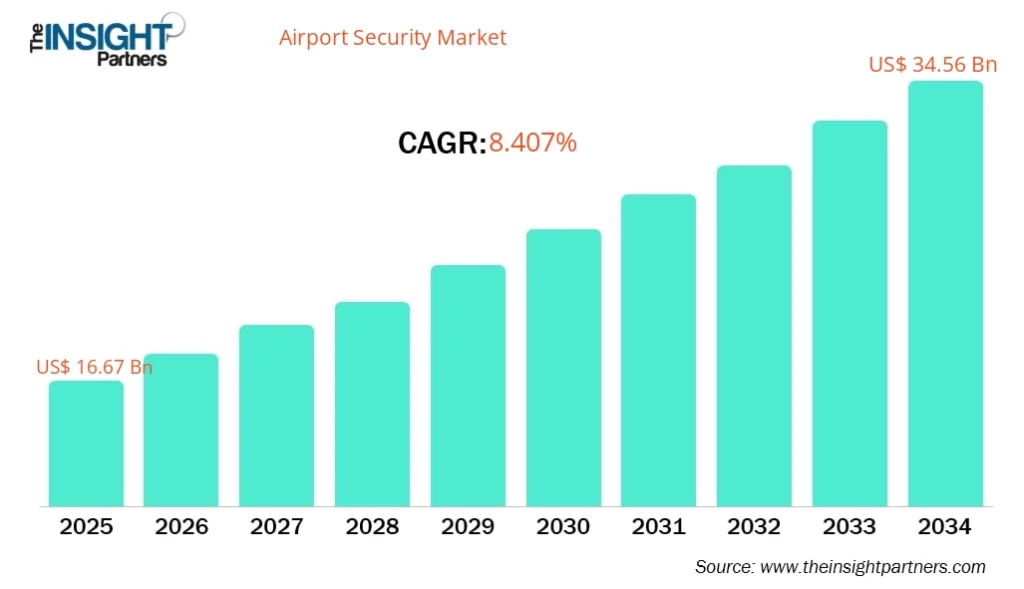
The global aviation industry is undergoing a major technological overhaul as airports worldwide prioritize passenger throughput, perimeter defense, and digital resilience. The Airport Security Market size is projected to reach US$ 16.67 Billion in 2025 and is expected to reach US$ 34.56 Billion by 2034. The market is expected to register a CAGR of 8.41% during the forecast period.
Escalating Passenger Traffic and Infrastructure Modernization
The primary catalyst propelling this expansion is the sustained surge in global domestic and international air passenger traffic, which has placed unprecedented pressure on legacy screening checkpoints. Airport operators and aviation authorities are aggressively upgrading existing terminals and constructing greenfield smart airports to eliminate bottlenecks while maintaining stringent safety protocols. Government mandates across North America, Europe, and Asia-Pacific requiring next-generation explosive detection systems and modernized terminal infrastructure are further accelerating capital expenditure in advanced security architectures.
Simultaneously, the proliferation of complex physical and digital threats has reshaped procurement strategies. Beyond traditional contraband and explosives detection, airports face mounting risks from unauthorized unmanned aerial systems (drones), perimeter breaches, and sophisticated cyberattacks targeting air traffic control, reservation databases, and biometric identity networks. Consequently, aviation stakeholders are transitioning away from siloed security hardware toward integrated, multi-layered defense ecosystems.
Get a PDF Sample- https://www.theinsightpartners.com/sample/TIPRE00017892
Technological Shifts: Biometrics, AI, and Computed Tomography
Rapid technological innovation is redefining the passenger journey from curb to gate. Touchless biometric identification incorporating facial recognition, iris scanning, and single-token digital credentials is becoming standard across major international hubs, drastically cutting queue times while enhancing identity verification accuracy. At security checkpoints, the widespread deployment of Computed Tomography (CT) 3D scanners and backscatter X-ray systems enables automated threat detection without requiring travelers to remove laptops or liquids from carry-on luggage.
Furthermore, the integration of artificial intelligence (AI) and machine learning into video surveillance and alarm resolution systems is enabling predictive threat assessment. Open-platform video management systems paired with AI analytics allow security teams to monitor vast terminal, landside, and airside perimeters in real time, flagging anomalous behavior instantaneously. Cybersecurity solutions have also emerged as a foundational pillar of airport defense, safeguarding interconnected Internet of Things (IoT) sensors and cloud-based command centers.
Market Segmentation Overview
By Security Type
- Access Control
- Cyber security
- Perimeter Security
- Screening
- Surveillance
By System
- Metal Detectors
- Fiber Optic Perimeter Intrusion
- Backscatter X-Ray Systems
- Cabin Baggage Screening Systems
Competitive Landscape and Key Players
Competition within the industry remains intense as established defense contractors and specialized detection technology providers vie for multi-year government and airport authority contracts. Market leaders are focusing heavily on research and development, strategic partnerships, and modular software upgrades to deliver higher detection accuracy and lower false-alarm rates.
Key players operating in the global Airport Security Market include:
-
American Science And Engineering, Inc.
-
Autoclear LLC
-
C.E.I.A. SpA
-
FLIR Systems, Inc.
-
L3 Security and Detection Systems
-
OSI Systems, Inc.
-
Robert Bosch LLC
-
Siemens AG
-
Smiths Detection LLC
-
Westminster Aviation Security Services Ltd.
Future Outlook
Looking ahead toward 2034, the Airport Security Market is poised to evolve toward fully autonomous, frictionless travel corridors. The rise of “Airport 4.0” characterized by hyper-connected digital ecosystems, edge computing, and real-time data sharing among airlines, border control, and airport operators will dictate future investment priorities. As artificial intelligence matures, self-learning screening algorithms will increasingly automate baggage and passenger threat resolution, reducing operational workloads on security personnel. Additionally, growing emphasis on sustainability will drive demand for low-power, solid-state scanning equipment. Vendors capable of unifying physical screening hardware, biometric identity management, and enterprise-grade cybersecurity into seamless, scalable platforms will capture the strongest growth opportunities over the coming decade.
Related Reports-
Airport Security Systems Market Share, Size & Demand by 2034
Passenger Security Systems Market Growth, Trends & Demand by 2034
About The Insight Partners
The Insight Partners is a leading market research and consulting firm delivering actionable insights through in-depth industry analysis and strategic intelligence. The firm supports clients across various industries in making informed decisions by providing comprehensive market forecasts, competitive assessments, and growth opportunities.
Contact Us:
If you have any queries about this report or if you would like further information, please contact us:
Contact Person: Ankit Mathur
E-mail: sales@theinsightpartners.com
Phone: +1-646-491-9876
Also Available in : Korean| German| Japanese| French| Chinese| Italian| Spanish