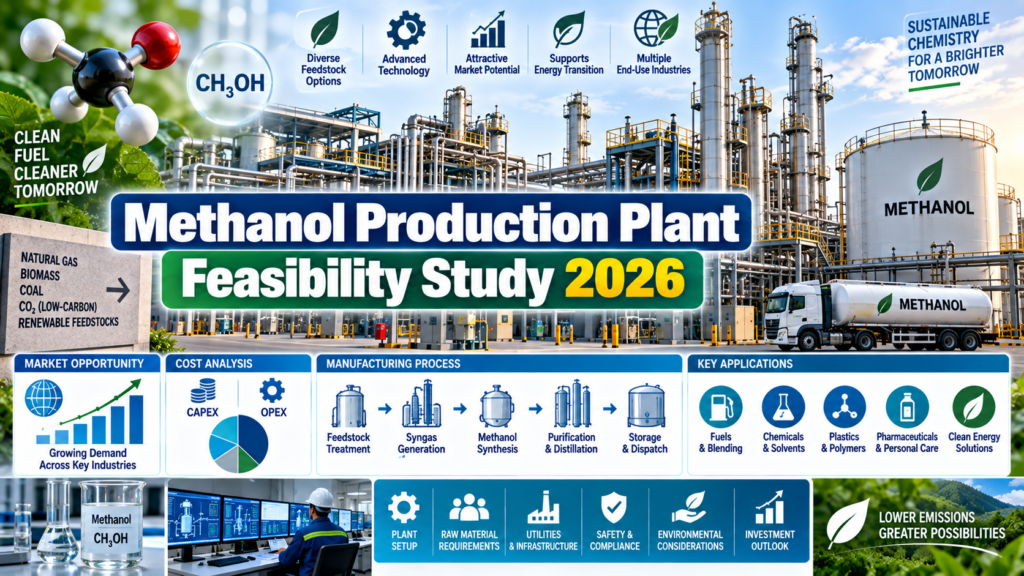
Setting up a methanol production plant involves several technically sophisticated processes, including feedstock handling and preparation, syngas generation through reforming or gasification, catalytic methanol synthesis, and final product purification through distillation. The facility requires specialized equipment such as reformers, gasifiers, compressors, synthesis reactors, distillation columns, storage tanks, and material handling systems. Since methanol is a toxic and highly flammable chemical produced under high-temperature and high-pressure conditions, implementing stringent industrial safety protocols, effective vapor containment systems, emission control measures, and comprehensive quality assurance procedures is essential for ensuring safe and efficient plant operations. Furthermore, developing a detailed methanol production plant DPR is crucial for evaluating the project’s technical and financial viability, including initial capital investment, machinery and equipment costs, production capacity, operating expenses, and overall commercial feasibility.
The methanol production industry is expected to witness steady growth through 2026, supported by increasing demand from methanol-to-olefins (MTO) processes, formaldehyde manufacturing, and fuel-blending applications. Growing investments in renewable and low-carbon methanol production are further creating opportunities amid the global transition toward cleaner energy sources and sustainable industrial practices. Additionally, technological advancements in the utilization of renewable feedstocks and captured carbon dioxide are facilitating the development of alternative methanol production pathways. Rising consumption across downstream chemical industries, coupled with growing interest in methanol as an alternative marine fuel, is further strengthening market prospects. As industries increasingly prioritize emission reduction, energy efficiency, and sustainable resource utilization, methanol is expected to remain an important chemical feedstock and energy carrier across the chemical, energy, transportation, and manufacturing sectors.
IMARC Group’s report, titled “Methanol Production Cost Analysis Report 2026: Industry Trends, Plant Setup, Machinery, Raw Materials, Investment Opportunities, Cost and Revenue,” provides a complete roadmap for setting up a methanol production plant. It covers a comprehensive market overview to micro-level information such as unit operations involved, raw material requirements, utility requirements, infrastructure requirements, machinery and technology requirements, manpower requirements, packaging requirements, transportation requirements, etc.
Request for a Sample Report: https://www.imarcgroup.com/methanol-manufacturing-plant-project-report/requestsample
Methanol Industry Outlook 2026
Expanding formaldehyde consumption in construction materials and the growing adoption of methanol-to-olefins (MTO) technology in polymer production continue to underpin methanol demand. Tightening regulations aimed at reducing marine emissions are accelerating interest in methanol as an alternative shipping fuel, while carbon capture and utilization (CCU) initiatives are supporting the development of renewable and green methanol projects. Rapid industrialization across Asia-Pacific and rising investment in downstream chemical complexes are further strengthening consumption.
However, challenges such as volatility in natural gas and coal prices, high initial capital investment for reforming and synthesis equipment, energy consumption concerns, and evolving environmental regulations may influence production costs and strategic investment decisions for new plant setups.
Key Insights for Setting Up a Methanol Production Plant
Detailed Process Flow
- Product Overview
- Unit Operations Involved
- Mass Balance and Raw Material Requirements
- Quality Assurance Criteria
- Technical Tests
Project Details, Requirements and Costs Involved
- Land, Location and Site Development
- Plant Layout
- Machinery Requirements and Costs
- Raw Material Requirements and Costs
- Packaging Requirements and Costs
- Transportation Requirements and Costs
- Utility Requirements and Costs
- Human Resource Requirements and Costs
Capital Expenditure (CapEx) and Operational Expenditure (OpEx) Analysis
Project Economics
- Capital Investments
- Operating Costs
- Expenditure Projections
- Revenue Projections
- Taxation and Depreciation
- Profit Projections
- Financial Analysis
Profitability Analysis
- Total Income
- Total Expenditure
- Gross Profit
- Gross Margin
- Net Profit
- Net Margin
Key Cost Components
- Raw Materials: The primary cost driver, including natural gas or coal used as feedstock along with steam and catalyst, which together account for the majority of operating expenses in methanol synthesis.
- Energy Costs: Methanol production is highly energy-intensive, particularly for reforming or gasification and compression stages, requiring significant amounts of natural gas, electricity, and steam.
- Machinery and Equipment: Capital investment in reformers, gasifiers, compressors, synthesis reactors, and distillation columns, along with ongoing maintenance costs.
- Labor: Includes salaries, training, and benefits for skilled and unskilled workers involved in plant operation, maintenance, and quality control.
- Utilities: Costs for water, compressed air, cooling systems, and other utilities essential for continuous, safe production.
- Packaging and Transportation: Expenses related to storing and distributing finished methanol to chemical manufacturers, fuel blenders, or end users, including logistics infrastructure and bulk storage terminals.
- Depreciation and Financing: Depreciation of fixed assets and interest or repayment obligations for loans or capital investment in plant setup.
- Compliance and Safety: Investment in emission control systems, environmental compliance, vapor and leak detection, safety measures, and waste treatment facilities.
- Overheads: Administrative costs such as insurance, office operations, licensing, marketing, and general plant management.
Economic Trends Influencing Methanol Plant Setup Costs 2026
Natural Gas and Coal Price Volatility: As natural gas and coal are the primary feedstocks for methanol synthesis, fluctuating global energy prices directly impact both capital and operating costs. Higher feedstock prices raise production expenses, making energy efficiency and supplier diversification more critical.
Carbon Pricing and Environmental Policies: Growing regulatory focus on greenhouse gas emissions increases costs related to emission control, carbon capture, and compliance systems. Carbon pricing mechanisms and tighter environmental rules may elevate initial capital outlay for new plant setups.
Inflation and Interest Rates: Rising inflation inflates the cost of building materials, civil construction, labor, and machinery, while higher interest rates increase the cost of loans and financing needed for plant construction, equipment procurement, and commissioning of reforming and synthesis units.
Government Subsidies and Stimulus: Policies supporting cleaner fuels, energy diversification, and domestic chemical manufacturing can reduce setup costs through grants, low-interest loans, or tax incentives aimed at methanol plant investments, particularly for renewable and low-carbon methanol projects.
Technological Advancements: Innovations in advanced reforming technology, high-efficiency synthesis catalysts, and CO2-to-methanol conversion can increase upfront CapEx but offer significant productivity gains, reduced energy consumption, and lower per-unit costs, enhancing long-term ROI.
Supply Chain Localization: Efforts to reshore chemical production and reduce dependence on imported methanol are incentivizing in-country investment in plant equipment and feedstock sourcing. This may increase initial costs where domestic gas or coal supply is limited but improves supply chain resilience and delivery turnaround.
Labor Market Considerations: Shortages of skilled process operators and engineers for high-pressure reforming and synthesis units can drive up wages or necessitate investment in operator training and retention programs, raising both initial setup and ongoing operational expenses.
Speak to an Analyst for Customized Report: https://www.imarcgroup.com/request?type=report&id=8448&flag=C
Challenges and Considerations for Investors
- Feedstock Price Volatility: Methanol production heavily depends on natural gas or coal-based feedstocks. Fluctuations in global energy prices can significantly impact production costs and profit margins.
- High Capital Intensity: Establishing a methanol plant requires substantial investment in reformers, gasifiers, synthesis reactors, and emission control systems. Long payback periods can deter risk-averse investors.
- Environmental Compliance: Stringent environmental regulations on greenhouse gas emissions, effluent discharge, and carbon footprint require additional investment in pollution control technologies and sustainable practices.
- Market Competition: The global methanol market is competitive, with several established players and excess production capacity in some regions. Investors must focus on operational efficiency or niche differentiation, such as renewable methanol, to remain viable.
- Logistics and Distribution: Transporting bulk methanol requires reliable infrastructure and storage facilities given its flammability and toxicity. Poor logistics can lead to distribution bottlenecks and increased delivery costs.
- Technological Barriers: Staying competitive requires adopting advanced, energy-efficient production technologies. Outdated systems lead to higher operational costs and greater environmental impact.
- Policy and Regulatory Risks: Changes in government policies, such as shifts in marine fuel regulations, carbon pricing, or energy subsidies, can alter market dynamics abruptly and affect investment outcomes.
Visit More Blog: https://www.imarcgroup.com/insight/methanol-manufacturing-plant-setup-cost-india
About Us:
IMARC Group is a global management consulting firm that helps the world’s most ambitious changemakers to create a lasting impact. The company excels in understanding its client’s business priorities and delivering tailored solutions that drive meaningful outcomes. We provide a comprehensive suite of market entry and expansion services. Our offerings include thorough market assessment, feasibility studies, company incorporation assistance, factory setup support, regulatory approvals and licensing navigation, branding, marketing and sales strategies, competitive landscape, and benchmarking analyses, pricing and cost research, and procurement research.
Contact Us:
IMARC Group
134 N 4th St. Brooklyn, NY 11249, USA
Email: sales@imarcgroup.com
Tel No:(D) +91 120 433 0800, 7827100593
United States: (+1-201-971-6302)