Aircraft Ducting components undergo rigorous testing for fire resistance and toxic gas emissions. Federal aviation regulations mandate that materials must not easily ignite or release harmful fumes. Insulation blankets are often wrapped around hot sections to protect surrounding sensitive electronics. Safety compliance is non-negotiable for all interior and exterior pneumatic systems.
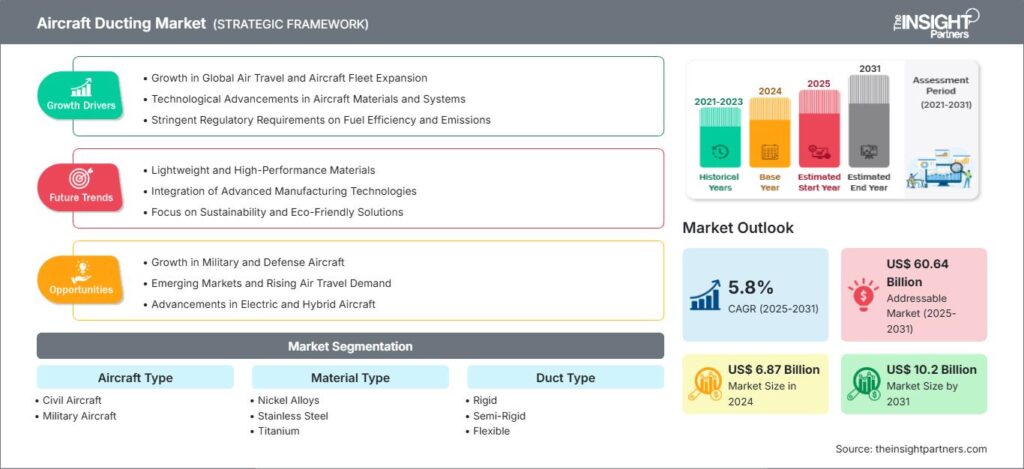
The global Aircraft Ducting Market size is expected to reach US$ 10.2 billion by 2031. The market is anticipated to register a CAGR of 5.8% during 2025–2031, propelled by rising commercial aircraft production rates, global air passenger traffic recovery and expansion, and an accelerating shift toward lightweight composite and high-performance metallic duct assemblies.
Aircraft ducting systems serve as the circulatory backbone of modern aviation platforms, managing critical airflow and fluid conveyance functions across environmental control systems (ECS), engine bleed air networks, thermal anti-ice systems, cabin pressurization, and exhaust assemblies. As original equipment manufacturers (OEMs) ramp up narrow-body and wide-body production to clear record order backlogs, demand for precision-engineered rigid, semi-rigid, and flexible ducting continues to climb across both commercial and defense sectors.
Key Market Drivers and Industry Dynamics
A primary catalyst behind market expansion is the sustained surge in commercial aircraft deliveries and fleet renewal initiatives. Airlines worldwide are aggressively replacing aging, fuel-intensive fleets with next-generation platforms that feature upgraded cabin air-management architectures and stricter thermal efficiency standards. Every newly manufactured aircraft requires an extensive network of high-pressure and low-pressure ducts capable of withstanding extreme temperature fluctuations, mechanical vibration, and corrosive operating conditions.
In parallel, defense modernization programs across North America, Europe, and the Asia-Pacific region are generating steady procurement for specialized military aircraft ducting. Modern fighter jets, military transport aircraft, and unmanned aerial vehicles (UAVs) rely on advanced titanium, nickel-alloy, and composite ducting solutions to minimize structural weight while maintaining durability under high-stress flight profiles.
Get a PDF Sample- https://www.theinsightpartners.com/sample/TIPRE00006210
Furthermore, the expanding global aviation Maintenance, Repair, and Overhaul (MRO) sector provides a resilient aftermarket revenue stream. Because tube and duct assemblies endure continuous thermal cycling and pressure loads, scheduled regulatory inspections and component replacements remain vital for fleet airworthiness.
Material Innovation and Regional Outlook
Weight reduction remains a top priority for aerospace engineers seeking to improve fuel burn and lower carbon emissions. While traditional materials such as aluminum, stainless steel, and titanium continue to anchor high-temperature engine bleed and anti-ice applications, composite and thermoplastic ducting are gaining rapid traction in low-pressure ECS and cabin ventilation zones. Additive manufacturing and digital twin simulation technologies are also transforming production workflows, enabling suppliers to fabricate complex geometries with fewer joints, reduced leakage points, and shorter prototyping cycles.
Regionally, North America maintains a leading share of the global Aircraft Ducting Market, supported by an entrenched aerospace manufacturing base, major OEM assembly hubs, and substantial defense expenditure. Meanwhile, Asia-Pacific is poised to exhibit the fastest growth trajectory through 2031, driven by expanding domestic air travel, new airline fleet orders, and rising local investments in aerospace component manufacturing.
Competitive Landscape and Key Players
The Aircraft Ducting Market is characterized by stringent aviation safety certifications, long-term OEM supply agreements, and continuous investment in precision forming and welding capabilities. Leading companies actively shaping the global competitive landscape include:
-
AmCraft Manufacturing, Inc.
-
Arrowhead Products
-
Eaton
-
Flexaust, Inc.
-
Leggett and Platt, Incorporated
-
Meggitt PLC
-
PMF Industries, Inc.
-
Sekisui Aerospace
-
Sigma Precision Components UK Ltd.
-
STEICO Industries Inc.
These market participants are focusing on capacity expansions, strategic acquisitions, and collaborative engineering with airframe and engine manufacturers to meet high-volume delivery schedules and next-generation platform specifications.
Future Outlook
Looking ahead toward 2031 and beyond, the Aircraft Ducting Market is positioned for sustained technological evolution as the aviation industry advances toward sustainable propulsion and electrified aircraft architectures. Emerging programs involving hybrid-electric propulsion, sustainable aviation fuel (SAF) compatibility, and cryogenic hydrogen fuel systems will introduce unprecedented thermal management and fluid conveyance requirements. Suppliers capable of integrating smart sensor diagnostics, ultra-lightweight composite structures, and modular duct assemblies will capture the greatest competitive advantage as global aviation transitions into its next era of efficiency and decarbonization.
Related Reports-
Aerospace Ducting Market Size, Demand & Growth by 2034
About The Insight Partners
The Insight Partners is a leading market research and consulting firm delivering actionable insights through in-depth industry analysis and strategic intelligence. The firm supports clients across various industries in making informed decisions by providing comprehensive market forecasts, competitive assessments, and growth opportunities.