Learning to drive is an important milestone that brings greater independence, flexibility, and confidence. However, choosing the right type of driving lessons can make a significant difference to the learning experience. For many new drivers, automatic cars offer a straightforward way to develop essential driving skills without the additional challenge of managing a manual gearbox and clutch.
As driving technology continues to evolve, automatic vehicles are becoming increasingly popular across the UK. From hybrid cars and electric vehicles to modern automatic petrol cars, learners have more opportunities than ever to experience automatic driving. For people living in the West Midlands, finding suitable automatic driving lessons Wednesbury can be an important first step towards becoming a safe and responsible driver.
Understanding how automatic lessons work, what to expect from an instructor, and how to prepare for the practical driving test can help learners make informed decisions.
Why Are Automatic Driving Lessons Becoming More Popular?
Automatic vehicles have become a common choice for everyday journeys. Many modern vehicles feature automatic transmissions, and the growing popularity of electric and hybrid cars has further increased interest in automatic driving.
Unlike manual vehicles, automatic cars do not require learners to operate a clutch pedal or manually change gears. The vehicle manages gear selection, allowing learners to concentrate on other important driving responsibilities.
Some key advantages include:
- Simpler vehicle control: Learners can focus on steering, braking, acceleration, and road positioning without coordinating a clutch and gearstick.
- Greater attention to traffic: Removing manual gear changes can help beginners concentrate on road conditions, pedestrians, cyclists, and other vehicles.
- Useful for urban driving: Automatic transmission can make stop-start traffic and busy junctions easier to manage.
- Suitable for modern vehicles: Automatic transmission is widely used in many hybrid and electric cars.
- Confidence development: Some learners find that fewer vehicle controls make their initial driving experience less overwhelming.
However, learning in an automatic car still requires patience, practice, and a good understanding of road safety. Learners must develop the same essential observation, anticipation, hazard awareness, and decision-making skills required of all drivers.
How to Choose an Automatic Driving Instructor in Wednesbury
Choosing an instructor is one of the most important decisions a learner makes. A qualified and supportive instructor can help beginners understand driving techniques, recognise mistakes, and gradually develop independent driving skills.
When researching an automatic driving instructor in Wednesbury, learners should consider several factors.
1. Check Qualifications and Professional Standards
Before starting lessons, check that the instructor is properly qualified and authorised to provide paid driving tuition.
In the UK, Approved Driving Instructors (ADIs) are registered with the Driver and Vehicle Standards Agency (DVSA). A trainee instructor may hold a trainee licence, subject to the relevant requirements.
Checking an instructor’s professional status helps learners make a more informed choice and understand the standards expected from their driving tuition.
2. Consider Teaching Style and Communication
Every learner develops at a different pace. Some people quickly become comfortable with steering and acceleration, while others need additional practice with junctions, roundabouts, or parking.
A good instructor should:
- Explain driving techniques in simple language.
- Provide clear instructions without creating unnecessary pressure.
- Identify areas that need improvement.
- Give constructive feedback after each lesson.
- Adapt teaching methods to the learner’s progress.
A positive learning environment can make lessons more productive and help nervous beginners become more comfortable behind the wheel.
3. Look for Local Road Knowledge
Learning in familiar surroundings can help students understand the types of roads and traffic situations they may encounter regularly.
Wednesbury and the surrounding West Midlands area provide opportunities to practise on different road types, including residential streets, busier roads, junctions, and roundabouts.
An instructor with knowledge of the local area can introduce learners to appropriate routes as their abilities improve. However, learners should also experience unfamiliar roads to develop the flexibility needed for independent driving.
What to Expect During Automatic Driving Lessons
A structured lesson programme usually introduces basic vehicle controls before progressing towards more complicated traffic situations.
Although lesson plans vary depending on individual ability, most learners develop their skills through several stages.
Understanding Automatic Vehicle Controls
The first lessons generally focus on understanding how an automatic car operates.
Learners should become familiar with:
- P (Park): Used when the vehicle is parked.
- R (Reverse): Used when reversing.
- N (Neutral): Disconnects the engine’s drive from the wheels.
- D (Drive): Used for normal forward driving.
- Brake pedal: Controls the vehicle’s speed and brings it to a stop.
- Accelerator pedal: Controls acceleration.
Automatic vehicles generally have two pedals: the accelerator and brake. Drivers normally use their right foot to operate both pedals, keeping the left foot away from them.
Understanding the gear selector, parking brake, mirrors, indicators, and dashboard controls is also important.
Developing Essential Road Skills
Once learners understand the basic controls, lessons can progress towards practical road situations.
These may include:
- Moving away and stopping safely.
- Steering and maintaining suitable road position.
- Approaching and emerging from junctions.
- Understanding traffic signs and road markings.
- Navigating roundabouts.
- Changing lanes safely.
- Reversing and completing parking manoeuvres.
- Responding appropriately to pedestrians and cyclists.
Each skill should be introduced at a suitable pace. Repeating difficult manoeuvres under an instructor’s guidance helps learners recognise mistakes and improve their technique.
Common Challenges Faced by Automatic Learners and How to Overcome Them
Although automatic cars remove the need for clutch control and manual gear changes, learners can still experience difficulties during their training.
Recognising these challenges early can make the learning process more effective.
Difficulty Maintaining Observation
Some beginners concentrate heavily on steering and vehicle speed, forgetting to check mirrors regularly.
The solution is to develop consistent observation habits. Learners should understand when to check mirrors, how to assess blind spots, and when observations are necessary before changing direction or position.
Nervousness at Busy Junctions
Busy junctions can be challenging because drivers must assess traffic speed, road markings, visibility, and available gaps.
An effective approach is to practise on quieter roads before progressing to more complex junctions. Learners should take sufficient time to assess the situation and avoid rushing decisions.
Poor Speed Management
Automatic vehicles can move forward when the transmission is engaged and the brake is released, depending on the vehicle. Beginners must therefore understand how to control speed smoothly.
Practising gentle acceleration, controlled braking, and appropriate following distances helps develop better vehicle management.
Lack of Confidence During Independent Driving
Some learners become dependent on instructor instructions and struggle when navigating unfamiliar routes.
To overcome this, instructors can gradually introduce independent driving exercises. Learners should practise following road signs, planning routes, and making safe decisions without relying on continuous directions.
Preparing for the UK Automatic Driving Test
Passing the practical driving test requires more than simply knowing how to operate an automatic car. Learners must demonstrate that they can drive safely, independently, and responsibly in different traffic conditions.
Before booking a test, learners should be comfortable with the DVSA driving test requirements.
Important preparation areas include:
- Vehicle safety: Understanding basic vehicle checks and controls.
- Observation: Using mirrors effectively and checking blind spots when necessary.
- Junctions: Approaching, assessing, and emerging safely.
- Positioning: Maintaining appropriate road position.
- Manoeuvres: Performing the required reversing exercises safely.
- Independent driving: Following sat-nav directions or traffic signs.
- Hazard awareness: Identifying potential dangers and responding appropriately.
Learners should also become familiar with the vehicle’s secondary controls, such as windscreen wipers, demisters, headlights, and hazard warning lights.
A mock driving test can be particularly useful because it allows learners to experience a test-like environment and identify areas requiring further practice.
It is important to remember that an automatic driving licence normally restricts the holder to driving automatic vehicles. Anyone who later wishes to drive a manual car will generally need to pass a separate practical test in a manual vehicle.

Finding Suitable Automatic Driving School Support in Wednesbury
When comparing driving tuition options, learners should look beyond lesson prices alone. Teaching quality, instructor experience, lesson availability, vehicle condition, and the structure of the learning programme are all important considerations.
People researching a driving school in Wednesbury automatic options should also consider the following questions:
- Does the school offer lessons specifically in automatic vehicles?
- Is the instructor properly qualified or authorised?
- Are lesson times suitable for work or education commitments?
- Does the instructor provide feedback on driving progress?
- Can lessons cover different road conditions?
- Is the teaching approach suitable for nervous beginners?
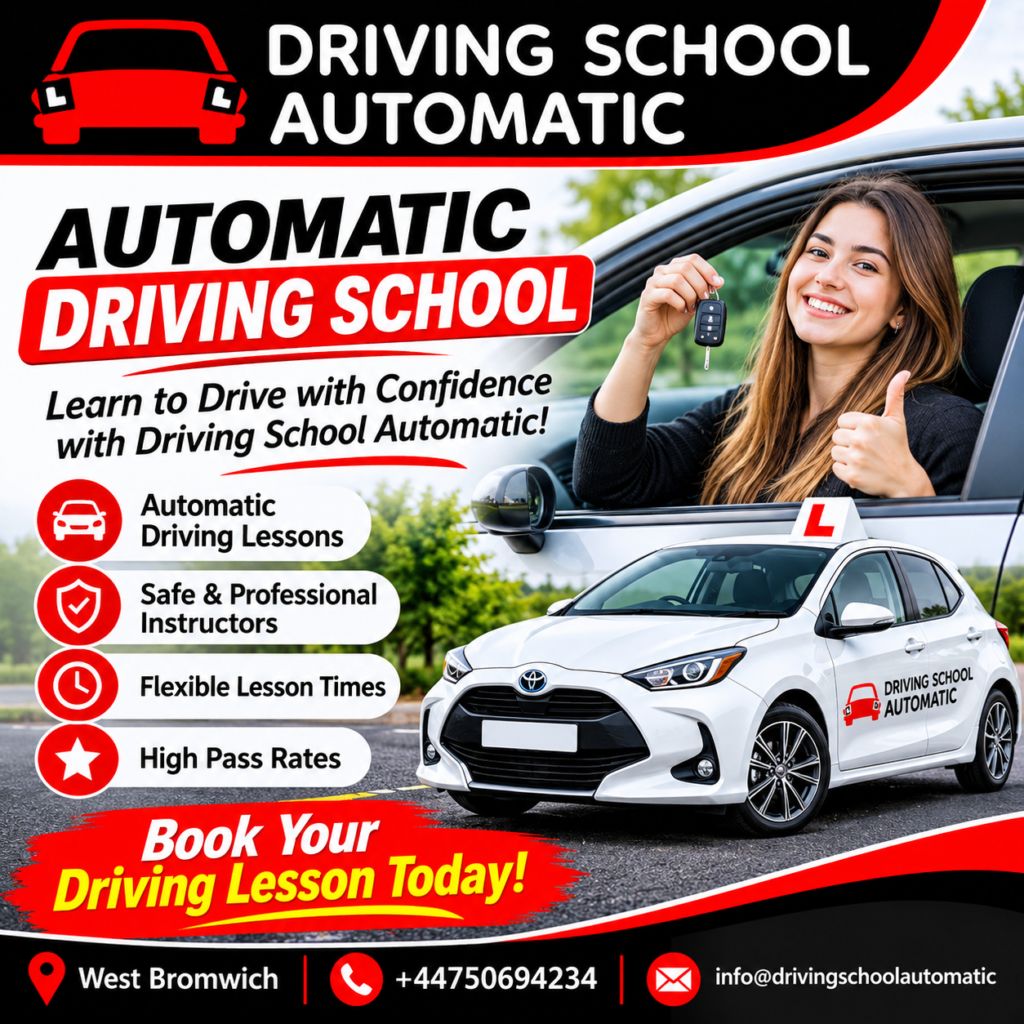
Learners in nearby areas may also compare providers based in West Bromwich and other surrounding communities. For example, Driving school Wednesbury automatic is a local-area provider associated with West Bromwich, which may be relevant to learners researching automatic driving tuition across the wider area.
Comparing providers carefully helps learners choose a learning environment that supports their individual needs rather than making a decision based only on convenience.
Conclusion
Learning to drive an automatic car can be a practical option for beginners who want to develop essential driving skills without managing a manual gearbox. However, successful learning still depends on consistent practice, effective instruction, road awareness, and responsible decision-making.
For learners considering automatic driving lessons in Wednesbury, selecting a qualified instructor, understanding the vehicle controls, practising different road situations, and preparing thoroughly for the practical test are all important steps.