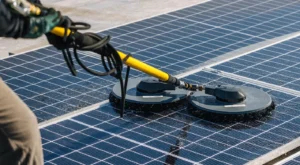
Dust, pollen, and bird droppings quietly block sunlight from reaching photovoltaic cells, cutting energy output before you notice a change on your utility bill. Understanding what professional solar panel cleaning services actually cost helps homeowners budget accurately without overpaying for routine maintenance. Across the United States, most residential visits run between $150 and $350, though roof height, panel count, and local labor rates can push quotes higher. Below is a complete breakdown of pricing models, cost factors, and smart ways to evaluate local quotes.
Average Cost of Professional Solar Panel Cleaning in the US
For a standard single-family home with 15 to 25 rooftop panels, a professional wash typically costs between $150 and $350 per visit. Homeowners with compact arrays of 10 to 12 panels on an easily accessible roof sometimes secure minimum-rate appointments around $130 to $150. Conversely, sprawling residential systems with 30 or more modules routinely land between $400 and $550.
Annual spending depends heavily on local climate and how often debris accumulates. Because most installers recommend scheduling service once or twice per year, the typical homeowner budgets roughly $300 to $700 annually for routine upkeep. Booking a spring wash after heavy pollen drop and an autumn wash before winter weather keeps production steady year-round.
Commercial properties operate under entirely different economics. Large flat-roof or ground-mounted arrays allow crews to move quickly with specialized rotary brushes and water-fed poles, dropping prices to a fraction of a dollar per watt. While a residential technician spends significant time setting up ladders and safety harnesses for 20 panels, a commercial crew can clean hundreds of modules in a single shift.
How Cleaning Companies Structure Their Pricing
Service providers rarely use a single universal rate sheet. Instead, exterior cleaning specialists, dedicated solar maintenance firms, and window washers rely on three distinct billing structures. Knowing how each model works makes comparing estimates much easier.
Per-Panel Pricing
Charging by the individual module is the most transparent and widely used approach for mid-sized residential arrays. Standard residential rates generally fall between $8 and $20 per panel, with $10 to $15 representing the middle of the market. If you have 20 panels on a straightforward roof at $12 per module, your pre-tax bill comes to $240.
Most companies pair per-panel rates with a minimum service call fee ranging from $100 to $150. If you only own eight panels, a $10 per-panel rate would equal $80, so the company applies its minimum trip charge to cover fuel, insurance, and setup time. Large systems often qualify for tiered volume discounts once the array exceeds 25 or 30 panels.
Flat-Rate Package Pricing
Some solar maintenance providers and franchise cleaning brands offer a single flat fee per visit regardless of exact panel count, or they group systems into broad size tiers. A flat-rate visit commonly sits between $200 and $350 for standard residential roofs. Other companies set a base tier—such as $150 for up to 15 panels—and add a small surcharge for every panel beyond that threshold.
Flat pricing eliminates surprises when you request an estimate over the phone. However, you should confirm what the flat rate excludes. Steep roof pitches, multi-story access, and heavily caked grime often trigger add-on fees even when a company advertises a flat base price.
Hourly Labor Rates and Bundled Plans
Complex custom installations, ground-mounted arrays spread across large acreage, or roofs requiring intricate rope-and-harness rigging are sometimes billed by the hour. Solar cleaning labor generally runs $50 to $100 per hour per technician. While hourly billing ensures you only pay for actual time on-site, always ask for a written time cap so slow work does not inflate your invoice.
Many providers also offer annual maintenance memberships or bundled cleaning-and-inspection packages. Combining a full wash with a visual electrical and racking inspection typically costs $350 to $450, saving $100 or more compared to booking two separate appointments.
Solar Panel Cleaning Pricing Models Compared
To help visualize how different billing structures impact your final bill, the table below outlines the three primary pricing models used across the United States alongside their typical rates and best-fit scenarios.
| Pricing Model | Typical Cost Range | Best Suited For | Key Watchouts |
| Per-Panel Rate | $8 – $20 per panel | Average homes with 12 to 25 panels | Minimum service fees of $100–$150 often apply to small arrays |
| Flat-Rate Package | $150 – $350 per visit | Predictable budgeting on standard single-story roofs | Steep pitches or two-story homes may trigger extra surcharges |
| Hourly Labor | $50 – $100 per hour | Oversized arrays (30+ panels) or difficult roof layouts | Request an estimated hour cap before technicians begin work |
| Clean + Inspection Bundle | $350 – $500 per visit | Systems over 5 years old needing preventive checks | Confirm the inspection covers wiring, inverters, and mounting hardware |
Comparing quotes across different models becomes straightforward once you convert every estimate into a total per-visit figure. Always ask each contractor whether purified water, roof access fees, and travel charges are already baked into the quote.
Key Factors That Influence Your Final Quote
Two neighbors with identical 20-panel arrays can receive quotes that differ by $150 or more. Technicians price jobs based on physical risk, setup time, water requirements, and local operating expenses rather than glass square footage alone.
Roof Height, Pitch, and Accessibility
Roof geometry is the single biggest cost driver after system size. A low-slope, single-story ranch home allows a technician to work safely from the ground using a telescoping water-fed pole or walk the roof perimeter with minimal rigging. That job takes roughly 45 to 60 minutes.
Two-story and three-story homes require taller extension ladders, fall-arrest harnesses, and anchor points. Steep roof pitches—generally anything steeper than a 6:12 or 7:12 slope—slow movement dramatically and increase liability insurance costs for the contractor. Expect roof access surcharges to add $50 to $150 to a standard quote. Ground-mounted arrays sit at the opposite end of the spectrum, often costing 15% to 25% less to clean because technicians never leave the ground.
Geographic Location and Local Labor Rates
Regional cost of living and market competition heavily shape service pricing. Homeowners in California, Hawaii, New York, and Massachusetts routinely pay 15% to 35% above the national average due to higher wages, stricter insurance requirements, and strong demand. A 20-panel wash that costs $200 in Texas or Ohio can easily reach $325 in coastal California or New England.
Travel distance also plays a role. Metro areas with dozens of competing exterior cleaning companies keep prices competitive. Rural homeowners living 45 minutes or more outside a service radius frequently face mileage fees of $50 to $100 unless they coordinate a group booking with nearby neighbors.
Severity and Type of Buildup
Routine dust and light pollen rinse away quickly with purified water and a soft-bristle brush. Panels that have gone three or more years without attention present a much tougher challenge. Baked-on bird droppings, tree sap, lichen, and wildfire ash bond tightly to tempered solar glass.
Removing stubborn organic buildup requires gentle soaking, non-abrasive biodegradable agitation, and multiple rinse passes so technicians do not scratch the anti-reflective coating. Heavy soiling can add $50 to $100 in extra labor time.
Purified Water Systems and Add-On Services
Reputable companies never spray untreated tap water onto hot solar panels. Tap water contains calcium, magnesium, and other dissolved minerals that dry into cloudy scale spots, blocking sunlight just like dirt. Professionals bring multi-stage deionized (DI) or reverse-osmosis (RO) filtration tanks in their vans so the water evaporates completely spot-free. Some providers include purified water in their base rate, while others list a $25 to $50 equipment fee in regions with hard municipal water.
Optional add-ons also change the final invoice:
-
Bird-proofing mesh installation: Adding wire critter guards around panel perimeters prevents pigeons and squirrels from nesting underneath, typically costing $300 to $800 depending on linear footage.
-
Gutter clearing: Many exterior cleaning crews offer discounted gutter cleanouts while their ladders are already up, adding $75 to $150.
-
Thermal or visual inspections: Checking for micro-cracks, loose racking bolts, or shading issues adds $100 to $200 when bundled with a wash.
Why Professional Cleaning Methods Matter for Panel Longevity
Solar modules look rugged, yet their top surfaces feature delicate anti-reflective coatings engineered to trap maximum photons. Using the wrong tools or water temperature can cause permanent damage that far exceeds the cost of hiring a specialist.
Pressure washers are the biggest hazard. High-pressure water jets can force moisture past rubber perimeter seals, leading to internal corrosion, delamination, and premature electrical failure. Aggressive scrubbing with stiff nylon bristles, household window cleaners, or abrasive powders strips away anti-reflective layers and leaves micro-scratches that trap future dirt faster.
Thermal shock presents another common pitfall. Spraying cold hose water onto glass baking in midday summer sun causes rapid contraction, which can crack tempered glass or damage internal solder joints. Experienced technicians schedule washes during early morning or late afternoon hours and rely exclusively on low-pressure deionized water paired with soft boar-hair or microfiber brushes. Following manufacturer-approved methods also protects your equipment warranty, as most solar brands explicitly void coverage for damage caused by improper cleaning.
Calculating the Return on Investment: Is Paying a Pro Worth It?
Homeowners often wonder whether spending $250 on solar panel cleaning actually pays for itself in electricity savings. The answer depends on your local electricity rates, system size, and how dirty your panels get.
According to research from the National Renewable Energy Laboratory (NREL) and industry field data, typical dust and pollen buildup reduces solar energy production by 3% to 7% across most US climates. In arid regions with infrequent rain, agricultural dust, or heavy bird activity, efficiency losses can climb to 15% or more.
Consider a realistic example. Suppose you own an 8 kW system generating 11,000 kilowatt-hours (kWh) per year in a state where electricity costs $0.20 per kWh. That system produces $2,200 worth of power annually. A 7% soiling loss costs you $154 per year in lost electricity credits. If you live in California or the Northeast where electricity exceeds $0.32 per kWh, that same 7% drop costs roughly $246 annually—nearly covering the entire price of a professional visit.
Conversely, if you live in the Pacific Northwest where frequent rain naturally washes light dust off tilted panels and electricity costs $0.13 per kWh, paying $300 twice a year will not pay for itself purely through extra kilowatt-hours. In low-rate, high-rainfall areas, a single annual cleaning combined with a preventive safety inspection offers the best balance of cost and equipment protection.
DIY Cleaning vs. Hiring a Professional
Tackling the job yourself looks inexpensive on paper, yet upfront gear and safety risks narrow the gap quickly. A safe DIY setup requires a soft-bristle extension brush ($40 to $80), a hose-end deionized water filter cartridge ($120 to $200) to prevent mineral spotting, and a sturdy ladder if you do not already own one ($150 to $300). Your first-year equipment outlay easily reaches $200 to $450.
DIY maintenance works well if you have a single-story home, a shallow roof pitch, or ground-mounted panels that you can reach safely without climbing onto slick wet shingles. Once you own the brush and deionized filter, ongoing supply costs drop to roughly $30 to $50 per year for replacement resin cartridges.
Hiring a professional makes far more sense for two-story homes, steep roofs, or arrays surrounded by tall trees that drop sap and heavy organic debris. Wet solar panels are extraordinarily slippery, and a single fall poses far greater financial and physical risk than a $250 service bill. Professionals carry workers’ compensation and general liability insurance, freeing you from personal injury risk while ensuring the glass gets cleaned safely.
Practical Tips for Getting an Accurate Quote
Before booking an appointment, taking a few minutes to prepare helps you secure fair pricing and avoid surprise fees on service day:
-
Count your panels and check roof stories. Knowing your exact panel count, approximate roof pitch, and whether trees overhang the array allows companies to give firm quotes rather than rough ballpark ranges.
-
Confirm deionized water usage. Ask specifically whether the crew uses multi-stage purified water rather than standard tap water with dish soap.
-
Verify insurance coverage. Request proof of general liability insurance and workers’ compensation so you are not held liable if a technician is injured on your property.
-
Ask about before-and-after photos. Reputable cleaners take timestamped photos from the roof so you can verify that stubborn bird droppings and grime around panel frames were thoroughly removed.
-
Schedule during shoulder seasons. Booking in early spring or mid-autumn often avoids peak summer waitlists and gives you the biggest production boost heading into high-sunlight months.
Conclusion
Professional solar panel cleaning typically costs between $150 and $350 for an average American home, with final pricing shaped by panel count, roof steepness, local labor rates, and buildup severity. Understanding per-panel, flat-rate, and bundled pricing models makes it much easier to compare local estimates fairly and spot hidden travel or roof-access fees. While homeowners with low, easily accessible roofs can handle light rinsing safely on their own, hiring an insured specialist using deionized water protects both your roof safety and your manufacturer warranty. Request two or three itemized quotes from local solar maintenance providers before your next peak sun season to keep your system performing at its best.
Frequently Asked Questions
How often should solar panels be professionally cleaned?
Most residential solar arrays benefit from professional cleaning once or twice a year. Homes in dusty desert climates, agricultural zones, coastal areas with salt spray, or neighborhoods with heavy tree pollen and bird activity may need service every three to four months to prevent buildup from blocking sunlight.
Does rain clean solar panels well enough on its own?
Light rain helps rinse away loose surface dust, especially on tilted roofs, but it cannot remove sticky pollen, bird droppings, tree sap, or mineral grime. In fact, light rain mixed with airborne dust often leaves behind a muddy film along the bottom edge of panel frames once the water evaporates.
Can cleaning solar panels void my manufacturer warranty?
Routine cleaning does not void your warranty, and many manufacturers actually require regular maintenance to keep coverage valid. However, using pressure washers, abrasive brushes, harsh chemical detergents, or cold water on hot glass can cause physical damage that manufacturers explicitly exclude from warranty protection.
What time of day is best for solar panel cleaning?
Early morning or late afternoon is ideal for washing solar panels. During these hours, the glass surface is cool to the touch, preventing thermal shock from cooler water and stopping purified water from evaporating too quickly before technicians can rinse away loosened dirt.
Is it better to hire a dedicated solar cleaner or a window washing company?
Both can do an excellent job as long as they use deionized water, soft-bristle brushes, and low-pressure equipment. Dedicated solar maintenance companies offer the added advantage of spotting loose wiring, cracked backsheets, or inverter error codes during the visit, whereas window cleaners often charge slightly less for basic exterior washing.