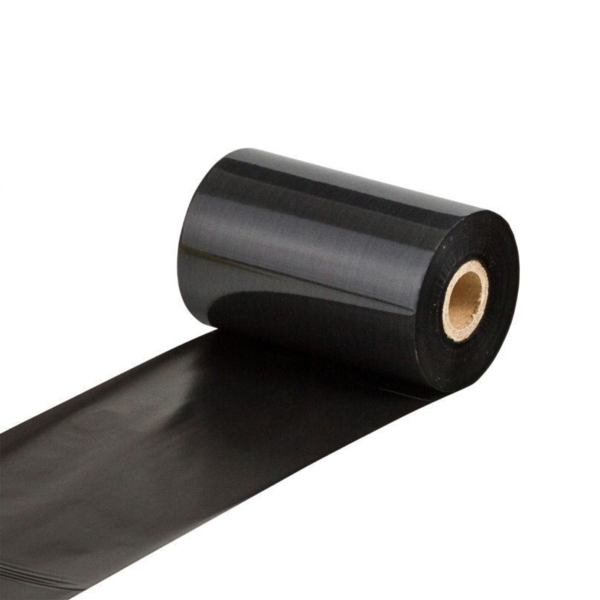
Choosing the right thermal transfer ribbon can make a significant difference to print quality, barcode readability, durability, and overall labeling costs. Businesses that print product labels, shipping labels, inventory tags, asset labels, or identification labels need a ribbon that matches both the label material and the conditions in which the printed information will be used.
A wax resin thermal transfer ribbon provides a practical balance between standard wax ribbons and high-performance resin ribbons. It produces sharper, more durable prints than conventional wax while remaining suitable for a broad range of coated paper and synthetic label materials.
This makes wax resin ribbons a popular option for logistics, manufacturing, retail, healthcare, warehousing, electronics, distribution, and many other industries.
In this guide, we explain what wax resin thermal transfer ribbons are, how they work, their main advantages, suitable applications, and what you should consider when choosing a ribbon for your thermal transfer printer.
What Is a Wax Resin Thermal Transfer Ribbon?
A wax resin thermal transfer ribbon is a printing ribbon made with an ink formulation containing a combination of wax and resin. It is designed for use in thermal transfer printers, where heat from the printhead transfers the ribbon’s ink onto the label or printing surface.
The wax component helps the ink transfer efficiently at relatively moderate temperatures, while the resin component improves durability, adhesion, and resistance to abrasion.
As a result, wax resin ribbons generally provide greater durability than standard wax ribbons without requiring the higher print temperatures associated with full resin formulations.
They are commonly used when labels need to remain clear and readable despite regular handling, friction, moisture, or moderate environmental exposure.
How Does Wax Resin Thermal Transfer Printing Work?
Thermal transfer printing uses three main components: the printer, ribbon, and label material.
Inside the printer, the thermal printhead applies controlled heat to specific areas of the ribbon. The heated ink layer melts and transfers onto the label surface, creating the required text, barcode, number, logo, or graphic.
The ribbon sits between the printhead and label material during printing. As labels move through the printer, the ribbon advances with them.
Wax resin formulations are engineered to provide strong transfer and adhesion to compatible surfaces. This allows businesses to produce clean and durable labels without relying on direct thermal materials that may gradually darken or fade when exposed to heat.
Wax vs Wax Resin vs Resin Thermal Transfer Ribbons
Understanding the difference between ribbon formulations is important before selecting a product.
Wax Thermal Transfer Ribbons
Wax ribbons are typically the most economical thermal transfer option. They work particularly well with uncoated and coated paper labels.
Wax formulations transfer easily and are suitable for applications where labels are unlikely to experience heavy abrasion, moisture, chemicals, or harsh environments.
Common applications include:
- Shipping labels
- Retail labels
- General warehouse labels
- Carton identification
- Short-term inventory labels
Wax ribbons are effective for general-purpose printing but provide less resistance to rubbing and environmental exposure.
Wax Resin Thermal Transfer Ribbons
A wax resin thermal transfer ribbon combines characteristics of wax and resin formulations.
It typically offers better scratch, smear, and moisture resistance than wax while maintaining excellent print quality across many materials.
Wax resin is commonly selected for coated papers and synthetic materials where additional durability is required.
Typical applications include:
- Product identification
- Warehouse tracking
- Healthcare labels
- Pharmaceutical labels
- Inventory management
- Logistics labels
- Retail product labels
- Industrial identification
For many businesses, wax resin provides an effective middle ground between affordability, print quality, and durability.
Full Resin Thermal Transfer Ribbons
Resin ribbons are designed for demanding applications. They typically require more heat during printing but provide excellent adhesion to compatible synthetic materials.
Full resin ribbons may be required when labels face exposure to chemicals, oils, solvents, extreme abrasion, outdoor conditions, or demanding industrial processes.
They are commonly used for specialized laboratory, automotive, electronics, chemical, and industrial labeling.
Key Benefits of Wax Resin Thermal Transfer Ribbon
Choosing the correct ribbon is about more than creating a visible image. Labels may need to remain readable throughout manufacturing, storage, shipping, handling, and final use.
Excellent Print Quality
Wax resin ribbons can produce sharp text, detailed graphics, and well-defined barcodes.
This is especially valuable for applications where labels contain small fonts, detailed product information, serial numbers, or compact barcodes.
High print definition also supports barcode scanning by maintaining clear separation between printed elements.
Improved Smudge Resistance
Labels frequently come into contact with hands, packaging, shelving, machinery, and other surfaces.
Standard wax printing may become damaged when subjected to repeated rubbing. Wax resin formulations offer improved resistance to smudging and abrasion, helping printed information remain readable for longer.
Better Moisture Resistance
Moisture can affect labels during transportation, refrigerated storage, manufacturing, or routine handling.
Wax resin printing generally provides greater moisture resistance than ordinary wax printing when paired with an appropriate label material.
However, businesses operating in very wet or chemically demanding environments should confirm whether wax resin provides enough protection or whether a full resin ribbon is required.
Versatility Across Label Materials
One of the biggest advantages of wax resin is its versatility.
Depending on the specific ribbon formulation, it can work effectively with:
- Coated paper
- Gloss paper
- Semi-gloss paper
- Polypropylene labels
- Polyethylene films
- Selected polyester materials
- Other compatible synthetic labels
Compatibility varies between ribbon products, so testing the ribbon with the exact label stock remains important.
Clear Barcode Printing
Barcodes need to remain readable throughout the life of the label.
Poor ribbon and label combinations can produce blurry edges, incomplete bars, smearing, or inconsistent density. These issues may lead to scanning problems and slow down warehouse, logistics, retail, or manufacturing operations.
A properly selected wax resin ribbon can produce crisp, high-contrast barcodes suitable for reliable scanning.
Balance Between Performance and Cost
Full resin ribbons offer high durability, but that level of performance is not necessary for every application.
Wax resin allows businesses to obtain greater durability than standard wax without automatically moving to a premium full-resin solution.
This performance-to-cost balance is one reason wax resin ribbons are widely used across commercial and industrial labeling environments.
Common Applications for Wax Resin Ribbons
The versatility of wax resin makes it suitable for many labeling requirements.
Product Labels
Manufacturers and retailers need labels containing product names, SKUs, barcodes, batch information, pricing, and other important details.
Wax resin helps this information remain clear during packaging, transportation, storage, and handling.
Warehouse and Inventory Labels
Warehouses rely heavily on barcode-based identification systems.
Labels may be scanned repeatedly and exposed to rubbing as products move between storage locations. Wax resin printing provides additional durability for inventory labels that require a longer usable life.
Shipping and Logistics
Some shipping labels experience more handling than basic paper labels can tolerate.
Wax resin may be suitable for logistics applications where improved abrasion resistance is needed, particularly when synthetic or premium coated label materials are used.
Retail Labels
Retail environments use thermal transfer printing for product identification, shelf management, pricing, inventory tracking, and barcode applications.
Wax resin can provide sharp printing while helping labels withstand regular handling.
Healthcare and Pharmaceutical Labels
Healthcare environments often require highly readable identification and tracking information.
Depending on the specific application and compliance requirements, wax resin ribbons may be used for sample identification, pharmaceutical labeling, general healthcare tracking, and related applications.
The ribbon and label material should always be evaluated against the environmental and regulatory requirements of the intended use.
Manufacturing Labels
Manufacturing facilities may need labels for work-in-progress tracking, component identification, packaging, inventory, and finished products.
Wax resin ribbons are useful where labels face moderate abrasion but do not require the extreme chemical resistance of a full resin formulation.
How to Choose the Right Wax Resin Thermal Transfer Ribbon
Not every ribbon works equally well with every printer or label material. Several factors should be considered before purchasing.
Check Printer Compatibility
Start by identifying your thermal transfer printer model.
Ribbon width, length, core size, winding direction, and ink orientation must be compatible with the printer.
Some printers require ink-side-in ribbons, while others use ink-side-out configurations.
Using an incompatible ribbon can cause poor printing or prevent proper installation.
Match Ribbon Width to Label Width
The ribbon should normally be slightly wider than the label material.
Using a ribbon that is too narrow can leave areas of the label unprinted and may expose the printhead directly to the label surface.
An excessively wide ribbon may increase material consumption unnecessarily.
Consider the Label Material
The label substrate has a major influence on ribbon performance.
A ribbon that performs well on coated paper may behave differently on polypropylene or polyester.
Before ordering large quantities, confirm that the ribbon formulation is recommended for your chosen label stock.
Evaluate Required Durability
Consider what will happen to the label after printing.
Will it be:
- Frequently handled?
- Exposed to moisture?
- Rubbed against packaging?
- Stored for several months?
- Used in cold conditions?
- Exposed to oils or chemicals?
- Used outdoors?
Wax resin is suitable for moderate durability requirements. More demanding environments may require a resin ribbon.
Consider Barcode Requirements
If labels contain barcodes, QR codes, serial numbers, or small text, print clarity should be a major consideration.
The ribbon should provide sufficient density and edge definition for reliable scanning.
Testing actual printed labels with the scanners used in your operation is a practical way to verify performance.
Importance of Matching the Ribbon and Label
Ribbon selection should never be considered separately from label selection.
Thermal transfer printing is a system. The printer, printhead, ribbon formulation, label coating, speed, temperature, and pressure all influence the final result.
For example, a premium wax resin ribbon may still produce poor results if it is paired with an incompatible synthetic surface.
Likewise, excessive printhead heat can cause spreading or ribbon problems, while insufficient heat can result in weak transfer.
Testing the complete combination helps identify suitable printer settings before full-scale production.
Wax Resin Ribbon for Barcode Printing
Barcode printing is one of the most common reasons businesses choose thermal transfer technology.
Barcodes need strong contrast and clearly defined edges so scanners can read them accurately.
A quality wax resin thermal transfer ribbon can support printing of:
- 1D barcodes
- 2D barcodes
- QR codes
- Inventory codes
- Serial numbers
- Asset identification codes
- Shipping identifiers
The exact barcode quality will also depend on printer resolution, label material, software settings, and print speed.
For high-density or very small barcodes, using a suitable printer resolution and optimized settings becomes especially important.
How to Improve Thermal Transfer Print Quality
Even the correct ribbon can produce inconsistent results if the printer is not configured or maintained properly.
Clean the Printhead Regularly
Dust, adhesive residue, and ribbon particles can accumulate on the printhead.
This may result in missing lines, faded areas, or inconsistent printing.
Follow the printer manufacturer’s recommended cleaning procedure and maintenance schedule.
Adjust Print Darkness Carefully
Increasing darkness usually increases the amount of heat applied by the printhead.
Too little heat may produce pale printing. Too much heat may reduce definition, damage ribbon performance, or increase printhead wear.
Start with the ribbon supplier or printer manufacturer’s recommended setting and adjust gradually.
Review Print Speed
High printing speeds can reduce the amount of time available for ink transfer.
If printing appears inconsistent, reducing the speed may improve image quality.
The optimum setting depends on the printer, ribbon, and label combination.
Store Ribbons Correctly
Thermal transfer ribbons should be kept in appropriate storage conditions and protected from excessive heat, moisture, direct sunlight, and contamination.
Always follow the manufacturer’s storage recommendations.
When Should You Choose Wax Resin Instead of Wax?
Wax resin is worth considering when standard wax does not provide sufficient durability.
You may need wax resin if your labels are becoming unreadable because of rubbing, scratching, smudging, or moderate moisture exposure.
It can also be a better choice when moving from basic paper labels to coated or synthetic label materials.
However, there is little benefit in paying for additional durability if your labels are used only briefly in clean, dry, low-contact conditions. In those situations, a standard wax ribbon may remain the more economical option.
When Is Full Resin a Better Choice?
Wax resin is versatile, but it is not designed for every environment.
A full resin ribbon may be more appropriate when labels experience demanding conditions such as strong chemicals, solvents, oils, high abrasion, extreme temperatures, or long-term outdoor exposure.
Applications involving strict industry requirements should be evaluated individually.
The goal is not simply to choose the strongest ribbon. It is to choose a formulation that provides the required performance without unnecessary cost.
Reducing Labeling Costs Through Correct Ribbon Selection
The cheapest ribbon does not always produce the lowest overall printing cost.
If an unsuitable ribbon causes unreadable labels, failed barcode scans, frequent reprinting, excessive printer adjustments, or premature printhead wear, operational costs can quickly increase.
Businesses should evaluate total performance rather than ribbon price alone.
Factors worth considering include ribbon yield, print speed, required heat settings, barcode readability, durability, reprint rates, and compatibility with existing label materials.
A well-matched wax resin ribbon can help create a stable printing process while minimizing unnecessary waste.
Why Print Testing Matters Before Bulk Purchasing
Technical specifications are useful, but actual testing provides the best indication of performance.
Before purchasing a large quantity of ribbon, test it using your normal:
- Thermal transfer printer
- Label material
- Print speed
- Darkness setting
- Barcode format
- Operating conditions
After printing, check image sharpness, barcode readability, adhesion, smudge resistance, and abrasion performance.
If labels will encounter moisture or other environmental conditions, include those factors in the testing process.
This approach can prevent costly compatibility problems after a bulk ribbon order has been placed.
Frequently Asked Questions About Wax Resin Thermal Transfer Ribbon
What is a wax resin thermal transfer ribbon used for?
A wax resin thermal transfer ribbon is used to print durable text, barcodes, graphics, serial numbers, and identification information onto compatible paper and synthetic labels. It is commonly used in retail, logistics, warehousing, manufacturing, healthcare, and product identification.
Is wax resin better than wax ribbon?
Wax resin generally provides better resistance to smudging, scratching, and moisture than standard wax ribbon. However, wax may be more economical for basic paper labels used in dry, low-contact environments. The better option depends on the application.
Can wax resin ribbons print on synthetic labels?
Yes. Many wax resin ribbons are designed to work with synthetic materials such as polypropylene and certain polyester or film-based labels. Compatibility should always be confirmed for the specific ribbon and label combination.
Is wax resin ribbon waterproof?
Wax resin printing can provide good moisture resistance when used with a suitable synthetic label, but it should not automatically be considered completely waterproof. Performance depends on the ribbon formulation, label material, exposure duration, and operating conditions.
Can I use wax resin ribbon for barcode labels?
Yes. Wax resin ribbons are widely used for barcode printing because they can provide strong contrast, sharp edges, and improved resistance to handling. Printer resolution, settings, and label quality also affect barcode readability.
What is the difference between wax resin and full resin ribbon?
Wax resin combines wax and resin components to balance printability, durability, and cost. Full resin ribbons contain a higher-performance resin formulation and are generally intended for demanding applications requiring greater resistance to chemicals, abrasion, heat, and environmental exposure.
How do I know which ribbon size I need?
Check your thermal transfer printer specifications and existing ribbon dimensions. Important measurements include ribbon width, ribbon length, core diameter, maximum roll diameter, and winding direction.
Does wax resin ribbon last longer than wax?
In applications involving regular handling or rubbing, wax resin printing generally offers better durability than wax. The actual lifespan depends on label material, storage, environmental exposure, and frequency of handling.
Why is my wax resin ribbon printing too lightly?
Light printing may result from insufficient printhead heat, excessive print speed, an incompatible label material, a dirty printhead, or an unsuitable ribbon formulation. Review printer settings and test adjustments gradually.
Is wax resin suitable for outdoor labels?
Wax resin may work for limited or protected outdoor applications, but long-term outdoor labels often require more specialized materials and resin ribbon formulations. UV exposure, rain, temperature changes, chemicals, and expected label life should all be considered.
Final Thoughts
A wax resin thermal transfer ribbon is a versatile choice for businesses that need more durability than standard wax printing without moving immediately to a full resin solution. It offers strong print definition, reliable barcode quality, improved resistance to smudging and abrasion, and compatibility with many coated paper and synthetic label materials.
The best results depend on choosing the ribbon as part of a complete printing system. Printer compatibility, ribbon dimensions, label material, environmental conditions, barcode requirements, print speed, and heat settings should all be considered before making a final selection.
For businesses handling inventory, logistics, manufacturing, retail, healthcare, or product identification, the right wax resin ribbon can improve label readability, reduce unnecessary reprints, and provide consistent performance throughout the label’s required service life.
Testing the wax resin thermal transfer ribbon with your specific printer and label stock before bulk purchasing is one of the most effective ways to ensure reliable printing, suitable durability, and better long-term value.