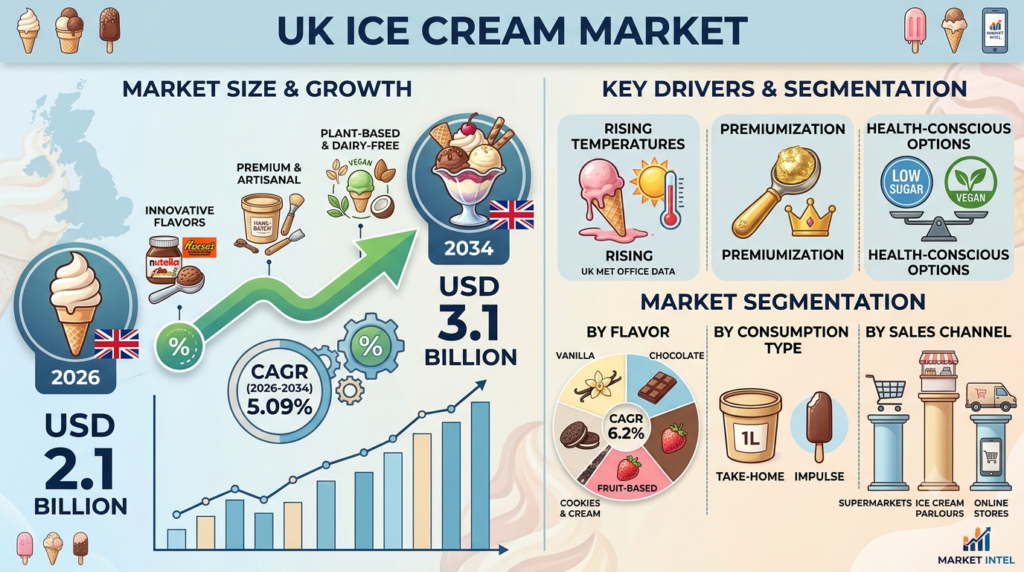
The UK ice cream market is witnessing steady growth driven by rising consumer interest in high-quality, artisanal flavors, the expanding availability of health-oriented options such as low-sugar and dairy-free products, and continued innovation in packaging and digital sales channels, particularly during peak seasons. The market size reached USD 2.1 Billion in 2026 (up from USD 1.9 Billion in 2025) and is projected to reach USD 3.1 Billion by 2034, exhibiting a compound annual growth rate (CAGR) of 5.09% during 2026-2034. Premiumization, flavor experimentation, plant-based innovation, and the rise of online sales and direct-to-consumer models are creating robust consumption patterns across impulse, take-home, and artisanal ice cream formats throughout the United Kingdom. This market is strategically important to the UK food and beverage sector as it connects dairy and ingredient suppliers, manufacturers, retailers, foodservice operators, and online platforms in a highly seasonal yet innovation-led category.
The UK ice cream market is poised for sustained expansion, driven by growing demand for premium and artisanal offerings, plant-based and lactose-free alternatives, and exciting flavor launches. With a projected CAGR of 5.09% through 2034, the market presents significant opportunities for established manufacturers and new entrants focused on innovation, health-conscious formulations, and sustainable packaging.
UK ICE CREAM MARKET SUMMARY
The UK ice cream market encompasses a wide range of frozen dessert products designed for indulgence, convenience, and shareable moments across retail, foodservice, and online channels. Key highlights include:
- Market Scope: Covers vanilla, chocolate, fruit, and other flavors across impulse, take-home, and artisanal categories, delivered in cup, stick, cone, brick, tub, and other formats.
- Market Size: USD 1.9 Billion in 2025, increasing to USD 2.1 Billion in 2026, with a projected value of USD 3.1 Billion by 2034 at a CAGR of 5.09% (2026-2034).
- Key Segments: Major segments include flavor (vanilla, chocolate, fruit, others), category (impulse, take-home, artisanal), product (cup, stick, cone, brick, tub, others), distribution channel (supermarkets and hypermarkets, convenience stores, ice cream parlors, online stores, others), and region.
- Consumer Demand: Growing interest in premium and artisanal ice creams, exotic and limited-edition flavors, and low-sugar, dairy-free, and vegan options is shaping purchase decisions.
- Distribution Landscape: Supermarkets and hypermarkets dominate distribution, convenience stores drive impulse purchases, and online stores, delivery platforms, and subscription models are rapidly gaining traction.
- Seasonality: Demand peaks in spring and summer, while producers work to flatten the curve through winter-friendly flavors, warm dessert pairings, take-home formats, and high-protein or dairy-free innovations.
PORTER’S FIVE FORCES ANALYSIS – UK ICE CREAM MARKET
The competitive dynamics of the UK ice cream market can be analyzed using Porter’s Five Forces framework.
Porter’s Five Forces Analysis – UK Ice Cream Market
- Competitive Rivalry: Intense competition between global leaders, private-label offerings, and a growing number of artisanal and niche producers drives continuous flavor launches, limited-edition releases, and promotional activity. Business implication: Players must differentiate through innovation, brand strength, premium positioning, and efficient supermarket and convenience-channel execution.
- Supplier Power: Manufacturers depend on dairy, sugar, cocoa, flavoring, and packaging suppliers, and input costs can fluctuate. Plant-based formulations using almond, coconut, and oat milk broaden the sourcing base. Business implication: Companies should diversify supplier relationships, secure long-term contracts, and invest in locally sourced and ethically certified ingredients.
- Buyer Power: Supermarkets and hypermarkets, the primary distribution channel, command significant bargaining power through bulk-buy discounts, multipack promotions, and exclusive listings, while consumers can easily switch between brands and formats. Business implication: Brands must build strong loyalty through quality, distinctive flavors, and engaging marketing, and diversify into convenience, online, and direct-to-consumer channels.
- Threat of Substitutes: Alternative desserts, confectionery, frozen yogurt, sorbets, and other snacks compete for the same indulgence occasions, particularly among health-conscious consumers. Business implication: Producers should expand low-sugar, high-protein, dairy-free, and vegan ranges and promote year-round consumption to defend share against substitutes.
- Threat of New Entrants: Large-scale manufacturing, cold-chain logistics, and supermarket listings create high barriers for mass-market players, but lower barriers exist for artisanal, premium, and direct-to-consumer brands leveraging social media, delivery platforms, and subscription models. Business implication: Established players should protect their positions through brand equity, product innovation, and distribution reach, while monitoring agile niche entrants.
Competitive Rivalry – Moderate to High (Healthy)
- Multi-tier competition spans multinational leaders (Unilever’s Wall’s, Magnum, Ben & Jerry’s, and Carte D’Or brands, and Froneri), confectionery-led entrants (Ferrero UK, Mars, Mondelez), and artisanal and regional specialists (Simply Ice Cream, Kelly’s of Cornwall, Brymor) – driving differentiation through flavor innovation, premium positioning, plant-based ranges, and sustainability credentials rather than purely price competition.
- Unilever’s planned launch of snackable formats (Magnum bonbon, upgraded Ben & Jerry’s Peaces, and Carte D’Or Mini Indulgence), Lotus Bakeries’ licensing deal with Froneri for Biscoff ice cream, and Brymor’s consolidation of Cream o’ Galloway production reflect active strategic repositioning that is strengthening the overall market ecosystem.
Request for Sample Report: https://www.imarcgroup.com/uk-ice-cream-market/requestsample
MARKET GROWTH DRIVERS:
Rising Demand for Innovative Flavors and Premium, Artisanal Offerings
Several key factors are propelling the expansion of the UK ice cream market. The growing demand for innovative and diverse flavors is a major driver, with brands continuously experimenting with unique ingredients and limited-edition offerings to attract adventurous consumers. In August 2024, Ferrero UK launched Nutella Ice Cream Tubs featuring hazelnut-flavored ice cream with Nutella swirls, while in November 2024 Brand of Brothers partnered with The Hershey Company to launch Reese’s ice cream in the United Kingdom. Additionally, the rise of premium and artisanal ice creams emphasizing high-quality ingredients, handcrafted production, and sophisticated taste profiles is appealing to consumers willing to pay more for superior products, as seen in Simply Ice Cream’s limited-edition Mini Egg Ice Cream relaunch in March 2024.
Health, Sustainability, and Digital Expansion
The UK ice cream market is also benefiting from the increasing focus on health and sustainability. There is a rising trend toward low-calorie, low-sugar, dairy-free, and vegan options as consumers become more health-conscious and environmentally aware. In February 2024, Magnum expanded its vegan range in the United Kingdom with Chill Blueberry Cookie sticks, and in June 2024 McDonald’s launched The Vegan Scoop in Choco and Strawberry flavors. Sustainable packaging and ethical sourcing practices further resonate with eco-minded shoppers, driving brand loyalty. Furthermore, the expansion of online sales and marketing, through delivery platforms such as Deliveroo, Uber Eats, and Just Eat, social media and influencer campaigns, subscription boxes, and direct-to-consumer models, is widening reach and supporting impulse purchases among younger demographics.
UK ICE CREAM MARKET SEGMENTATION
Segmentation analysis provides a detailed view of the UK ice cream market by category:
- Flavor Insights: Vanilla, Chocolate, Fruit, Others.
- Category Insights: Impulse Ice Cream, Take-Home Ice Cream, Artisanal Ice Cream.
- Product Insights: Cup, Stick, Cone, Brick, Tub, Others.
- Distribution Channel Insights: Supermarkets and Hypermarkets, Convenience Stores, Ice Cream Parlors, Online Stores, Others.
- Regional Insights: London, South East, North West, East of England, South West, Scotland, West Midlands, Yorkshire and The Humber, East Midlands, Others.
COMPETITIVE LANDSCAPE
The UK ice cream market features a competitive landscape in which large multinational manufacturers operate alongside confectionery-led brands and artisanal and regional producers. Key companies operating in the market include:
- Unilever (Wall’s, Magnum, Ben & Jerry’s, Carte D’Or) / The Magnum Ice Cream Company
- Froneri Ice Cream UK Ltd.
- Mars, Incorporated
- Mondelez International, Inc.
- Ferrero UK
- Kelly’s of Cornwall Ltd.
- Brymor Ice Cream
- Simply Ice Cream
Strategic developments are shaping the competitive arena, notably Unilever’s plan to launch new snackable ice cream formats in the UK (September 2024), Lotus Bakeries’ agreement with Froneri to produce, market, and distribute Lotus Biscoff-branded ice cream (March 2025), and Wall’s limited-edition Minecraft-themed ice cream launched with a TikTok influencer campaign (July 2025).
REGIONAL ANALYSIS:
Regional dynamics within the UK ice cream market are shaped by population density, tourism, local sourcing preferences, and retail and hospitality infrastructure:
- London: The UK’s largest and most diverse market, with strong demand for premium, exotic, and bespoke flavors, plant-based and health-conscious options, and a vibrant food festival and events scene.
- South East: A high population density and affluent consumer base make it a key market for premium and artisanal ice creams, with coastal areas boosting summer demand and strong retail and hospitality channels.
- North West: Cities such as Manchester and Liverpool combine established brands with emerging local producers, with strong preference for innovative flavors, family-friendly and value-for-money options.
- East of England: Demand for dairy-free and health-conscious options alongside classic flavors, with a young university population encouraging experimentation and an emphasis on local sourcing and sustainability.
- South West: A thriving market influenced by coastal lifestyle and tourist influx, with highly popular artisanal ice creams featuring regional ingredients such as Cornish clotted cream and Devon strawberries.
- Scotland: Preference for rich, indulgent flavors and growing demand for vegan and dairy-free options, with local brands using Scottish ingredients and festivals such as the Edinburgh Festival offering showcase opportunities.
- West Midlands: A dynamic market driven by a diverse population and strong retail presence, with growing interest in plant-based options and a central location that facilitates efficient distribution across the UK.
- Yorkshire and The Humber: A competitive mix of national brands and local artisans, with consumers favoring high-quality, locally sourced options and growing interest in vegan and low-sugar alternatives.
- East Midlands: A growing market influenced by a diverse population and urban development, with demand for both classic and innovative flavors and local artisans using regional ingredients.
RECENT INDUSTRY DEVELOPMENTS
July 2025: Wall’s launched a limited-edition Minecraft-themed ice cream, available exclusively at Morrisons in the UK before a wider European roll-out, supported by a TikTok influencer campaign targeting Gen Z.
March 2025: Lotus Bakeries signed a deal with UK-based Froneri to produce, market, and distribute Lotus Biscoff-branded ice cream across several European countries starting in 2026, with expansion planned through 2028.
January 2025: Brymor announced that production of Scottish ice cream brand Cream o’ Galloway will relocate from Galloway to its facility in North Yorkshire to use more modern, efficient, and environmentally friendly equipment.
November 2024: Brand of Brothers partnered with The Hershey Company to launch Reese’s ice cream in the United Kingdom, blending milk chocolate and peanut butter.
September 2024: Unilever announced plans to launch new snackable ice cream formats in the UK, including Magnum bonbon, upgraded Ben & Jerry’s Peaces, and Carte D’Or Mini Indulgence.
August 2024: Ferrero UK launched Nutella Ice Cream Tubs, featuring hazelnut-flavored ice cream with Nutella swirls.
Key Aspects Required for the UK Ice Cream Market
- Market Performance: USD 2.1 Billion in 2026, with a projected trajectory to USD 3.1 Billion by 2034.
- Market Outlook: A 5.09% CAGR during 2026-2034 indicates steady growth across impulse, take-home, and artisanal ice cream categories.
- Growth Drivers: Rising demand for premium and artisanal offerings; increasing popularity of plant-based, low-sugar, and lactose-free options; flavor innovation and limited-edition launches; expansion of online sales and direct-to-consumer channels; and seasonal product launches that maintain year-round consumer interest.
- Competitive Landscape: A multi-tier structure with global manufacturers (Unilever/The Magnum Ice Cream Company, Froneri) alongside confectionery-led brands (Ferrero UK, Mars, Mondelez) and artisanal and regional producers (Simply Ice Cream, Kelly’s of Cornwall, Brymor).
- Value Chain Analysis: From sourcing of dairy, plant-based, cocoa, sugar, and flavoring inputs through manufacturing, packaging, and cold-chain distribution to supermarkets, convenience stores, ice cream parlors, and online platforms, ending with consumers.
- Industry Trends: Innovative and exotic flavors; rising demand for premium and artisanal ice creams; plant-based and dairy-free options; online sales and digital marketing; and seasonal influence on consumption patterns.
- Strategic Recommendations: Invest in plant-based, low-sugar, and high-protein innovation; strengthen premium and artisanal portfolios; expand e-commerce, delivery, and direct-to-consumer capabilities; adopt sustainable packaging and ethical sourcing; and develop winter-friendly and all-season offerings to reduce seasonality.
Note: If you need any specific information that is not covered currently within the scope of the report, we will provide the same as a part of customization.
Request Customization: https://www.imarcgroup.com/request?type=report&id=21907&flag=E
- Report Format, Delivery, and Customization Details
- Report Format Mode: PPT, PDF, and Excel
- Report Delivery Mode: Online Delivery, Physical Delivery
- Report Delivery Time: Report Delivered Over Email within 24 to 48 hours. If requested by the client, a physical copy will be delivered within three to ten days.
- Report Confirmation Mode: Yes via Email
- Report Customization Mode: Yes via Email / Call
- Report Table of Content: Yes
- Report List of Figures: Yes
- Report Methodology Mode: Yes
- Request For Sample Report: Yes