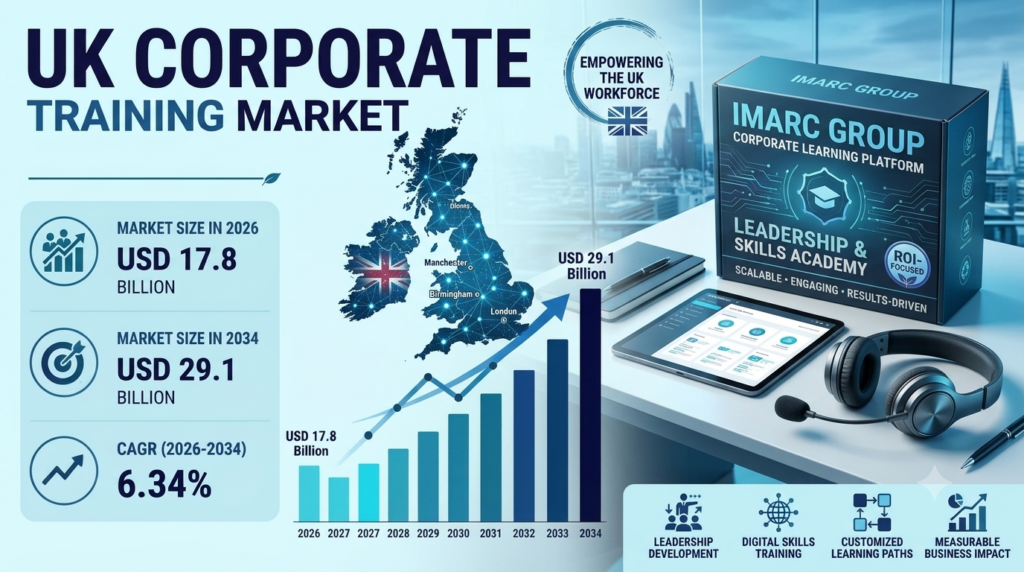
The UK corporate training market is witnessing strong growth driven by rising demand for employee upskilling, rapid digital and AI adoption, and an expanding requirement for compliance and regulatory training across key industries. The market size increased from USD 16.3 Billion in 2025 to USD 17.8 Billion in 2026 and is projected to reach USD 29.1 Billion by 2034, exhibiting a compound annual growth rate (CAGR) of 6.34% during 2026-2034. The reformed Growth and Skills Levy, which carries funding of £3.3 billion in England for 2026-27 and has allowed employers to fund short apprenticeship units since April 2026, along with the national AI Skills Boost target of upskilling 10 million workers by 2030, is creating robust demand for structured, technology-enabled workforce training across the country. This market is strategically important to the UK economy as it directly supports workforce productivity, regulatory compliance, and the skills pipeline needed for the nation’s digital, industrial, and green transitions.
The UK corporate training market is poised for sustained expansion, driven by AI-led upskilling, compliance requirements, and a more flexible Growth and Skills Levy. With a projected CAGR of 6.34% through 2034, the market presents significant opportunities for established training providers, digital learning platforms, and new entrants focused on blended, microlearning, and AI-enabled formats.
UK CORPORATE TRAINING MARKET SUMMARY
The UK corporate training market encompasses a wide range of employer-funded programmes designed to build workforce skills, improve organizational efficiency, and ensure regulatory compliance across sectors.
- Scope: Covers customer management, technical training, soft skills, and other corporate learning programmes delivered to employees across public and private organizations.
- Ecosystem: Includes content developers, specialist training providers, e-learning and learning management system (LMS) vendors, awarding and assessment bodies, consultancies, and in-house learning and development teams, supported by policy bodies such as Skills England.
- Major Segments: Training service (customer management, technical training, soft skills, and others), deployment (on-site and off-site), mode of learning (instructor-led classroom only, blended learning, online or computer-based methods, mobile and social learning, and others), and industry vertical (IT and telecom, BFSI, automobile, manufacturing, healthcare, and others).
- Market Size and Outlook: The market grew from USD 16.3 Billion in 2025 to USD 17.8 Billion in 2026 and is expected to reach USD 29.1 Billion by 2034 at a 6.34% CAGR during 2026-2034.
- Key Demand Factors: Rising demand for employee upskilling, significant technological improvements, the expanding requirement for compliance and regulatory training, and a surging emphasis on organizational efficiency and productivity.
- Policy Backdrop: The Growth and Skills Levy (including apprenticeship units from April 2026), Skills England, and the AI Skills Boost programme are widening funded routes for workforce training.
- Structural Challenge: Learning and Work Institute (L&W) reports that employer training investment per employee has fallen 29% since 2011 to around £1,700, and average training days per trainee fell from 7.8 to 5.7 between 2011 and 2024, pointing to strong headroom for efficient, shorter, and digital training formats.
PORTER’S FIVE FORCES ANALYSIS – UK CORPORATE TRAINING MARKET
The competitive dynamics of the UK corporate training market can be analyzed using Porter’s Five Forces framework.
Porter’s Five Forces Analysis – UK Corporate Training Market
- Competitive Rivalry: Moderate to High. The market includes global digital learning platforms, specialist UK providers, awarding bodies, and a large base of boutique consultancies, all competing on content quality, accreditation, technology, and measurable outcomes. Business implication: Providers must differentiate through sector expertise, accredited and AI-enabled offerings, and demonstrable return on training investment rather than competing on price alone.
- Supplier Power: Moderate. Suppliers include subject-matter experts and trainers, content and intellectual property owners, and technology vendors (LMS, VR/AR, and AI platforms). Large technology platforms hold meaningful leverage, while specialist trainer talent can be scarce. Business implication: Providers should build proprietary content, retain a multi-vendor technology stack, and invest in trainer development to limit dependence on any single supplier.
- Buyer Power: High and Increasing. Large employers, levy payers, and public sector bodies purchase through structured procurement and scrutinize return on investment, while free government programmes such as the AI Skills Hub raise price expectations. Business implication: Providers must offer modular pricing, outcome-based evidence, and integrated reporting to retain and grow corporate accounts.
- Threat of Substitutes: Moderate to High. In-house learning teams, free public programmes, vendor certifications, on-the-job learning, open online courses, and generative AI tutoring tools can replace elements of paid corporate training. Business implication: Providers should embed learning in the flow of work, personalize content, and offer recognized credentials that substitutes cannot easily match.
- Threat of New Entrants: Moderate. Barriers are low for digital, microlearning, and niche AI-coaching offerings, but higher for regulated apprenticeship delivery, which requires approved provider status, quality assurance, and established employer relationships. Business implication: Established players should defend positions through accreditation, brand trust, and long-term enterprise partnerships, while monitoring agile digital entrants.
Competitive Rivalry – Moderate to High (Healthy)
- Multi-tier competition spans global digital learning platforms (Skillsoft, LinkedIn Learning), UK specialists (QA, Corndel), awarding and assessment organizations (Pearson), and AI-focused entrants (Multiverse) – driving differentiation through personalization, accreditation, and blended delivery rather than destructive price competition.
- LinkedIn’s AI-driven mentorship matching platform for UK corporates (July 2024), Multiverse’s AI apprenticeship programme for Crown Estate (August 2024), and Pearson’s partnership in the AI Skills Boost initiative (June 2026) reflect active strategic repositioning toward AI-enabled and credentialed learning that is strengthening the overall market ecosystem.
Request for Sample Report: https://www.imarcgroup.com/uk-corporate-training-market/requestsample
MARKET GROWTH DRIVERS:
Rising Demand for Employee Upskilling, Compliance Training, and Productivity
Several key factors are propelling the expansion of the UK corporate training market. The rising demand for employee upskilling and reskilling is a powerful driver as employers respond to rapid technological change; L&W projects that 2.5 million more jobs will need higher-level skills by 2035. Training programmes increasingly combine technical skills with soft skills such as leadership and communication, delivered through online courses, workshops, and seminars. In parallel, the expanding requirement for compliance and regulatory training, covering health and safety, data protection, anti-corruption, and other regulatory areas, provides steady baseline demand as organizations seek to reduce risk, avoid legal penalties, and maintain industry certifications. Additionally, the surging emphasis on organizational efficiency and productivity is encouraging employers to invest in structured learning, even as employer training spend per employee has fallen 29% since 2011 to around £1,700, indicating considerable headroom for scalable, cost-effective training solutions.
MARKET GROWTH DRIVERS:
Technology Adoption, AI Skills, and Supportive Government Policy
The UK corporate training market is also benefiting from accelerating technology adoption and supportive policy. Digital learning platforms, including LMS and e-learning solutions, are making training more flexible, interactive, and scalable, while virtual reality (VR) and augmented reality (AR) simulations enhance engagement and retention for complex skills and safety training. Artificial intelligence (AI) is enabling personalized learning paths, training-effectiveness analytics, and skill-gap identification. Microlearning within the UK e-learning market is expanding by about 18% year-over-year, and gamification is lifting participation in soft skills, customer service, and sales training. Government-backed skills reforms are further strengthening demand: the Growth and Skills Levy, backed by £3.3 billion of funding in England for 2026-27, has supported short, flexible apprenticeship units since 28 April 2026, while the AI Skills Boost programme targets 10 million workers by 2030, including at least 2 million SME employees. Furthermore, the rise of remote and hybrid work is sustaining demand for online, blended, mobile, and social learning formats.
UK CORPORATE TRAINING MARKET SEGMENTATION
Segmentation analysis provides a detailed view of the UK corporate training market by category:
- Training Services Insights: Customer Management, Technical Training, Soft Skills, Others.
- Deployment Insights: On-Site, Off-Site.
- Mode of Learning Insights: Instructor Led Classroom Only, Blended Learning, Online or Computer-Based Methods, Mobile and Social Learning, Others.
- Industry Vertical Insights: IT and Telecom, BFSI, Automobile, Manufacturing, Healthcare, Others.
- Regional Insights: London, South East, North West, East of England, South West, Scotland, West Midlands, Yorkshire and The Humber, East Midlands, Others.
COMPETITIVE LANDSCAPE
The UK corporate training market features a competitive and fragmented landscape, with global digital learning platforms, specialist UK training providers, and awarding and assessment organizations competing alongside in-house learning and development teams. Key companies operating in the market include:
- QA Ltd.
- Skillsoft Corp.
- Pearson plc
- Corndel Ltd.
- Multiverse
- LinkedIn Corporation (LinkedIn Learning)
- Mind Tools Ltd.
- Franklin Covey Co.
Strategic developments are shaping the competitive arena, notably LinkedIn’s launch of an AI-driven mentorship matching platform for UK corporates (July 2024), Multiverse’s delivery of an AI apprenticeship programme for Crown Estate (August 2024), the introduction of apprenticeship units under the Growth and Skills Levy (April 2026), and Pearson’s role in the government’s AI Skills Boost initiative (June 2026), all of which are pushing providers toward AI-enabled, modular, and credentialed training.
REGIONAL ANALYSIS:
Regional dynamics within the UK corporate training market are shaped by the concentration of employers, industry clusters, and local skills priorities:
- London: The leading demand center, supported by the dense concentration of corporate headquarters, financial and professional services, and technology firms that drive demand for leadership, compliance, and digital training.
- South East: Demand is supported by technology, pharmaceutical, and logistics clusters, with strong uptake of technical and digital upskilling programmes.
- North West: Manufacturing, healthcare, and a growing digital sector sustain demand for technical training and apprenticeship-linked programmes.
- East of England: Life sciences, technology, and logistics employers drive demand for specialist technical and compliance training.
- South West: Aerospace, defence, and advanced engineering employers contribute to demand for technical and safety-critical training.
- Scotland: Energy transition, financial services, and public sector employers support demand, within a devolved skills system managed by Skills Development Scotland.
- West Midlands: Automotive and advanced manufacturing employers are driving reskilling demand tied to electrification and digital production.
- Yorkshire and The Humber: Financial and business services, manufacturing, and Humber-based energy activity support demand for both technical and soft skills training.
- East Midlands: Advanced manufacturing, aerospace, rail engineering, and logistics employers contribute to steady technical training demand.
- Others: The remaining UK regions, including the North East, Wales, and Northern Ireland, are smaller in market share but are seeing growth from regional skills programmes and industry-specific training needs.
RECENT INDUSTRY DEVELOPMENTS
September 2026: Learning and Work Institute published ‘Understanding employer investment in skills’, finding that employer training investment per employee has fallen 29% since 2011, average training days per trainee declined from 7.8 in 2011 to 5.7 in 2024, and 2.5 million more jobs will need higher-level skills by 2035.
August 2026: System changes under the Growth and Skills Levy took effect for levy-paying employers in England from 1 August 2026, including new account, expiry, and co-investment rules.
June 2026: Pearson joined the UK government’s AI Skills Boost initiative as a partner, contributing training, assessment, and digital credentialling expertise to help employers and workers verify AI skills.
April 2026: The first wave of apprenticeship units, short and flexible training courses for existing employees funded through the Growth and Skills Levy, opened to new starts in England on 28 April 2026, with initial focus areas including AI, digital, and engineering.
January 2026: The UK government expanded its AI Skills Boost programme, opening free AI training to every adult and raising the target to upskill 10 million workers by 2030, including at least 2 million SME employees.
August 2024: Crown Estate launched an AI employee training programme, delivered by Multiverse, to equip team members with advanced AI and machine learning capabilities and the ability to execute ethical AI projects.
July 2024: LinkedIn launched an AI-driven mentorship matching platform for UK corporates, connecting employees with personalized mentors based on skills and career goals.
July 2024: Prime Minister Keir Starmer unveiled Skills England, a new skills training organization aimed at reducing the UK’s long-term reliance on overseas workers and addressing skills gaps by bringing together government, businesses, training providers, and unions.
May 2022: The UK government allocated £50 Million to establish the Smart Manufacturing Data Hub, helping SMEs adopt digital technologies and boosting corporate training through data-driven insights, virtual testbeds, and digital innovation grants.
Key Aspects Required for the UK Corporate Training Market
- Market Performance: USD 16.3 Billion in 2025, rising to USD 17.8 Billion in 2026, with a projected trajectory to USD 29.1 Billion by 2034.
- Market Outlook: A 6.34% CAGR during 2026-2034 indicates robust growth across customer management, technical, and soft skills training, and across on-site, off-site, and digital delivery formats.
- Growth Drivers: Rising demand for employee upskilling and reskilling; rapid adoption of digital, VR/AR, and AI-enabled learning; expanding compliance and regulatory training requirements; emphasis on organizational efficiency and productivity; and policy support through the Growth and Skills Levy and AI Skills Boost.
- Competitive Landscape: A multi-tier structure of global digital learning platforms (Skillsoft, LinkedIn Learning), UK specialist providers (QA, Corndel), awarding and assessment organizations (Pearson), and AI-focused entrants (Multiverse), with moderate to high competitive intensity.
- Value Chain Analysis: From content creation and curriculum design by subject-matter experts, through technology and platform enablement (LMS, VR/AR, AI), to delivery (on-site, off-site, and blended), and finally employer adoption, assessment, credentialling, and measurement of learning outcomes.
- Industry Trends: Microlearning, gamification, VR/AR simulations, AI-driven personalization, blended learning, and short modular apprenticeship units are reshaping delivery, alongside a continued focus on compliance training.
- Strategic Recommendations: Focus on AI and digital skills programmes, blended and microlearning formats, and modular offerings aligned with Growth and Skills Levy funding; develop accredited, outcome-measurable solutions; and build strong partnerships with large employers, SMEs, and public sector bodies.
Note: If you need any specific information that is not covered currently within the scope of the report, we will provide the same as a part of customization.
Request Customization: https://www.imarcgroup.com/request?type=report&id=24958&flag=E
- Report Format, Delivery, and Customization Details
- Report Format Mode: PPT, PDF, and Excel
- Report Delivery Mode: Online Delivery, Physical Delivery
- Report Delivery Time: Report Delivered Over Email within 24 to 48 hours. If requested by the client, a physical copy will be delivered within three to ten days.
- Report Confirmation Mode: Yes via Email
- Report Customization Mode: Yes via Email / Call
- Report Table of Content: Yes
- Report List of Figures: Yes
- Report Methodology Mode: Yes
- Request For Sample Report: Yes