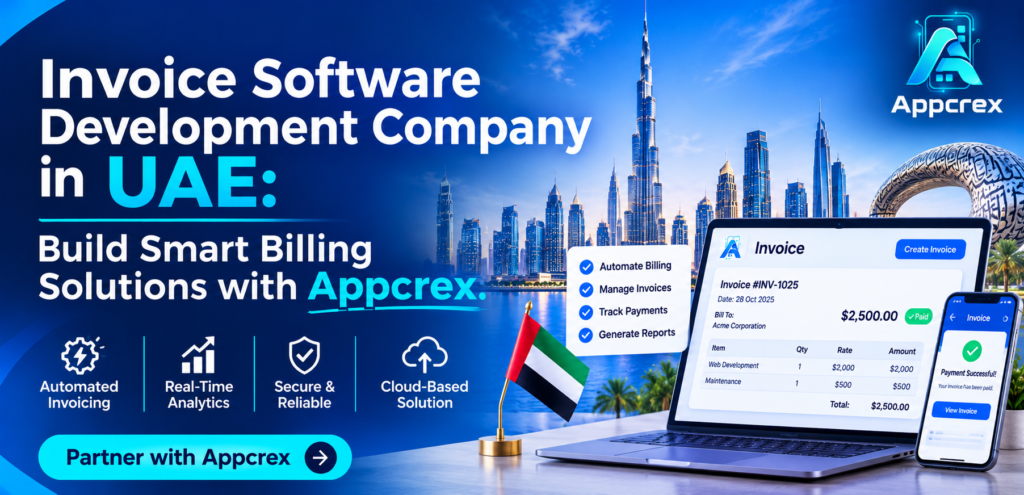
Businesses across the UAE handle invoices, payments, customer records, and financial transactions every day. Managing these activities manually often leads to billing errors, delayed payments, and difficulties in maintaining accurate financial records. Invoice software helps businesses organize these processes through a centralized digital platform.
Choosing a reliable Invoice Software Development Company in UAE helps businesses build customized billing solutions based on their operational and financial requirements.
Appcrex provides software and application development solutions for businesses looking to automate invoicing, simplify billing operations, and improve financial management. With features such as automated invoice generation, payment tracking, VAT calculations, and reporting, businesses gain better control over their billing activities.
What Is Invoice Software?
Invoice software is a digital solution designed to create, manage, send, and track business invoices. It helps companies maintain customer information, record transactions, calculate taxes, and monitor outstanding payments.
Modern invoice management systems also support accounting integrations, payment gateways, financial reports, and electronic invoicing workflows.
For businesses operating in the UAE, invoice software should support relevant VAT requirements and prepare for the country’s electronic invoicing framework.
Why Do Businesses in the UAE Need Invoice Software?
Businesses need accurate billing processes to manage financial transactions and maintain organized records. Invoice software reduces repetitive work and improves visibility into payment activities.
Here are some important benefits.
- Automated Invoice Generation
Manual invoice creation takes time and increases the possibility of errors. Invoice software generates professional invoices using saved customer details, product information, prices, and tax settings.
Businesses can create invoices quickly and maintain consistent billing formats.
- Accurate VAT Calculations
Businesses registered for VAT need suitable tax calculations and invoice records. Custom invoice software supports configurable VAT rates, taxable amounts, and tax summaries.
The software should follow applicable UAE tax requirements and allow updates when regulations change.
- Faster Payment Tracking
Payment tracking helps businesses monitor paid, pending, overdue, and partially paid invoices.
Automated reminders also help businesses follow up with customers and manage outstanding balances.
- Better Financial Record Management
A centralized invoice database stores transaction details in an organized format. Authorized employees can access invoice histories, customer records, and financial reports.
- Improved Business Productivity
Automation reduces repetitive administrative tasks. As a result, finance teams spend less time preparing invoices and more time managing important financial activities.
Essential Features of Invoice Software
The right invoice management system should support your business operations, customer requirements, and financial workflows.
- Automated Invoice Creation
This feature allows users to generate invoices using predefined templates.
Important functions include:
- Automatic invoice numbering
- Customer and business details
- Product and service descriptions
- Quantity and pricing information
- VAT calculations
- Invoice date and payment terms
- Download and sharing options
- VAT Management
VAT management helps businesses calculate applicable taxes and organize tax-related information.
Useful features include:
- Configurable VAT rates
- Taxable and non-taxable item management
- VAT summaries
- Tax reports
- Credit note management
- Tax information on invoices
- Customer Management
Customer management stores important information such as names, contact details, billing addresses, and transaction histories.
This feature helps businesses prepare invoices without entering customer information repeatedly.
Payment integration allows customers to complete transactions through supported digital payment methods.
Depending on business requirements, the system can connect with payment gateways that support card payments, digital wallets, and online transactions.
- Recurring Invoices
Businesses offering monthly subscriptions, maintenance services, or regular contracts often need recurring invoices.
This feature automatically generates invoices according to predefined billing schedules.
- Invoice Tracking and Notifications
Invoice tracking provides real-time information about payment status.
Businesses can configure notifications for:
- Newly generated invoices
- Sent invoices
- Successful payments
- Pending payments
- Overdue invoices
- Financial Reports and Analytics
Reporting features help business owners understand financial performance.
Common reports include:
- Total sales
- Monthly revenue
- Outstanding payments
- VAT summaries
- Customer payment history
- Invoice status reports
- Multi-User Access
Multi-user access allows employees to work within the same platform with different permissions.
For example, administrators can manage settings, accountants can review financial records, and sales teams can generate invoices.
- Cloud-Based Data Access
Cloud-based invoice software allows authorized users to access business records through supported devices and locations.
It also supports centralized data management and easier collaboration between departments.
UAE E-Invoicing Requirements: What Businesses Should Know
Electronic invoicing is an important part of the UAE’s digital transformation programme. Businesses developing invoice software should understand the difference between a regular digital invoice and a compliant electronic invoice.
According to the UAE Ministry of Finance, an eInvoice contains structured invoice data that is issued and exchanged electronically between suppliers and buyers and reported electronically to the Federal Tax Authority.
A PDF, Word document, scanned image, or invoice sent through email does not qualify as an eInvoice under the UAE framework.
The UAE system follows a structured electronic invoicing model based on the Peppol framework. Businesses subject to the requirements need to work with an Accredited Service Provider (ASP) for electronic invoice exchange and reporting.
UAE E-Invoicing Implementation Timeline
The mandatory implementation follows a phased approach.
| Business Category | ASP Appointment Deadline | Implementation Deadline |
| Annual revenue of AED 50 million or more | 30 October 2026 | 1 January 2027 |
| Annual revenue below AED 50 million | 31 March 2027 | 1 July 2027 |
| Government entities | 31 March 2027 | 1 October 2027 |
These timelines reflect the latest published guidance available as of November 2026. Businesses should check the latest Ministry of Finance and Federal Tax Authority updates before implementation.
How Invoice Software Supports E-Invoicing
Businesses should evaluate invoice software with features that support the UAE electronic invoicing framework.
Important technical capabilities include:
- Structured invoice data generation
- Required invoice field validation
- Electronic credit note support
- Integration with an Accredited Service Provider
- Secure invoice data exchange
- Invoice status tracking
- Data storage and retrieval
- API-based accounting and ERP integration
Important: Developing invoice software does not automatically make a company an Accredited Service Provider. Businesses subject to the UAE e-invoicing system must appoint an eligible ASP. A software development company can build the billing platform and integrate it with an accredited provider, subject to the applicable technical requirements.
Types of Invoice Software Solutions
Different businesses require different billing systems. A development company should understand your business model before selecting the right solution.
- Custom Invoice Management Software
Custom invoice management software supports specific billing workflows. Businesses can request features based on their services, customer requirements, and financial processes.
- VAT Invoice Software
VAT invoice software helps businesses calculate applicable taxes and maintain tax-related invoice records.
- Online Billing Software
Online billing software allows businesses to generate, share, and track invoices through a web-based platform.
- Mobile Invoice Application
Mobile invoice applications help business owners and employees create invoices, review payments, and access customer information through smartphones.
- Subscription Billing Software
Subscription billing software supports recurring payments, automated billing schedules, subscription plans, and payment notifications.
- ERP-Integrated Invoice Software
ERP-integrated invoice systems connect billing activities with inventory, accounting, sales, and other business operations.
Invoice Software Development Process
A structured development process helps businesses build reliable billing solutions.
Step 1: Requirement Analysis
The development team studies your business model, invoice workflows, tax requirements, and integration needs.
This stage identifies the essential features and technical priorities.
Step 2: UI/UX Design
Designers prepare wireframes and user interface layouts. The objective is to create a simple dashboard where employees can manage invoices, customers, and payments.
Step 3: Technology Selection
The development team selects suitable frontend, backend, database, and cloud technologies based on the project’s requirements.
Step 4: Software Development
Developers build the invoice management dashboard, billing modules, customer database, reporting features, and required integrations.
Step 5: Testing and Quality Assurance
The testing team checks invoice calculations, tax settings, user permissions, payment workflows, data security, and application performance.
Step 6: Integration and Deployment
The software is connected with required third-party services, accounting platforms, payment gateways, or an Accredited Service Provider.
After testing, the system moves to the selected hosting environment.
Step 7: Maintenance and Updates
Regular maintenance helps businesses fix technical issues, improve performance, and update features according to changing operational requirements.
Technology Stack for Invoice Software Development
The right technology stack supports application performance, security, and scalability.
| Technology | Purpose |
| React.js | Web dashboard development |
| Angular | Business application frontend |
| Flutter | Cross-platform mobile applications |
| Node.js | Backend development |
| Python | Backend services and automation |
| PostgreSQL | Relational database management |
| MongoDB | Flexible data storage |
| AWS | Cloud infrastructure |
| REST APIs | Third-party integrations |
The final technology selection depends on software complexity, integration requirements, security needs, and future expansion plans.
How Much Does Invoice Software Development Cost in UAE?
The cost of developing invoice software depends on the number of features, application complexity, integrations, user roles, and customization requirements.
The following figures provide indicative estimates:
| Software Type | Estimated Development Cost |
| Basic Invoice Software | AED 10,000–20,000 |
| Medium-Level Billing Software | AED 20,000–45,000 |
| Advanced Custom Invoice Software | AED 45,000–90,000+ |
These estimates are indicative, not fixed quotations. Advanced features such as ERP integration, automated payment reconciliation, multi-company management, and e-invoicing integration influence the final development budget.
Factors Affecting Development Cost
Feature Requirements: Advanced billing and reporting features require additional development work.
Application Design: Custom dashboards and multiple user interfaces affect design and development costs.
Third-Party Integrations: Payment gateways, accounting platforms, and ASP connections add integration requirements.
Data Security: Authentication, encryption, access controls, and secure storage require appropriate implementation.
Maintenance: Hosting, updates, technical support, and system monitoring contribute to ongoing expenses.
How to Choose the Right Invoice Software Development Company in UAE
Selecting a suitable development partner is important for building reliable financial software.
Consider these factors before choosing a company:
- Technical Expertise: Review experience in software and application development.
- Custom Development: Check whether the company supports your specific billing requirements.
- Integration Capabilities: Evaluate experience with APIs, accounting systems, and payment gateways.
- Security Practices: Review authentication, encryption, and data access controls.
- Scalability: Choose software architecture that supports future business growth.
- Testing Process: Confirm that the development team follows proper quality assurance practices.
- Post-Launch Support: Review maintenance and technical support services.
For UAE e-invoicing, also verify the proposed integration approach and confirm which Accredited Service Provider will handle the regulated exchange and reporting process.
Why Choose Appcrex for Invoice Software Development?
Appcrex provides custom software and mobile application development solutions for businesses seeking digital transformation.
The company focuses on building applications around business requirements, user experience, and operational goals.
Appcrex development capabilities include:
- Custom invoice software development
- Billing and payment management systems
- VAT calculation and reporting features
- Customer and vendor management
- Accounting software integration
- ERP and CRM integration
- Mobile invoice application development
- API development and integration
- Cloud-based software solutions
- Software maintenance and technical support
Appcrex follows a structured development approach, from requirement analysis and UI/UX design to development, testing, and deployment.
For businesses preparing for UAE e-invoicing, Appcrex can develop the supporting invoice management platform and explore integration with an appropriate Accredited Service Provider. The ASP handles the regulated e-invoice exchange and reporting responsibilities.
Future Trends in Invoice Software Development
Invoice management technology continues to improve through automation, cloud computing, and intelligent data processing.
Artificial Intelligence
AI-powered features support invoice data extraction, document classification, payment pattern analysis, and automated financial workflows.
Cloud-Based Billing Systems
Cloud-based solutions provide centralized access to billing information and support collaboration across different business locations.
Automated Payment Reconciliation
Payment reconciliation features help compare invoice records with incoming transactions and identify outstanding balances.
Advanced Data Analytics
Analytics tools help businesses understand revenue patterns, customer payment behavior, and financial performance.
API-Based Integrations
API integrations connect invoice software with accounting platforms, ERP systems, payment gateways, and e-invoicing service providers.
Adopting suitable technologies helps businesses improve billing operations and prepare for future digital requirements.
Frequently Asked Questions
- What does an invoice software development company in UAE do?
An invoice software development company designs and builds billing solutions for businesses. Services include invoice generation, VAT calculations, payment tracking, customer management, financial reporting, and third-party integrations.
- How much does invoice software development cost in UAE?
Basic invoice software might cost AED 10,000–20,000. Medium-level solutions might cost AED 20,000–45,000, while advanced custom platforms might cost AED 45,000–90,000 or more.
- What features should invoice software include?
Important features include automated invoice generation, VAT calculations, customer management, payment tracking, recurring billing, financial reports, and secure user access.
- Is invoice software mandatory for businesses in UAE?
Businesses need to maintain appropriate tax and financial records. Those falling within the scope of the UAE electronic invoicing framework must follow the applicable phased implementation requirements.
- Is a PDF invoice considered an electronic invoice in UAE?
No. Under the UAE e-invoicing framework, a PDF, scanned document, Word file, or email attachment does not qualify as a structured eInvoice.
- What is an Accredited Service Provider in UAE e-invoicing?
An Accredited Service Provider is an approved service provider responsible for supporting electronic invoice exchange and reporting under the UAE framework.
- Can custom invoice software integrate with UAE e-invoicing?
Yes. A custom invoice platform can integrate with an appropriate Accredited Service Provider through supported technical interfaces, subject to the UAE framework’s requirements.
- Does Appcrex develop custom invoice software?
Appcrex provides custom software and application development services. Businesses can discuss billing requirements, VAT-related features, payment integrations, and e-invoicing integration needs.
Conclusion
Invoice software helps businesses manage billing activities, improve payment tracking, organize financial records, and reduce manual work. As the UAE advances its electronic invoicing programme, businesses should evaluate software that supports structured invoice data and integration with an Accredited Service Provider.
Choosing the right Invoice Software Development Company in UAE helps establish a reliable foundation for efficient billing and financial management.
Appcrex supports businesses with custom software development solutions designed around their operational requirements.
Ready to improve your billing process? Connect with Appcrex and plan an invoice software solution for your business.