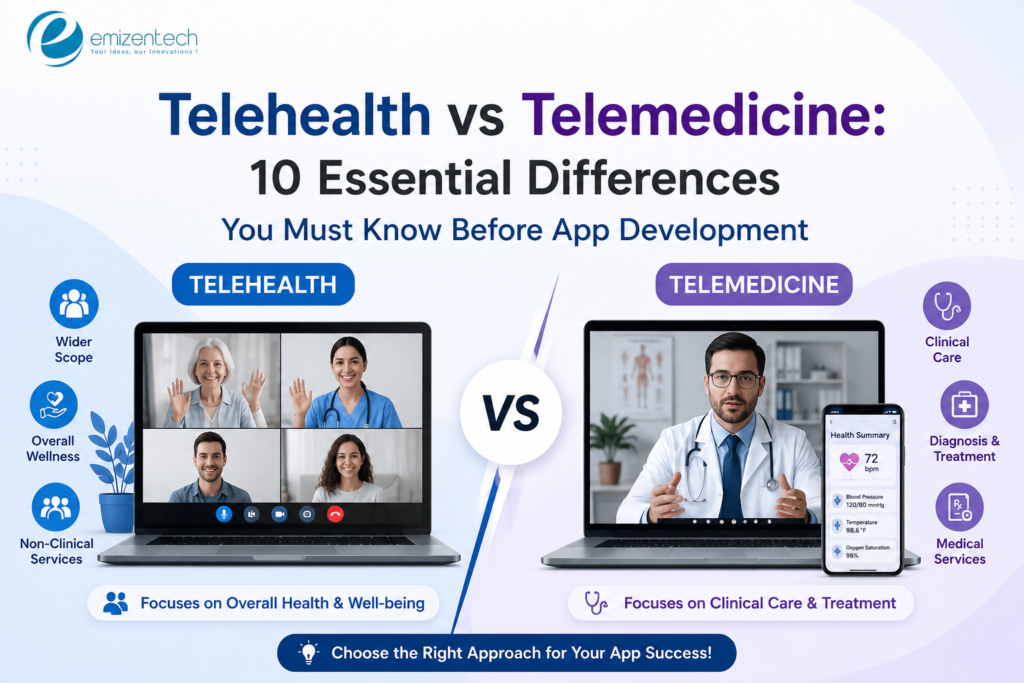
The digital healthcare ecosystem is expanding rapidly, but many businesses still confuse telehealth and telemedicine during product planning. This confusion often leads to incorrect feature scope, compliance gaps, and poor architectural decisions in healthcare app projects.
Understanding the distinction is critical before investing in digital health solutions, especially when working with a healthcare app development partner. The right classification directly influences product strategy, user experience, and long-term scalability.
This guide breaks down the core differences between Telehealth vs Telemedicine and explains how each impacts app development decisions in 2026 and beyond.
What is Telehealth?
Telehealth refers to a broad digital healthcare system that extends beyond clinical treatment. It includes wellness services, remote monitoring, preventive care, and patient engagement tools delivered through digital platforms.
To better understand how these solutions are designed and implemented, explore this comprehensive guide on telehealth app development.
Scope of Digital Health Services
Telehealth platforms cover multiple healthcare touchpoints, including fitness tracking, chronic disease monitoring, virtual health education, and non-clinical support systems. Healthcare app development experts often build these systems as multi-module platforms to serve diverse user needs.
Technology and User Interaction Layer
From a development perspective, telehealth apps rely heavily on mobile dashboards, IoT integration, and cloud-based analytics systems. These platforms prioritize continuous engagement rather than isolated medical interactions.
Patient Engagement and Monitoring
Telehealth systems emphasize long-term patient interaction through reminders, lifestyle tracking, and wellness insights. This requires scalable backend systems capable of processing real-time health data.
What is Telemedicine?
Telemedicine focuses specifically on delivering clinical healthcare services remotely. It enables diagnosis, consultation, treatment, and prescription management through secure digital communication channels.
Clinical Care Delivery Model
Telemedicine platforms are designed for direct medical interactions between patients and licensed healthcare providers. A healthcare app development partner typically ensures these systems support real-time consultations and medical decision workflows.
Security and Compliance Requirements
These applications demand strict compliance standards, secure data exchange, and encrypted communication channels. Every feature must align with medical regulations and patient safety protocols.
Core Functional Workflows
Telemedicine apps revolve around appointment booking, video consultations, digital prescriptions, and integration with electronic medical records for continuity of care.
Telehealth vs Telemedicine: 10 Essential Differences for App Development
The difference between telehealth and telemedicine directly impacts how a healthcare application is planned, designed, and scaled. Each model carries unique requirements in terms of features, compliance, architecture, and user experience. Choosing the wrong direction early often leads to product limitations and increased development costs.
1. Scope of Services
Telehealth:
Telehealth covers a wide healthcare ecosystem that includes preventive care, wellness programs, remote monitoring, and patient education. It is not limited to medical treatment but focuses on overall health management and long-term engagement.
Telemedicine:
Telemedicine is limited to clinical care delivery. It focuses strictly on diagnosing conditions, providing treatment, and managing patient recovery through virtual consultations.
2. Target Users
Telehealth:
Telehealth platforms cater to a broad user base, including patients, caregivers, fitness users, and healthcare professionals. It is designed for continuous interaction across multiple health-related touchpoints.
Telemedicine:
Telemedicine primarily serves patients and licensed medical practitioners. Its user base is narrower and focused on direct clinical interaction.
3. Core Functionality
Telehealth:
Telehealth apps include health tracking, wellness monitoring, educational content, lifestyle management tools, and preventive care features aimed at overall well-being.
Telemedicine:
Telemedicine apps focus on clinical workflows such as virtual consultations, diagnosis, prescription generation, and follow-up treatment.
4. Regulatory Complexity
Telehealth:
Telehealth platforms may have varying compliance requirements depending on the services offered. Non-clinical features generally face lighter regulatory constraints.
Telemedicine:
Telemedicine systems require strict compliance with healthcare regulations due to direct involvement in diagnosis and treatment, making governance more complex.
5. App Architecture Requirements
Telehealth:
Telehealth applications require modular and scalable architecture to support multiple services like wellness tracking, monitoring, and engagement tools within a single ecosystem.
Telemedicine:
Telemedicine platforms demand highly secure, workflow-driven architecture focused on real-time consultations, medical accuracy, and compliance enforcement.
6. Data Sensitivity Level
Telehealth:
Telehealth systems manage mixed data types including lifestyle information, wellness metrics, and general health data, which may not always require strict clinical-level security.
Telemedicine:
Telemedicine handles highly sensitive medical data such as patient records, prescriptions, and diagnostic reports, requiring advanced encryption and strict access control.
7. Integration Needs
Telehealth:
Telehealth platforms integrate with wearable devices, fitness trackers, IoT health devices, and third-party wellness APIs for continuous health monitoring.
Telemedicine:
Telemedicine systems integrate with EMR/EHR systems, diagnostic labs, pharmacies, and hospital management systems to support complete clinical workflows.
8. Monetization Models
Telehealth:
Telehealth apps commonly use subscription models, corporate wellness programs, freemium plans, or preventive care packages for revenue generation.
Telemedicine:
Telemedicine platforms typically monetize through pay-per-consultation, insurance billing systems, or partnerships with hospitals and clinics.
9. Development Cost & Complexity
Telehealth:
Telehealth applications are moderately complex due to multiple feature modules but are generally easier to scale incrementally.
Telemedicine:
Telemedicine apps are more expensive and complex due to real-time communication systems, compliance requirements, and secure clinical data handling.
10. Scalability & Future Expansion
Telehealth:
Telehealth platforms are designed to evolve into full digital health ecosystems covering wellness, prevention, and continuous care management.
Telemedicine:
Telemedicine systems scale within structured healthcare networks, primarily expanding across hospitals, clinics, and provider groups.
Which One Should You Build in 2026?
Selecting between telehealth and telemedicine is more than a product decision—it shapes your application’s functionality, compliance requirements, user experience, and long-term growth potential. The right choice depends on your business model, target audience, healthcare services, and future expansion plans. Partnering with a healthcare app development company can help you assess these factors and build a solution that aligns with your business objectives while meeting industry standards.
For Startups: Build a Telehealth Platform for Broader Market Reach
Startups looking to enter the digital healthcare market often find telehealth platforms more suitable because they support a wider range of services beyond clinical consultations. Features such as wellness tracking, remote patient monitoring, preventive care, and health education help attract a broader audience while creating multiple monetization opportunities through subscriptions, premium services, and corporate wellness programs.
For Hospitals and Healthcare Providers: Choose Telemedicine for Clinical Care
Hospitals, clinics, and healthcare professionals generally benefit more from telemedicine platforms because they are purpose-built for delivering virtual clinical services. These solutions streamline online consultations, diagnosis, treatment planning, electronic prescriptions, and patient follow-ups while ensuring compliance with healthcare regulations and secure handling of sensitive medical data.
For Long-Term Growth: Consider a Hybrid Healthcare Platform
Many organizations are moving toward hybrid healthcare platforms that combine the strengths of both telehealth and telemedicine. This approach enables businesses to offer preventive care, wellness management, remote monitoring, and virtual consultations through a single ecosystem. A unified platform not only enhances the patient experience but also provides greater flexibility to expand services as healthcare needs and market demands continue to evolve.
Conclusion
Telehealth and telemedicine may appear similar, but they serve fundamentally different purposes in digital healthcare ecosystems. Choosing the correct model directly impacts architecture, compliance, and long-term scalability.
A well-planned strategy supported by EmizenTech ensures that healthcare platforms are built with the right balance of functionality, security, and user experience, enabling sustainable growth in the evolving healthcare landscape.
FAQs
1. What is the main difference between telehealth and telemedicine?
Telehealth is a broader concept that includes preventive care, remote patient monitoring, health education, wellness programs, and virtual healthcare services. Telemedicine is a subset of telehealth that focuses specifically on remote clinical services such as online consultations, diagnosis, treatment, and prescription management.
2. Which is better for healthcare app development: telehealth or telemedicine?
The right choice depends on your business goals. If you want to build a comprehensive digital health platform with wellness and patient engagement features, telehealth is the better option. If your objective is to provide virtual consultations and clinical care, telemedicine is the more suitable approach.
3. Is telemedicine more expensive to develop than telehealth?
In many cases, yes. Telemedicine applications often require advanced security measures, video consultation capabilities, EHR/EMR integration, and compliance with healthcare regulations, making them more complex and costly than many telehealth solutions.
4. How can a healthcare app development help build telehealth or telemedicine apps?
A healthcare app development company can help define the right product strategy, select an appropriate technology stack, ensure regulatory compliance, integrate third-party healthcare systems, and build a secure, scalable application tailored to your business and user requirements.