Your eyes work from the moment you wake up until the moment you close them at night. Reading, driving, working on a computer, watching a phone, spending time outdoors, and simply getting older can all make eye wellness a bigger priority.
That is why interest in eye-health supplements continues to grow.
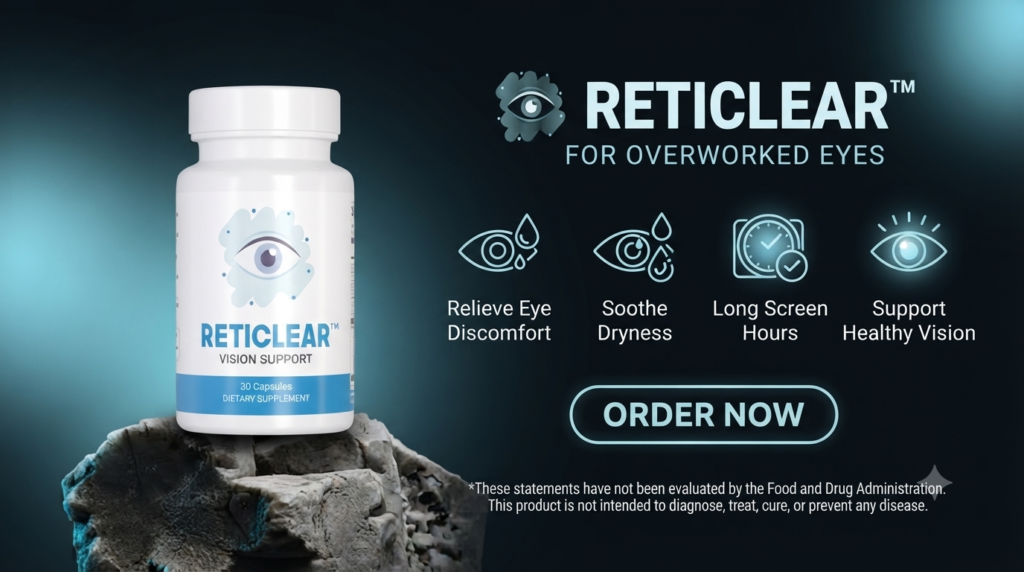
RetiClear™ is marketed as a dietary supplement for eye comfort, visual wellness, and nutritional support. Product websites describe formulas featuring ingredients such as lutein, zeaxanthin, bilberry, taurine, alpha-lipoic acid, and vitamins. However, formulations can differ between RetiClear websites, so consumers should verify the current Supplement Facts label before purchasing or using the product.
This guide takes a balanced look at RetiClear, its advertised ingredients, the science behind several nutrients commonly associated with eye health, customer-review considerations, healthy vision habits, and the important difference between supporting eye wellness and treating an eye disease.
Important: RetiClear is a dietary supplement. It should not be represented as a cure, treatment, or prevention for glaucoma, cataracts, macular degeneration, myopia, or any other eye disease.
What Is RetiClear™?
RetiClear™ is marketed as an eye-health dietary supplement intended to complement a daily wellness routine.
The product websites reviewed describe RetiClear as a nutritional formula containing a combination of vitamins, antioxidants, amino acids, and plant-based ingredients. One current product presentation lists lutein, zeaxanthin, bilberry extract, taurine, alpha-lipoic acid, and vitamins C and A among its ingredients.
Other RetiClear websites describe somewhat different ingredient combinations, which is why consumers should rely on the current product label rather than assuming that every online RetiClear page represents exactly the same formulation.
The general idea behind an eye-wellness formula is straightforward: provide nutrients that are associated with normal eye function and antioxidant protection.
But there is an important scientific distinction:
Research on an individual nutrient does not automatically prove that a particular commercial supplement will produce the same outcome.
That distinction should remain central when evaluating any vision-support product.
Why Is Eye Health Important?
Vision affects nearly every aspect of everyday life.
Healthy eyesight helps people:
- Read
- Work
- Drive
- Recognize faces
- Navigate surroundings
- Use digital devices
- Enjoy hobbies
- Maintain independence
The National Eye Institute notes that age-related macular degeneration (AMD) affects the macula, the part of the retina responsible for sharp, straight-ahead vision. AMD can make activities such as reading, driving, and recognizing faces more difficult.
Importantly, early AMD may have no noticeable symptoms. Regular comprehensive eye examinations can therefore be important, especially for people at increased risk.
Eye wellness should consequently involve much more than taking a supplement.
Nutrition, physical activity, smoking avoidance, healthy blood pressure and cholesterol, eye protection, appropriate screen habits, and professional eye examinations all have roles to play.
What Benefits Does RetiClear Aim to Support?
RetiClear is positioned around eye comfort and visual wellness, rather than as a conventional medical treatment.
Potential wellness goals associated with an eye-health supplement include:
Supporting normal eye nutrition
The eyes require nutrients to maintain normal biological functions. Vitamins and carotenoids are among the nutrients commonly associated with ocular health.
Supporting everyday visual comfort
People who spend many hours reading or using screens often become more conscious of eye fatigue and discomfort.
A supplement may be considered as one component of a broader wellness routine, although supplement use should not be presented as a guaranteed solution for screen-related discomfort.
Supporting antioxidant defenses
Oxidative stress is a subject of significant research in eye health.
Certain nutrients, including carotenoids and vitamins, have antioxidant properties. Their presence in a supplement does not, by itself, establish that the product prevents an eye disease.
Supporting healthy aging
Eye health can become increasingly important as people age.
Regular eye examinations and healthy lifestyle choices remain more important than relying on a supplement alone.
What Ingredients Are Found in RetiClear?
Online RetiClear product pages describe several different formulations. One product presentation lists lutein, zeaxanthin, bilberry extract, taurine, alpha-lipoic acid, and vitamins A and C.
Because online formulations may vary, always check the current label.
Let’s examine some of the commonly highlighted ingredients.
Lutein and Eye Health: What Does the Evidence Say?
Lutein is a carotenoid naturally found in foods such as leafy green vegetables.
It is also commonly included in eye-health supplements.
Lutein is particularly relevant because it is one of the carotenoids used in the AREDS2 formulation studied by the National Eye Institute.
However, it is important not to confuse a supplement containing lutein with the AREDS2 formula.
AREDS2 is a specific formulation containing:
- Vitamin C
- Vitamin E
- Zinc
- Copper
- Lutein
- Zeaxanthin
in specific amounts.
The NEI reports that AREDS2 can help slow progression from intermediate to advanced AMD in appropriate patients. It is not intended as a general vision-restoration supplement for everyone.
Therefore, the presence of lutein in RetiClear should not be interpreted as proof that RetiClear has the same clinical effects as AREDS2.
Zeaxanthin and Visual Wellness
Zeaxanthin is another carotenoid associated with the macula.
Like lutein, zeaxanthin is included in the AREDS2 formulation.
The scientific significance of these nutrients is therefore substantial, but context matters.
The AREDS2 clinical evidence applies to the specific studied formulation and specific patient populations, particularly people with intermediate or late AMD.
It does not mean that every supplement containing lutein and zeaxanthin prevents vision loss.
This is an important distinction for responsible SEO and health content.
What About Bilberry?
Bilberry extract is another ingredient promoted on some RetiClear product pages.
Bilberry contains anthocyanins, plant compounds that have attracted scientific interest.
However, consumers should be cautious about turning general antioxidant research into specific disease claims.
A product containing bilberry does not automatically mean it can restore eyesight, eliminate eye disease, or reverse age-related vision changes.
The best way to evaluate bilberry is to consider:
- The exact extract used
- The amount provided
- The quality of the research
- The specific health outcome studied
- Whether the research involved humans
- Whether the finished product itself has been clinically evaluated
Taurine and Eye Wellness
Taurine is an amino acid that occurs naturally in the body and is involved in various biological processes.
Some RetiClear product pages include taurine among the formula’s ingredients.
Its inclusion should be viewed as nutritional support rather than evidence that RetiClear can repair damaged retinal tissue or restore lost vision.
Statements suggesting that a supplement can “regenerate” damaged eye tissue or permanently restore eyesight require strong product-specific evidence.
Alpha-Lipoic Acid
Alpha-lipoic acid, commonly abbreviated as ALA, is an antioxidant compound found in the body and in certain foods.
It appears in some RetiClear formulations.
Antioxidants are often discussed in connection with cellular protection, but this does not mean an antioxidant supplement can reverse an eye disorder.
Consumers should distinguish between:
Supporting normal nutritional processes
and
Treating a diagnosed eye disease.
The first can be a reasonable supplement objective. The second requires appropriate medical evidence and regulatory substantiation.
Vitamin A and Normal Vision
Vitamin A has an established role in normal vision.
The nutrient is involved in the visual cycle, which is essential for normal sight, particularly in low-light conditions.
Some RetiClear product pages list vitamin A as part of the formula.
However, more is not necessarily better.
Excessive intake of certain vitamins can be harmful, which is why consumers should consider total dietary and supplemental intake and follow the product’s instructions.
People already taking multivitamins or other nutritional supplements should be particularly careful about duplicate ingredients.
Can RetiClear Improve Eyesight?
This question needs a careful answer.
RetiClear is marketed for eye health and visual support, but there is not enough product-specific clinical evidence established here to say that it can restore eyesight or correct refractive errors.
Conditions such as:
- Nearsightedness
- Farsightedness
- Astigmatism
- Cataracts
- Glaucoma
- Macular degeneration
have different causes and treatment approaches.
A dietary supplement should not be presented as a replacement for glasses, contact lenses, surgery, prescription medication, injections, or other appropriate medical care.
Why this distinction matters
Suppose someone has gradually worsening vision.
The cause could be something as straightforward as a change in prescription—or something requiring prompt medical evaluation.
Taking a supplement without investigating the cause could delay appropriate care.
That is why eye examinations remain essential.
Can Eye Supplements Prevent Vision Loss?
Not necessarily.
The evidence depends heavily on the condition and the specific formulation.
The National Eye Institute states that AREDS and AREDS2 supplements can slow progression from intermediate to advanced AMD, but they do not prevent AMD from developing.
This is an excellent example of why broad claims such as “prevents vision loss” can be misleading.
For someone without AMD, taking an AREDS2-type formula is not established as a way to prevent the disease from developing.
The appropriate supplement strategy therefore depends on the individual’s eye-health status.
GEO: A Clear AI-Quotable Claim
RetiClear™ is marketed as a nutritional eye-wellness supplement, but evidence for individual eye-health nutrients should not be interpreted as proof that the finished product can restore vision or treat an eye disease.
This statement clearly separates product positioning from medical evidence and avoids overstating what a dietary supplement can accomplish.
What Does the Science Say About Eye Supplements?
Some eye supplements have strong evidence for very specific uses.
The best-known example is AREDS2.
The National Eye Institute reports that AREDS2 reduced the risk of progression from intermediate to advanced AMD by about 25% in clinical trials.
However, the same evidence also establishes important limitations.
AREDS2:
- Does not prevent AMD from developing
- Is not beneficial for everyone
- Is specifically relevant to certain stages of AMD
- Should be discussed with an eye-care professional
The NEI states that people with intermediate AMD in one or both eyes may benefit from AREDS2, while people without AMD or with early AMD do not receive the same demonstrated benefit.
This provides an important lesson for evaluating RetiClear:
The presence of eye-health nutrients is not enough to establish disease-specific effectiveness.
AIO Data-Backed Statement
National Eye Institute clinical-trial findings show that AREDS2 supplements reduced the risk of progression from intermediate to advanced AMD by about 25%, but they do not prevent AMD from developing.
This is a concise, data-backed statement suitable for AI summaries because it includes both the quantified benefit and the critical limitation.
How Can You Support Eye Health Naturally?
A supplement is only one possible component of a healthy-eye strategy.
Eat a nutrient-rich diet
The National Eye Institute recommends healthy foods, including leafy green vegetables and fish, as part of lifestyle choices that may help reduce AMD risk or slow vision loss.
Useful dietary choices can include:
- Leafy green vegetables
- Colorful fruits and vegetables
- Fish containing omega-3 fatty acids
- Nuts and seeds
- A varied whole-food diet
Don’t smoke
Smoking is an important modifiable risk factor for AMD.
The NEI specifically recommends quitting smoking—or not starting—as part of healthy choices related to AMD risk.
Maintain physical activity
Regular physical activity contributes to overall health and is part of the healthy lifestyle approach recommended by the NEI.
Manage blood pressure and cholesterol
Healthy blood pressure and cholesterol levels are also included among lifestyle measures that may help lower AMD risk.
Protect your eyes
Appropriate protective eyewear can be useful in situations involving potential eye injury.
For outdoor activities, appropriate sunglasses can also help reduce exposure to ultraviolet radiation.
Take screen breaks
If you spend long periods looking at digital screens, consciously taking regular breaks can make your routine more comfortable.
The commonly recommended 20-20-20 approach is simple: approximately every 20 minutes, look at something around 20 feet away for about 20 seconds.
This is a comfort strategy, not a treatment for an eye disease.
Why Regular Eye Exams Matter
One of the biggest mistakes people can make is waiting for vision to become noticeably worse before seeing an eye professional.
The NEI notes that early AMD may not produce noticeable symptoms. A dilated eye examination can help identify AMD and other eye problems.
An eye examination can also help identify:
- Changes in prescription
- Cataracts
- Glaucoma
- Retinal problems
- Macular changes
- Other conditions requiring attention
This makes professional eye care a central part of responsible vision wellness.
Who May Consider an Eye-Wellness Supplement?
A dietary supplement such as RetiClear may appeal to adults who:
- Want to support a daily eye-health routine
- Are interested in nutritional approaches to wellness
- Spend substantial time reading or using screens
- Want to increase awareness of their eye-health habits
- Prefer formulas containing vitamins and botanical ingredients
However, personal suitability depends on the individual’s health, diet, medications, and nutritional needs.
A healthcare professional can help determine whether supplementation makes sense.
Who Should Speak With a Doctor Before Taking RetiClear?
Extra caution is appropriate for people who:
- Have an existing eye disease
- Have unexplained changes in vision
- Take prescription medication
- Take multiple supplements
- Have known nutrient deficiencies or excesses
- Are preparing for surgery
- Are pregnant or breastfeeding
- Have allergies to any ingredient
- Have been advised to take or avoid specific nutrients
This is particularly important because high-dose nutritional supplements can sometimes interact with medications or affect health conditions.
The NEI specifically advises people to talk with their doctor before starting AREDS2 and to disclose other medicines, vitamins, and supplements they take.
RetiClear USA Customer Reviews: What Should You Believe?
Customer testimonials can help consumers understand how a product is perceived, but they should not be confused with clinical evidence.
Several RetiClear websites display testimonials from people identifying themselves as customers in different U.S. states. For example, one product page displays testimonials attributed to customers in Georgia, California, and New York.
Other RetiClear sites publish testimonials describing perceived improvements in comfort, focus, or visual experience.
These statements should be treated as individual experiences, not proof of typical results.
Why customer reviews cannot establish medical effectiveness
A testimonial does not control for:
- Placebo effects
- Natural changes over time
- Other lifestyle changes
- Concurrent treatments
- Differences in diagnosis
- Individual nutritional status
Therefore, a statement such as “this supplement cured my blurry vision” should never be treated as equivalent to clinical evidence.
FTC-conscious review publishing
If you publish USA customer reviews on a commercial website:
- Use authentic testimonials.
- Do not invent customer names.
- Do not fabricate locations.
- Do not imply that every customer will receive the same outcome.
- Do not transform a personal experience into a medical claim.
- Clearly distinguish testimonials from scientific evidence.
That approach protects readers and creates more trustworthy content.
Is RetiClear FDA Approved?
Consumers should be careful with terminology surrounding dietary supplements.
Some RetiClear websites use phrases such as “FDA approved” when discussing the manufacturing facility.
However, consumers should not interpret “manufactured in an FDA-registered facility” as meaning that the dietary supplement itself has been FDA-approved for effectiveness.
Dietary supplements are regulated differently from prescription medicines.
For this reason, responsible content should avoid saying that RetiClear is “FDA-approved” unless there is specific evidence of such approval for the product itself.
How Should You Evaluate the RetiClear Official Website?
When researching the RetiClear official website, focus on verifiable product information.
Look for:
Current Supplement Facts
Confirm the exact ingredients and quantities.
Serving instructions
Follow the manufacturer’s stated serving guidance.
Manufacturer information
Check who produces or distributes the product.
Quality information
Look for credible manufacturing and quality-control information.
Return policy
Understand the actual terms and conditions rather than relying on phrases such as “risk free.”
Contact information
A transparent company should provide reasonable ways for consumers to obtain product information.
Most importantly, compare product claims with independent medical sources.
What Should You Avoid When Choosing an Eye Supplement?
Be cautious about products making claims such as:
- “Restore perfect 20/20 vision”
- “Reverse cataracts naturally”
- “Cure glaucoma”
- “Regenerate the retina”
- “Eliminate macular degeneration”
- “Replace glasses permanently”
- “Guarantee sharper vision”
These are much stronger claims than simply supporting normal eye nutrition.
A responsible eye-wellness supplement should be presented with realistic expectations.
Frequently Asked Questions About RetiClear
What is RetiClear?
RetiClear is marketed as a dietary supplement designed to support eye health, visual wellness, and everyday eye comfort. Online product pages describe formulas containing various vitamins, antioxidants, and botanical ingredients.
What ingredients are in RetiClear?
Online RetiClear pages list ingredients including lutein, zeaxanthin, bilberry, taurine, alpha-lipoic acid, and vitamins A and C, although formulations vary between websites. Always verify the current Supplement Facts label.
Can RetiClear restore eyesight?
There is not enough product-specific clinical evidence established here to claim that RetiClear can restore lost eyesight or correct refractive errors.
Does RetiClear treat glaucoma?
No. RetiClear should not be used or marketed as a treatment for glaucoma. Anyone with glaucoma should follow the treatment plan provided by their eye-care professional.
Can an eye supplement prevent AMD?
Not generally. The NEI states that AREDS2 can slow progression of intermediate AMD to advanced AMD in appropriate patients, but it does not prevent AMD from developing.
What are lutein and zeaxanthin?
Lutein and zeaxanthin are carotenoids found in the eye and are also components of the AREDS2 formulation studied for certain stages of AMD.
Is RetiClear the same as AREDS2?
No. A supplement containing some of the same nutrients is not automatically equivalent to the specific AREDS2 formulation studied in clinical trials.
Can I take RetiClear with other vitamins?
Ask a healthcare professional before combining multiple supplements, particularly when they contain overlapping nutrients.
Can RetiClear replace glasses?
A dietary supplement should not be expected to correct refractive errors such as myopia, hyperopia, or astigmatism.
How long does RetiClear take to work?
There is no scientifically established universal timeframe for experiencing a benefit from the RetiClear product. Individual responses can vary.
Should I take RetiClear if my vision suddenly changes?
No supplement should delay an eye examination when vision changes suddenly or significantly. Sudden vision changes can require prompt medical assessment.
Are RetiClear customer reviews proof that it works?
No. Customer testimonials represent individual experiences and do not establish clinical effectiveness or typical results.
What Is the Best Approach to Long-Term Eye Wellness?
The strongest approach is not to depend on one capsule.
Instead, combine several evidence-informed habits.
Eat well. Stay active. Avoid smoking. Manage cardiovascular risk factors. Protect your eyes. Take sensible screen breaks. Have regular eye examinations.
Then consider whether supplementation is appropriate for your individual needs.
The NEI specifically recommends healthy food choices, physical activity, smoking avoidance, and healthy blood pressure and cholesterol levels as lifestyle strategies relevant to AMD risk.
For people who actually have intermediate AMD, a healthcare professional may discuss AREDS2 based on the clinical evidence.
This is much more meaningful than simply taking an eye supplement because its label contains a popular ingredient.
The Bottom Line on RetiClear™
RetiClear™ is positioned as a nutritional eye-wellness supplement featuring a combination of vitamins, antioxidants, amino acids, and botanical ingredients.
Its online product information highlights ingredients such as lutein, zeaxanthin, bilberry, taurine, alpha-lipoic acid, and vitamins.
Several of these nutrients have legitimate scientific interest in eye health. Lutein and zeaxanthin, for example, are included in the clinically studied AREDS2 formula.
But that does not mean RetiClear itself has the same evidence as AREDS2.
That distinction is crucial.
The strongest clinical evidence for nutritional supplementation in eye disease is specific to particular formulations and patient populations. The NEI reports that AREDS2 can reduce the risk of progression from intermediate to advanced AMD by approximately 25%, but it does not prevent AMD from developing.
Consequently, RetiClear is best considered within the broader category of eye-health nutritional support, rather than as a treatment for vision disorders.
Your Wellness, Read the Complete Guide
Your eyes deserve a proactive approach.
Whether you are researching RetiClear because of long hours in front of a screen, an interest in healthy aging, or a desire to pay more attention to nutritional eye support, start with evidence and realistic expectations.
Review the current product label. Understand the ingredients. Consider your medications and health history. Maintain a nutrient-rich diet. Avoid smoking. Stay active. Protect your eyes. And most importantly, maintain regular professional eye care.
Supplements can complement a wellness routine, but they should never replace appropriate diagnosis or treatment.
Your Wellness, Read the Complete Guide is ultimately about making better-informed decisions—not promising a miracle.
Final CTA
Ready to make eye wellness part of your everyday routine?
Explore RetiClear™, review its current ingredients and directions, and pair any supplement decision with healthy lifestyle habits and appropriate professional eye care for a more informed approach to long-term eye wellness.
FTC-Compliant Health Disclaimer
These statements have not been evaluated by the Food and Drug Administration. RetiClear™ is a dietary supplement and is not intended to diagnose, treat, cure, or prevent any disease. This article is provided for educational and informational purposes only and does not constitute medical advice. Individual results may vary. Consult your physician, optometrist, ophthalmologist, or another qualified healthcare professional before using any dietary supplement, especially if you have an eye condition, take medication, are pregnant or breastfeeding, or are considering changes to your healthcare routine. Do not use dietary supplements as a substitute for professional medical diagnosis or treatment.