I’ve spent a good chunk of my career sitting across the table from fraud investigators, forensic document examiners, and identity verification engineers, listening to them describe the same recurring frustration: the moment a security feature becomes good enough to stop casual counterfeiting, someone finds a way around it. Not always through sophistication — sometimes through sheer patience, cheap equipment, and a market willing to pay for a convincing-looking card.
The phrase “fake ID maker” gets thrown around casually, usually in the context of a novelty website or a dorm-room side hustle. But from a security research standpoint, it’s a useful lens. It forces us to ask a harder question: what exactly are these operations replicating, what are they failing to replicate, and what does that gap tell us about the state of identity document security today?
This isn’t a how-to. It’s an autopsy of a persistent problem — one that touches security printing, materials science, cryptography, and human judgment all at once.
Why Identity Documents Are Security Products, Not Just Paperwork
It’s easy to forget that a driver’s license or a national ID card is, functionally, a security product in the same category as a banknote or a passport. Governments and standards bodies treat them that way, layering in overlapping defenses so that defeating one doesn’t mean defeating all of them.
The logic is defense in depth. A single security feature — say, a hologram — can eventually be reverse-engineered or approximated. But when that hologram is combined with laser-engraved personalization, UV-reactive ink, tactile elements, and a data layer that’s cryptographically tied to a government database, the cost and complexity of faking the whole package rises sharply. A convincing forgery of one layer doesn’t help if the other layers don’t match.
This is why document security has evolved into distinct categories:
- Substrate security — the physical material the document is made from
- Print security — how ink and images are applied
- Personalization security — how a specific individual’s data is bound to that physical document
- Machine-readable security — how a scanner or chip verifies the document electronically
- Human-verification cues — features designed to be checked by eye or touch
A fake ID maker, in most cases, is only ever attacking the first two or three categories. The rest is where the real security lives.
Polycarbonate Substrates: The Material Barrier Most Counterfeits Never Clear
Most modern government-issued ID cards in the US and EU are made from polycarbonate, not PVC or laminated paper. Polycarbonate is a rigid, layered plastic that’s fused under heat and pressure into a single block — which matters because it means the layers can’t be peeled apart without visibly destroying the card.
This is a deliberate design response to an older vulnerability. PVC cards, common a couple of decades ago, could sometimes be delaminated, altered, and resealed. Polycarbonate largely closes that door. When investigators examine a suspected counterfeit, one of the first physical tests is simply trying to find a seam — a legitimate polycarbonate card shouldn’t have one.
Counterfeit operations working with laminate-and-print kits are, structurally, starting from a different material with different optical and tactile properties. Under raking light or with a loupe, the difference in surface texture and flex is often obvious to a trained eye, even before checking a single printed feature.
Laser Engraving vs. Printed Personalization
Here’s a distinction that trips up a lot of casual observers: on a genuine polycarbonate ID, the photo, signature, and variable text data usually aren’t printed with ink at all. They’re laser-engraved — burned into the polycarbonate layers using a focused laser that changes the material’s color at a microscopic level, sometimes even creating a grayscale image inside the card body rather than on its surface.
This matters for two reasons. First, it’s difficult to replicate without laser engraving equipment that’s expensive, specialized, and generally restricted to legitimate document issuers and their approved suppliers. Second, laser-engraved data sits at a different depth than surface printing, so it interacts differently with UV light, produces a distinct image under magnification, and can’t simply be reprinted with a standard inkjet or dye-sublimation printer.
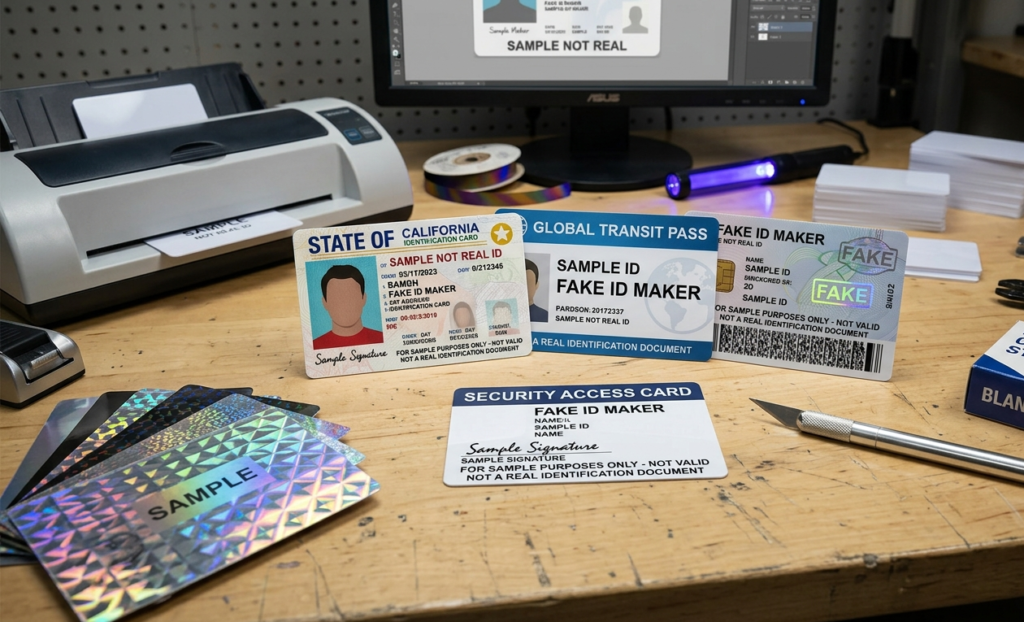
Most fake ID makers rely on dye-sublimation or inkjet-based printing onto PVC or a laminate pouch. It can look convincing at a glance under normal lighting. It usually falls apart under magnification, UV inspection, or when someone runs a fingernail across the surface and feels ink sitting on top of the card rather than data embedded within it.
UV Features, OVI Inks, and the Limits of Visual Inspection
Ultraviolet security features exist because visible-light inspection alone was never going to be enough. Genuine documents often carry UV-fluorescent patterns, fibers, or printed elements that are invisible under normal light and only appear under a UV lamp — sometimes in a specific color, sometimes as a hidden secondary image aligned precisely with the visible design.
Optically variable ink (OVI) takes this further. It shifts color depending on the viewing angle — green to blue, gold to green, depending on the formulation — because it uses layered pigment flakes that reflect light differently as the card tilts. This is genuinely hard to fake convincingly because the ink itself is a controlled, specialized product, not something available through general commercial printing suppliers.
I’ve talked to bouncers and retail loss-prevention staff who say the UV lamp is the single most useful five-dollar tool they own, not because it catches everything, but because it catches the most common category of amateur forgery: a card with no UV response at all, or a UV pattern that’s obviously wrong once you’ve seen a hundred genuine ones.
Kinegrams, DOVIDs, and Why Holograms Are Harder to Copy Than They Look
Diffractive Optically Variable Image Devices — DOVIDs, of which Kinegrams are a well-known commercial example — are probably the most recognizable “high security” feature on an ID, and also the most misunderstood. People assume any shiny, shifting image is a hologram and therefore secure. In practice, the security comes from the diffraction grating structure itself, which is produced through electron-beam lithography and precision origination equipment that isn’t available outside a small number of licensed security printers.
What a counterfeiter can access — generic holographic foil, sometimes called “hot stamp” foil — produces a shine and a shift, but not the specific, registered, multi-layer imagery of a real DOVID. Forensic examiners look for image resolution, the presence of hidden or kinetic elements that only appear at certain tilt angles, and precise registration with other card features. Generic foil almost never survives that scrutiny.
Microprinting and the Forensic Value of Things You Can’t See Unaided
Microprinting is text so small — often under a millimeter in height — that it reads as a fine line to the naked eye and only resolves into legible characters under magnification. It’s cheap for issuers to produce relative to other security features, but it’s disproportionately effective because standard commercial printers, particularly consumer-grade ones, can’t reproduce it at the same resolution. Under a loupe, genuine microprint is crisp; a scanned-and-reprinted copy usually renders as a blurred or broken line.
Security threads, embedded in some ID substrates, work on a similar principle: layered inside the material rather than printed on top, sometimes with their own microtext or metallic elements, and visible only when backlit.
RFID, PKI, and the Move Toward Machine-Verifiable Trust
Physical features solve the “does this document look right” problem. They don’t solve the “is this data actually issued by an authority and unaltered” problem — that’s where digital security comes in.
Passports and some enhanced driver’s licenses in the US carry an embedded RFID chip that stores a digital copy of the printed data, along with a biometric photo, protected using Public Key Infrastructure. The issuing authority digitally signs the chip’s data using a private key; verification systems check that signature against a public key certificate. If even a single byte of the stored data has been altered, the signature validation fails.
This is a fundamentally different security model than a hologram or UV ink. It doesn’t rely on something being hard to physically reproduce — it relies on cryptography being computationally infeasible to forge without the issuing authority’s private key. A fake ID maker can, in theory, clone the outward appearance of an RFID chip, but producing one that passes a genuine PKI signature check without access to the government’s signing infrastructure is a different order of problem entirely, and outside the reach of typical counterfeiting operations.
This is also why digital identity credentials — mobile driver’s licenses, verifiable credential wallets, and similar systems — are gaining traction. They shift the trust anchor away from a physical object that has to be visually inspected and toward a cryptographically verifiable data package that a relying party’s system checks automatically.
Where Human Verification Still Matters
It’s tempting, in a security write-up, to make this sound like a purely technical arms race. It isn’t. A lot of fraud is caught — or missed — because of how humans are trained to look at documents, not because of any specific security feature.
Fraud investigators talk about “feature fatigue” — the tendency of someone checking IDs hundreds of times a night to stop actually examining the document and start pattern-matching on gestalt impressions: right color, right size, roughly right photo. A well-made fake ID doesn’t need to defeat every security feature. It often just needs to be good enough that a tired, rushed human doesn’t look closely.
This is precisely why organizations pair physical security features with structured verification procedures and training, and increasingly with automated document-scanning tools that check UV response, MRZ (machine-readable zone) checksums, and barcode data consistency in ways a human eye can’t do reliably at speed.
Biometric Verification and the Next Layer of Defense
The most recent evolution in identity verification doesn’t stop at the document at all — it ties the document to the person presenting it. Biometric verification, whether through a live selfie compared against the ID photo using facial recognition, or liveness detection designed to catch printed photos and video replays, addresses a specific failure mode: a document that’s genuinely issued but is being used by someone other than the person it was issued to.
This matters because a sophisticated fake isn’t the only threat model. A stolen genuine document, or one obtained through identity fraud rather than physical forgery, can pass every printed and digital security check because it’s real — it’s just being used by the wrong person. Biometric binding is the response to that specific gap.
A Hypothetical Scenario: What a Layered Check Actually Looks Like
Imagine a bar’s ID scanner flags a card as “valid” because the barcode data is internally consistent and matches the printed name and date of birth. That’s one signal, not a verdict. A barcode can be encoded correctly with entirely fabricated data if the counterfeiter has researched the correct field structure — something that’s publicly documented in some state specifications.
A more rigorous check layers signals: does the barcode data match the printed data (yes/no), does the UV pattern respond as expected, does the card feel like polycarbonate or feel like laminated PVC, does the photo show any sign of being reprinted or swapped, does the person in front of you resemble the photo and the stated age. No single check is authoritative. The strength comes from requiring multiple independent checks to be defeated simultaneously — which is exactly the defense-in-depth principle document issuers build toward, and exactly what most fake ID operations struggle to achieve across the board rather than in isolated features.

Why This Keeps Evolving
Every few years, a security feature that once felt state-of-the-art becomes commercially replicable enough that issuers move on. Laminate holograms gave way to true DOVIDs. Simple UV ink gave way to multi-color and multi-layer UV response. Static printed data gave way to laser engraving. Physical-only verification is giving way to PKI-backed digital credentials.
This isn’t a sign that document security is failing — it’s a sign that it’s functioning the way any security system should: as a moving target rather than a fixed wall. The realistic goal was never “unforgeable.” It was raising the cost, skill, and equipment required to forge a document to the point where doing so at scale is impractical for all but well-resourced actors, who are a much smaller and more trackable population than casual counterfeiters.
Looking Ahead
The next phase of this arms race is likely to be less about the physical card and more about what happens when physical documents stop being the primary credential at all. As mobile driver’s licenses, verifiable digital credentials, and biometric-bound identity wallets become more common, the attack surface shifts from “can you replicate a hologram” to “can you compromise a cryptographic key, a mobile device, or a biometric matching pipeline.” That’s a different set of problems for security researchers, and in some ways a harder one, because the failure modes are less visible to the naked eye than a smudged UV pattern.
For now, though, the gap between what a legitimate ID contains and what a typical fake ID maker can replicate remains wide, layered, and — for anyone doing the forensic work properly — usually detectable.
Frequently Asked Questions
Is it actually possible to make an ID that passes every security check?
Not without access to the same materials, equipment, and cryptographic signing infrastructure that legitimate issuers use — which is tightly controlled. Most fakes replicate surface appearance, not the underlying material, engraving process, or digital signature layer, and that’s usually where forensic examination catches them.
Why do bars and retailers still get fooled sometimes?
Often it’s less about the fake being flawless and more about verification fatigue — a busy employee glancing at a card rather than checking multiple independent features. That’s a human-factors problem as much as a technology one.
Do UV lights actually catch most fakes?
They catch a meaningful share of low-effort forgeries, since UV response is one of the harder features to replicate without specialized ink. But it’s one signal among several, not a standalone test.
What’s the difference between a hologram and a DOVID?
“Hologram” is often used loosely for any shiny, shifting foil. A true DOVID, like a Kinegram, is produced through precision lithography that generates specific diffraction patterns, multi-layer imagery, and kinetic effects that generic foil can’t reproduce at the same fidelity.
Are digital IDs actually more secure than physical ones?
In some ways, yes — they rely on cryptographic signatures rather than physical replication difficulty, which raises a different bar for forgery. But they introduce new attack surfaces around device security, key management, and biometric spoofing that researchers are still actively studying.