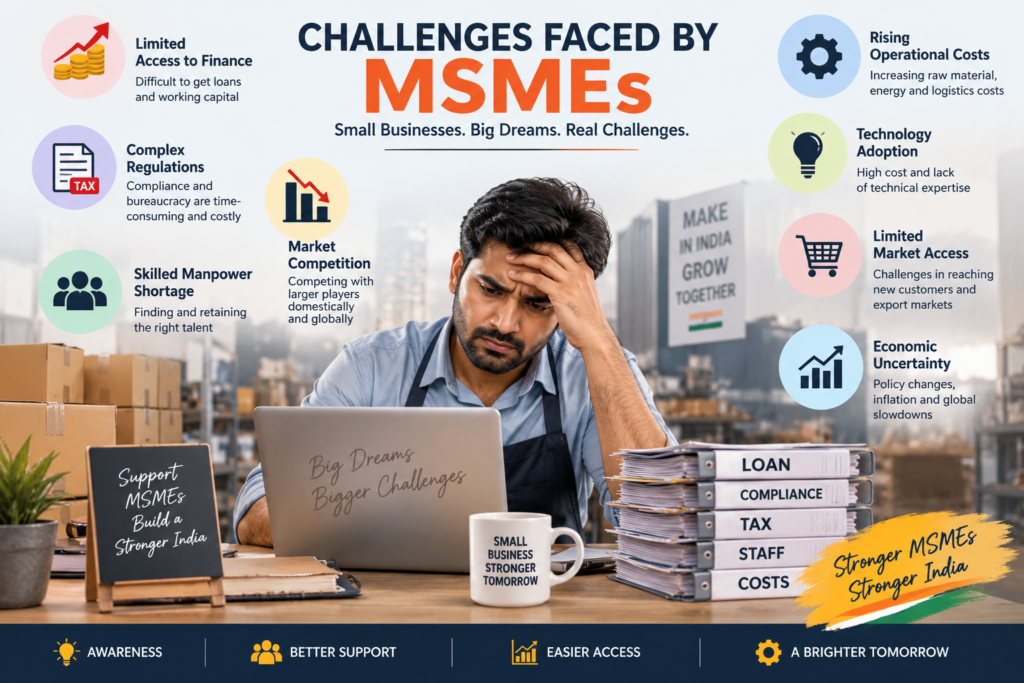
Micro, Small, and Medium Enterprises (MSMEs) are a vital part of India’s economy. They contribute to employment generation, manufacturing, services, trade, innovation, and regional development. From small retailers and manufacturers to technology companies and service providers, MSMEs operate across a wide range of industries. However, many businesses face financial, operational, technological, and market-related difficulties that can affect their stability and growth.
Understanding the challenges faced by MSMEs is important for business owners, entrepreneurs, policymakers, and financial professionals. Identifying these problems early can help businesses adopt practical strategies and build a stronger foundation for long-term growth.
Major Challenges Faced by MSMEs in India
1. Limited Access to Finance
Access to adequate and timely finance is one of the most significant challenges faced by MSMEs. Businesses need funds for inventory, salaries, equipment, expansion, marketing, technology, and daily operations.
Some MSMEs may find it difficult to obtain financing because of limited credit history, inadequate documentation, irregular cash flow, or insufficient financial records.
Solution: Businesses should maintain proper accounting records, monitor creditworthiness, prepare financial statements, and explore suitable financing options according to their requirements and repayment capacity.
2. Working Capital and Cash Flow Issues
Cash flow management is another major business problem. Customers may delay payments while suppliers, employees, and service providers still require timely payments. This can create a gap between money coming into and going out of the business.
Solution: MSMEs should prepare cash flow forecasts, establish clear payment terms, follow up on outstanding invoices, manage inventory efficiently, and maintain adequate working capital.
3. Increasing Competition
Indian MSMEs face competition from established companies, large corporations, online marketplaces, local businesses, and international brands. Businesses with limited marketing budgets may find it difficult to compete on price and visibility.
Solution: MSMEs can differentiate themselves through product quality, specialized services, customer experience, competitive pricing, faster delivery, and strong branding.
4. Lack of Skilled Workforce
Finding employees with the right technical, digital, managerial, sales, and operational skills can be challenging. Smaller businesses may also struggle to retain experienced professionals because larger companies can sometimes offer greater resources and career opportunities.
Solution: Businesses can invest in employee training, skill development, performance incentives, and a positive workplace environment. Technology can also be used to automate repetitive activities.
5. Technology Adoption Challenges
Technology has become increasingly important for business efficiency. Accounting software, inventory systems, CRM platforms, cloud applications, digital payments, and analytics tools can improve productivity.
However, some MSMEs hesitate to adopt new technology because of implementation costs, limited technical knowledge, or concerns about changing established processes.
Solution: Businesses should identify their specific needs and adopt affordable technology gradually. Training employees can also make technology implementation more effective.
Read also: RKS London: Your Trusted Partner for Fire Protection and Security Solutions
6. Marketing and Customer Acquisition
Many MSMEs have quality products and services but struggle to reach potential customers. Limited marketing budgets and a lack of digital expertise can restrict their ability to compete for online visibility.
Solution: MSMEs can use SEO, social media marketing, content marketing, online business listings, referrals, email marketing, and targeted advertising to reach relevant customers.
7. Delayed Customer Payments
Delayed payments from customers can create serious financial pressure, particularly for businesses that depend on regular working capital. Outstanding invoices can prevent MSMEs from paying suppliers, purchasing inventory, or investing in growth.
Solution: Businesses should establish clear credit policies, communicate payment deadlines, monitor receivables, and follow up consistently on overdue invoices. Suitable invoice financing solutions may also be considered where appropriate.
8. Supply Chain Problems
Supply chain disruptions can affect the availability and cost of raw materials, inventory, transportation, and finished products. Changes in supplier pricing or delivery schedules can directly affect profitability.
Solution: MSMEs should build relationships with reliable suppliers, monitor inventory levels, evaluate alternative suppliers, and use inventory management systems where appropriate.
9. Rising Operating Costs
Increasing expenses for raw materials, transportation, salaries, rent, utilities, technology, and other operational requirements can reduce profit margins.
Solution: Business owners should regularly review expenses, negotiate supplier terms, improve productivity, reduce unnecessary costs, and monitor profitability.
10. Regulatory and Compliance Burden
MSMEs may need to manage taxation, accounting, registrations, employment requirements, industry regulations, and other compliance responsibilities. Managing these requirements can consume considerable time and resources.
Solution: Businesses should maintain organized documentation, track compliance deadlines, use accounting tools, and seek professional assistance when required.
11. Limited Digital Presence
Customers increasingly use search engines, websites, social media, and online reviews when researching businesses. MSMEs without a strong digital presence may lose potential customers to competitors.
Solution: A professional website, optimized business profiles, useful content, social media activity, and genuine customer reviews can improve online visibility and customer trust.
12. Difficulty in Business Expansion
Growing an MSME requires sufficient capital, employees, technology, infrastructure, and customers. Businesses that expand too quickly without proper planning may face cash flow and operational problems.
Solution: Expansion should be based on realistic financial projections, customer demand, operational capacity, and available resources.
Causes Behind the Challenges Faced by MSMEs
The challenges faced by MSMEs in India can arise from several factors. Limited financial resources, changing market conditions, increasing competition, delayed customer payments, technology gaps, shortage of skilled employees, rising costs, and supply chain uncertainty can all affect business performance.
External economic conditions can also influence demand, input costs, and access to capital. Therefore, MSMEs need to continuously monitor their business environment and prepare strategies for potential risks.
How MSMEs Can Overcome Key Business Problems
A structured approach can help MSMEs manage their challenges more effectively. Business owners should regularly review financial performance, cash flow, expenses, inventory, customer acquisition, and employee productivity.
Businesses should also set measurable goals and track key performance indicators. This can help identify weak areas and support better decision-making.
Improve Financial Management
Maintaining accurate accounting records helps business owners understand revenue, expenses, profitability, receivables, and liabilities. Regular financial reviews can help identify cash flow problems before they become serious.
Adopt Appropriate Technology
MSMEs do not need to adopt every new technology. Instead, they should choose tools that solve specific business problems. Accounting, inventory, CRM, payment, communication, and cybersecurity solutions can improve efficiency when implemented correctly.
Strengthen Customer Relationships
Customer retention can contribute significantly to business stability. Providing reliable products, responsive support, transparent communication, and after-sales service can encourage repeat business and referrals.
Develop Employees
Regular training can improve employee productivity and help businesses adapt to changing technology and market requirements. Skilled employees can also reduce dependence on business owners for routine tasks.
Build Multiple Sales Channels
Depending on one customer, marketplace, or sales channel can increase business risk. MSMEs can explore websites, local markets, distributors, social media, referrals, and other suitable channels to diversify customer acquisition.
Importance of Working Capital Management
Working capital is essential for managing everyday business expenses. MSMEs need sufficient liquidity to purchase inventory, pay suppliers, manage salaries, cover operating expenses, and respond to unexpected requirements.
Effective working capital management involves controlling inventory, collecting receivables on time, negotiating suitable supplier terms, and maintaining a realistic cash reserve.
Role of Digital Transformation in MSME Growth
Digital transformation can help MSMEs improve efficiency and compete more effectively. Online marketing can increase customer reach, while accounting and business management software can improve financial visibility.
Cloud-based applications can support collaboration, while digital payment systems can make transactions more convenient. Cybersecurity should also be considered as businesses become increasingly dependent on digital systems.
Strategies for Sustainable MSME Growth
MSMEs can improve long-term stability by focusing on the following strategies:
- Maintain accurate financial records.
- Monitor cash flow and working capital.
- Control unnecessary operating expenses.
- Improve customer retention.
- Adopt relevant digital tools.
- Train employees regularly.
- Strengthen online visibility.
- Build reliable supplier relationships.
- Monitor market and competitor trends.
- Diversify products and customer channels where practical.
- Review business performance regularly.
Conclusion
The challenges faced by MSMEs in India include limited access to finance, cash flow pressure, increasing competition, skilled workforce shortages, technology adoption issues, delayed customer payments, supply chain difficulties, rising operating costs, and regulatory responsibilities.
Although these challenges can create obstacles to business growth, MSMEs can improve their resilience through effective financial planning, digital transformation, efficient operations, strong customer relationships, employee development, and strategic decision-making. By identifying business problems early and implementing practical solutions, Indian MSMEs can improve stability and create sustainable growth opportunities.