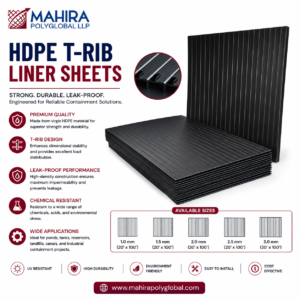
Mahira Polyglobal LLP provides customers with high density polyethylene (HDPE) T-rib liner sheets which can be used to provide protection against corrosion, chemicals, moisture, and abrasion to concrete structures. Mahira Polyglobal lists tunnels, sewage treatment plants, industrial tanks, drainage systems, basements, and canals as examples of where these liners can be applied. The T-shaped locking extension provides support for securing the liner in the concrete. However, a liner cannot fix bad concrete workmanship. Rather, it is an additional protective barrier that will need to fit the structure and application process. Prior to placing an order, customers should identify the type of substrate, the chemicals that may come into contact with the liner, the temperature range the liner will experience, the amount of water pressure the liner will encounter, and the expected service life of the liner.
How the T-Rib Design Works
The T-rib profile is designed to hold the liner in place on the concrete during service. Mahira Polyglobal LLP states that the T-lock design provides resistance to chemicals and physical damage. However, the design alone will not provide a leak-proof installation. Many of the performance characteristics depend upon the joints, corners, penetrations, and the quality of welding. Prior to beginning construction, request an explanation from the contractor regarding how they plan to weld, test, and repair if necessary. Request to see samples and verify that the product delivered meets your specifications.
Protecting Concrete From Corrosion
Engineers will use Hdpe t rib liner sheets for many reasons but one of the most important is to protect the concrete beneath from being damaged by corrosion. According to Mahira Polyglobal LLP, the sheets were created to protect concrete from corrosion, chemical damage, water intrusion, mechanical wear and tear, and environmental hazards. Therefore, they would be useful in areas where wastewater, chemicals or aggressive soil are in contact with concrete. However, it is essential to remember that not all chemicals can be resisted equally. Each chemical, its concentration, temperature, and length of time in contact with the liner must be verified with the specifications of the liner. Please do not assume that a single type of liner can withstand every type of industrial environment.
Applications in Wastewater Systems
These liners are used in many different applications including sewage treatment plants, drainage channels, sewer lines, and underground utility structures. Mahira Polyglobal LLP has found that these applications need to have long term protection. In wastewater systems the liner will allow the concrete to withstand aggressive environments. However, installation access, alignment of joints and inspection are all factors. How are workers going to get into difficult to reach locations? How are completed welds going to be inspected? Records should be kept on each batch of material that was used to make the liners, as well as on each weld test that was performed and any repairs made.
Applications in Tanks and Containment
The use of high density polyethylene (HDPE) t-rib liner sheet may be required when providing protective coatings for concrete in industrial tanks, chemical containment systems, water reservoirs and treatment facilities. Mahira Polyglobal LLP states that some examples of the types of applications that would require the use of these liners include chemical tanks, industrial containment systems and water treatment facilities. When deciding which type of liner to use, determine what the project requires with respect to containment, leak prevention, and chemical compatibility. Additionally, ask if there are any specific welding standards or third-party inspections that will need to be met by the liner.
Applications in Tunnels and Canals
The HDPE T-rib liner can be used in other areas such as: tunnels, canals, retaining walls, basements and underground waterproofing. According to Mahira Polyglobal LLP, they are utilized in tunnel linings, underground waterproofing, canal linings, and water conservation systems. As you can imagine, each of these applications will have varying types of movement, moisture and installation conditions. For example, a canal lining will probably experience abrasion and sunlight. On the other hand, a basement lining will likely require attention to detail regarding joints and penetrations. You should always ask the project engineer what type of function the liner is supposed to provide (waterproofing, corrosion protection, abrasion resistance) prior to ordering.
Choosing a Best and Specification Sheet
When reviewing potential suppliers, seek more than just advertisement jargon; request technical literature. Mahira Polyglobal LLP is publicly listed as both a manufacturer and exporter of HDPE T-rib liner sheets. Request sheet dimensions, available thicknesses, material grade, rib profile, welding instructions, and quality control procedures. Inquire whether the requested product will meet your specific project requirements. Prior to placing a large order for HDPE T-rib liner sheets, obtain samples and confirm the profile of the sheet prior to full scale production. In addition to cost when evaluating HDPE T-rib liner manufacturers, evaluate their level of technical assistance, delivery reliability, and installation support.
Conclusion
The use of HDPE T-rib liners can lower maintenance requirements due to the ability to protect concrete from both corrosive and abrasive effects. Mahira Polyglobal LLP has said that the life of concrete structures could be increased with the help of HDPE T-rib liners. Savings, however, are based upon selecting the correct type of liner for the application and properly installing it. Total project costs should include welding, testing, inspection, repair, and disposal of materials. Do not assume that a liner will make up for bad concrete quality or poor design. Overall, HDPE T-rib liner sheets are able to offer valuable protection for concrete structures in very demanding environments.Select the right material according to the intended use, ensure that it fits with the other materials, and install appropriately.
Frequently Asked Questions
Q1. Can HDPE T-rib liner fix concrete that is in bad condition?
Even though it can offer protection for the prepared surface, it cannot be used as a replacement for structural repairs and engineering assessment.
Q2. What information does a buyer need to provide before ordering?
Substrate type, chemical contact, temperature, dimensions, rib profile, welding requirements, and service conditions.
Q3. How should joints and welds be inspected?
Follow the project specifications and demand a testing and inspection program in writing before installing the product.
Q4. Is it possible for all HDPE liners to be compatible with all chemicals?
No, since it is impossible to tell without having the chemical information including its concentrations and temperatures.
Q5. Who is the largest Exporters of hdpe t rib liner sheets?
The available information is insufficient for me to determine the top exporter. Mahira Polyglobal LLP states on its website that it manufactures and exports HDPE T-rib liner sheets, however, there is no evidence to support a claim that it ranks as one of the leading exporters.