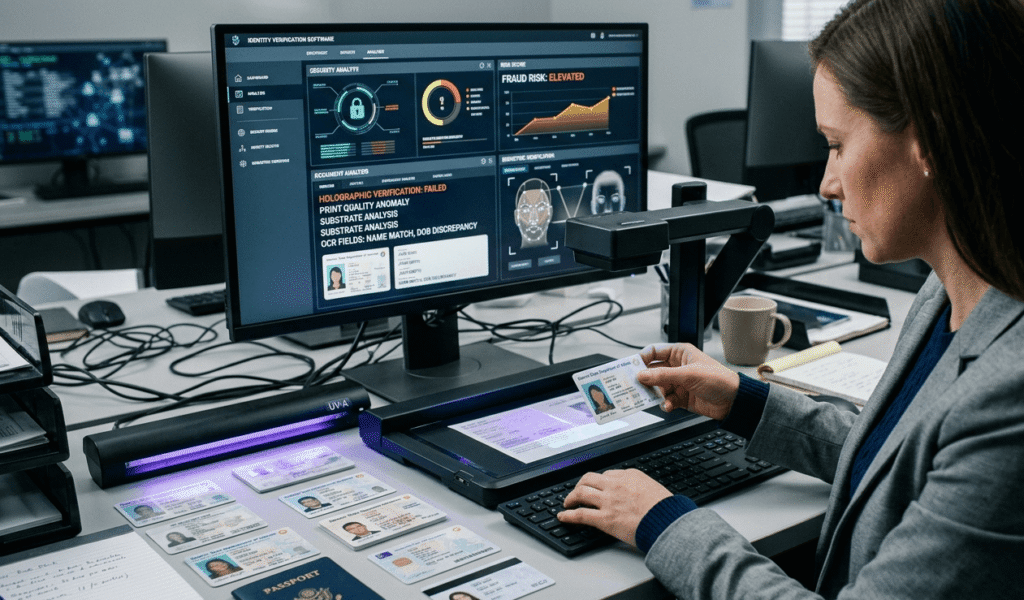
A fraud analyst examining an identity document under a document authentication scanner, multiple verification signals displayed on a monitor in the background.
A bartender checking IDs on a Friday night and a KYC analyst reviewing onboarding documents for a fintech app are doing versions of the same job: deciding, in seconds, whether a piece of plastic or a digital scan represents a real person telling the truth. Fake ID detection sits at the intersection of those two worlds now, and the gap between them is closing fast. What used to be a matter of holding a card up to the light has become a discipline that blends forensic printing analysis, cryptography, and machine learning — often within the same verification pipeline.
That shift didn’t happen because visual inspection got worse. It happened because the documents got harder to judge by eye alone, and because the stakes of getting it wrong — account fraud, underage access, sanctions violations — kept climbing.
Why Fake ID Detection Has Become a Layered Discipline
Ask any experienced fraud investigator what worries them most, and it’s rarely a single dramatic forgery. It’s the document that looks almost right. A convincing print job can fool the naked eye. A well-executed data layout can pass a quick glance. What trips up a fraudulent document is usually the accumulation of small inconsistencies across multiple signals — not any single glaring flaw.
That’s the core logic behind modern fake ID detection (fake id cards): no individual check is expected to carry the full weight of the decision. A hologram might look right under casual light but fail under ultraviolet inspection. A barcode might encode data that doesn’t quite match what’s printed on the card face. A face might match the photo but the document’s issuing pattern might not match known templates for that jurisdiction and year. Layering signals doesn’t guarantee certainty — nothing in this field does — but it narrows the space where a fraudulent document can hide.
Organizations that rely on one feature, whether that’s a hologram check or a single database lookup, tend to develop blind spots. Fraud tactics evolve toward whatever gap the defender left open. That’s part of why regulated industries increasingly treat document authentication as a risk-scoring exercise rather than a pass/fail test.
The Physical Security Features Examiners Still Rely On
Physical documents still carry decades of accumulated security engineering, and it’s worth understanding what each layer is actually for.
Optically variable devices — the shifting holograms and color-changing inks seen on driver’s licenses and passports — exist because they’re difficult to reproduce with standard commercial printing equipment. Microprinting, those impossibly small lines of text that appear as solid strokes to the naked eye, serves a similar purpose: it’s a signal that requires specialized equipment to replicate convincingly. Guilloche patterns, the fine interlocking curved lines found on currency and official documents, are engineered so that even slight irregularities become visible under magnification.
UV-reactive fibers and IR-responsive inks add another dimension entirely, because they’re invisible under normal lighting and only reveal themselves under specific examination conditions. Forensic examiners use this to their advantage: a genuine document behaves predictably under UV and IR light because its materials were manufactured to a known specification. Deviations — dull fluorescence, missing fiber patterns, inconsistent ink behavior — are red flags precisely because they’re hard for a fraudster to know they need to replicate.
None of these features work in isolation, though. A skilled examiner cross-references material characteristics, layout consistency, and printing technique against a reference specification for that document type. That comparison — known document behavior versus what’s in hand — is the backbone of forensic document examination.
Machine-Readable Zones and the Problem of Data Consistency
Every modern identification document carries at least one machine-readable layer: a barcode, a 2D code, or an ICAO-standard machine-readable zone (MRZ) on travel documents. These aren’t just convenience features. They’re a second, independently encoded copy of the document’s core data, and that redundancy is exactly what makes them useful for detection.
Here’s the logic: a fraudulent document creator has to get the printed data, the encoded data, and the physical security features to all agree. That’s three separate systems to falsify convincingly, and each one raises the technical bar. Automated verification platforms exploit this by cross-checking the name, date of birth, and document number printed on the card against what’s encoded in the barcode or MRZ. A mismatch — even a subtle one, like a transposed digit — is often the first thing that flags a document for closer review.
Document number validation adds another layer. Many document numbering schemes follow internal logic — check digits, sequential ranges tied to issuance periods, jurisdiction-specific formats — that a legitimate document will satisfy and a fabricated one may not, especially if the fraudster wasn’t working from current, accurate specifications.
Chips, NFC, and the Shift Toward Cryptographic Trust
The most significant change in document security over the last two decades has been the move from features you can see to features you can cryptographically verify. NFC-enabled passports and next-generation ID cards embed a chip that stores the holder’s data along with a digital signature issued by the document’s issuing authority.
This matters because it changes the nature of the problem for a defender. Instead of asking “does this hologram look right,” a verification system can ask “does this chip’s digital signature validate against a trusted certificate chain.” That’s a fundamentally different kind of assurance — rooted in public-key infrastructure rather than visual judgment. The International Civil Aviation Organization’s specifications for electronic machine-readable travel documents laid much of this groundwork, and similar cryptographic approaches have since spread to domestic identity credentials.
It’s not invulnerable, though. Chip validation depends on the verifying system having access to a current, trustworthy certificate list, and interoperability between issuing countries and verification vendors remains an ongoing operational challenge. A chip that fails to read isn’t necessarily fraudulent — capture equipment, chip damage, or outdated certificate stores can all produce false negatives. That’s a genuine limitation worth naming honestly, rather than treating chip verification as an infallible solution.
Where AI Fits Into Fake ID Detection “(fake id cards)”
Computer vision and machine learning have become standard components of automated document verification, and it’s worth being precise about what they actually do. These systems are generally trained to recognize document templates across hundreds of issuing jurisdictions, assess image quality, detect signs of digital manipulation (screen glare patterns, pixel-level tampering artifacts, font inconsistencies), and score the overall likelihood that a document matches its claimed type and issuer.
What AI-assisted detection is good at: processing volume, catching subtle template mismatches a human might miss on a tired night shift, and flagging statistical anomalies across large datasets. What it struggles with: genuinely novel document formats, poor-quality smartphone captures, and — critically — false positives on legitimate but unusual documents. A worn driver’s license, a document photographed under bad lighting, or a legitimate but rare document type can all trigger fraud scoring that has nothing to do with actual fraud.
This is why responsible verification vendors describe their AI output as a risk signal, not a verdict. Vendors that imply otherwise are overstating what pattern recognition can actually guarantee.
Why Human Reviewers Still Matter
There’s a persistent temptation in this industry to treat automation as a replacement for trained human judgment. It rarely holds up in practice. Automated systems are excellent at consistency and scale; they’re comparatively poor at handling edge cases, legitimate document variation across jurisdictions, and the kind of contextual reasoning a trained examiner develops over years of exposure to real documents.
Reviewer fatigue is a real operational concern — someone looking at their three-hundredth document of a shift is going to miss things a fresh reviewer wouldn’t. That’s precisely why escalation workflows exist: automated systems triage the bulk of cases and route ambiguous or high-risk documents to trained human examiners, who bring judgment that current models can’t fully replicate. Overreliance on automation creates blind spots. Underreliance creates bottlenecks and inconsistency. The balance point shifts depending on risk tolerance, document volume, and the consequences of getting a decision wrong.
The Road Ahead: Digital Identity and Verifiable Credentials
The next phase of this field looks less like physical documents and more like cryptographically verifiable digital credentials — mobile driver’s licenses, verifiable credential standards, and identity wallets that let a person prove a specific claim (age, residency, licensure) without handing over a full document scan. Privacy-preserving verification, where an entity confirms “this person is over 21” without ever seeing a birthdate, is a genuinely promising direction, though standardization and cross-jurisdictional trust frameworks are still maturing.
Risk-adaptive authentication — where the depth of verification scales with the risk of the transaction — is also gaining traction, paired with device intelligence and behavioral signals that add context beyond the document itself. None of this eliminates the underlying tension, though. Every new verification layer creates a new surface that defenders have to understand and monitor, and every generation of identity security has had to solve a problem the previous generation didn’t anticipate.
That pattern is unlikely to end. What changes is the sophistication of the layered evidence available to defenders — from UV light and magnifying glasses to cryptographic signatures and adaptive risk scoring. The organizations that do this well aren’t the ones chasing a single silver-bullet technology. They’re the ones treating identity assurance as a continuously evolving, multi-signal risk decision, backed by people who know when to trust the machine and when to look closer themselves.
FAQs
FAQ 1
Can a convincing-looking fraudulent document still fail automated verification?
Yes, often. A document that passes casual visual inspection can still fail because automated systems cross-check data across multiple layers — printed text, barcode data, chip signatures — that all have to agree. Getting every layer consistent is significantly harder than getting the surface appearance right.
FAQ 2
Why isn’t checking one visible security feature enough?
Because any single feature can eventually be studied and approximated well enough to pass casual inspection. Layered verification — combining optical, data-consistency, and cryptographic checks — forces a document to be consistent across systems that are independently difficult to falsify together.
FAQ 3
How does chip or NFC verification improve authentication?
It shifts the check from a visual judgment to a cryptographic one. A chip’s digital signature can be validated against a trusted certificate chain, which provides a stronger form of assurance than appearance alone — though it depends on the verifier having current, trustworthy certificate data.
FAQ 4
Can AI reliably detect fraudulent identity documents?
AI-assisted systems are effective at flagging template mismatches and manipulation artifacts at scale, but they’re not infallible. Poor image quality, unusual legitimate documents, and novel formats can all produce false positives or false negatives, which is why AI output is typically treated as a risk signal rather than a final decision.
FAQ 5
Why do legitimate documents sometimes trigger fraud alerts?
Worn cards, unusual lighting during capture, rare document formats, or legitimate regional variations can all resemble anomalies to an automated system. This is a known limitation of automated fraud detection and a major reason trained human reviewers remain part of the process.