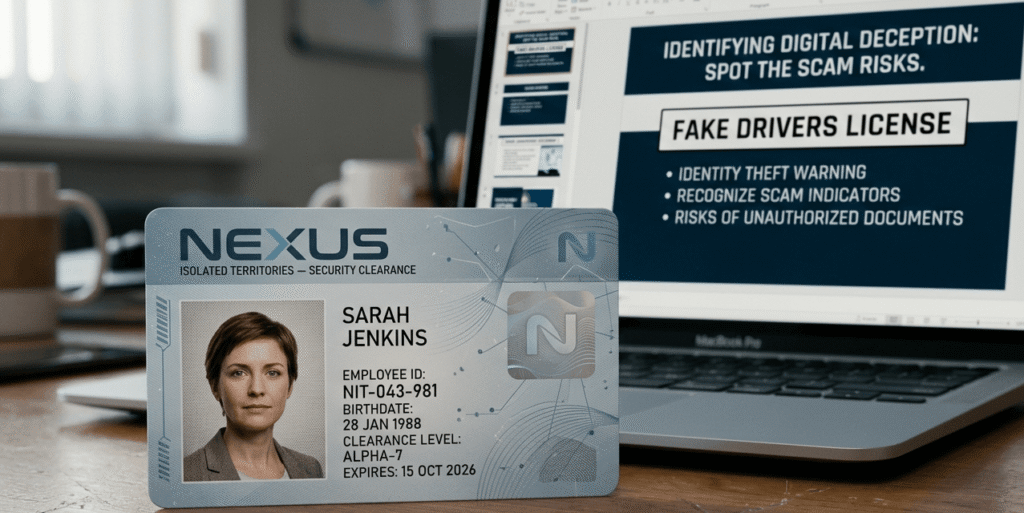
A fraud analyst reviewing an identity queue during a busy Friday evening might see three hundred document submissions in a single shift. Most are unremarkable — a driver’s license photographed under decent light, a face that matches, a barcode that decodes cleanly. Then one submission takes an extra half-second to process. The font kerning on the date of birth is almost right. The ghost image is present but slightly misaligned. Nothing about it screams “fraud” to a casual glance, and that’s exactly the point.
Search interest around fake Drivers License buying isn’t a fringe curiosity. It reflects a persistent behavioral pattern that shows up in fraud analytics, underage-access statistics, and identity-verification failure logs year after year. People search for it out of curiosity, some out of research for security work, and a smaller number with intent to acquire a fraudulent document. From a defensive standpoint, the motivation behind the search matters less than understanding why the underlying documents keep evolving and why detection has become a far more layered discipline than it was even a decade ago.
This piece looks at that landscape from the side of the people who have to catch the fakes — not make them.
Why Fraudulent Identification Remains a Persistent Problem
Physical ID documents were never designed to withstand the level of digital replication tools available today. A driver’s license from the early 2000s relied heavily on a handful of static features — a watermark, a hologram sticker, maybe a UV element. Consumer-grade scanning and printing technology has improved so dramatically that some of those older security layers no longer provide meaningful resistance on their own.
I’ve often seen analysts assume that because a document “looks right,” it passed inspection. That assumption is precisely why layered verification systems exist. A convincing print job can fool an eye in under two seconds. It has a much harder time surviving a system that cross-checks font metrics, barcode data, and issuing-authority formatting simultaneously.
There’s also a structural reason fraud persists: identity documents serve as the root of trust for dozens of downstream processes — age-restricted purchases, financial account opening, rental agreements, employment verification. Any weakness at that root propagates outward. Fraud teams describe this as the “keystone problem” — compromise the ID, and everything built on top of it inherits the risk.
Why Visual Inspection Alone Fails
Human reviewers are good at pattern recognition but inconsistent at sustained vigilance. Studies on document examiner fatigue consistently show accuracy drops measurably after the first hour of continuous review. That’s not a criticism of examiners — it’s a known limitation of manual visual checks performed at scale.
A common misconception is that trained staff can reliably “just tell” when a document is fraudulent. Some can, some of the time, particularly with obvious amateur forgeries. But mid-tier forgeries — the ones built with real security-feature knowledge — are specifically designed to survive a glance. That’s why regulated industries have largely shifted decision-making away from a single human judgment call and toward systems that combine multiple independent evidence sources.
The Limits of a Single Security Feature
No individual security feature, no matter how sophisticated, is meant to stand alone. Holograms can be photographed and reproduced with reasonable fidelity under the wrong lighting conditions during a review. UV reactive ink can be approximated. Microprinting can be simulated at low resolution well enough to pass a phone camera check. Document designers know this, which is why modern licenses stack five, six, sometimes ten distinct feature categories, each requiring a different detection method.
The Physical Security Feature Stack
Optically Variable Devices and Holography
Modern holograms and other optically variable elements shift color or imagery depending on viewing angle. Genuine versions are produced using specialized diffraction-grating equipment that isn’t accessible through consumer print shops. Detection systems check for the specific optical shift pattern rather than just the presence of a shiny overlay — a distinction that separates authentic elements from imitation foil.
Guilloche Patterns and Fine-Line Printing
Guilloche patterns — those intricate, mathematically generated line designs — are difficult to reproduce accurately because they require precision vector generation and specialized press equipment. Under magnification, forged versions often show line breaks, inconsistent stroke width, or resolution artifacts from the printing process used to create them. Forensic examiners look specifically at line continuity as a fast authenticity signal.
UV and IR Reactive Elements
Ultraviolet-reactive ink and infrared-responsive layers are invisible under normal lighting and only reveal themselves under specific wavelengths. Because most reproduction equipment can’t replicate the exact chemical composition of these inks, this remains one of the more resilient authentication layers — though it requires dedicated inspection equipment, which limits its usefulness in casual point-of-sale settings.
Microprinting
Text small enough to require magnification to read is a deceptively simple but effective control. Consumer printers generally can’t resolve text at that scale without it degrading into a blur or solid line. Fraud investigators frequently cite microprinting clarity as one of the fastest tells under a loupe or macro camera lens.
Machine-Readable Data and Cross-Verification
Beyond the visual layer, every modern driver’s license carries machine-readable data — a barcode, a magnetic stripe (in older formats), or a structured 2D code such as PDF417. This data should match the printed information exactly: name, date of birth, document number, expiration date, issuing jurisdiction.
This is where a lot of forgeries genuinely fall apart. Producing convincing printed graphics is one challenge. Encoding barcode data that matches an issuing authority’s actual formatting standards, checksum logic, and field structure is a separate and considerably harder challenge. Verification systems decode this data automatically and flag any mismatch between what’s printed and what’s encoded — a check that’s nearly instantaneous and very difficult to spoof convincingly without deep knowledge of a specific state’s formatting specification.
Document number consistency checks go further still, applying jurisdiction-specific logic (sequential patterns, embedded date codes, regional prefixes) that fraud teams rarely disclose publicly, precisely because that obscurity is part of what makes the check effective.
Chips, Cryptography, and the Next Authentication Layer
Enhanced driver’s licenses and increasingly, mobile driver’s licenses (mDLs), incorporate embedded chips or cryptographically signed digital credentials. NFC-enabled documents allow a verifying device to read data directly from a secure chip rather than relying solely on printed or barcode information, and that chip data is cryptographically signed by the issuing authority.
This matters because it shifts the trust model. Instead of asking “does this document look right,” the system asks “can this document prove, cryptographically, that it was issued by a legitimate authority and hasn’t been altered since.” Forging a convincing physical appearance is one problem. Forging a valid cryptographic signature without the issuing authority’s private key is a fundamentally different order of problem — one that’s effectively infeasible with current computing capabilities when implemented correctly.
Digital identity wallets extend this concept further, storing verifiable credentials that can be selectively disclosed (proving someone is over 21 without revealing their exact birthdate, for example) while maintaining cryptographic proof of authenticity. This is arguably the most significant structural shift in identity verification in the last twenty years, and it’s still in a relatively early adoption phase across US states.
Biometric Verification and Liveness Detection
Document authenticity is only half the equation. Identity-proofing systems increasingly pair document checks with biometric matching — comparing the photo on the ID against a live selfie capture. This closes a gap that pure document analysis can’t: a perfectly authentic, unaltered ID that simply belongs to someone else.
Liveness detection adds another layer on top of that, verifying that the selfie capture comes from an actual live person in real time rather than a photograph, video replay, or synthetic image presented to the camera. Liveness systems typically analyze subtle cues — micro-movements, texture response under varying light, depth signals from multiple camera angles — that are difficult to replicate through a static image or screen replay.
Why does this matter for a discussion ostensibly about fake IDs buying? Because increasingly, the weakest point in identity fraud isn’t the physical document at all — it’s the verification session around it. Attackers have adapted to strong document security by shifting effort toward the biometric capture step. Defenders have responded in kind, which is why liveness detection has become a near-universal requirement in serious KYC deployments rather than an optional add-on.
Where Automated Systems Still Struggle
No detection stack is perfect, and it’s worth being honest about that. Automated systems can produce false positives — flagging legitimate documents, particularly older or worn IDs, unusual state formats, or documents from less common jurisdictions the model wasn’t trained on extensively. They can also produce false negatives when a forgery is sophisticated enough to satisfy every automated check individually while still being fraudulent in ways only a trained human examiner would catch through contextual judgment.
This is why risk-based identity verification has become the dominant approach rather than a single pass/fail gate. Low-risk transactions might rely on automated checks alone. Higher-risk transactions — larger financial exposure, regulatory sensitivity — route to manual review by a trained examiner, sometimes supplemented by forensic-grade equipment.
How Forensic Document Examination Complements Automation
Trained forensic document examiners bring something automated systems still can’t fully replicate: contextual judgment built from exposure to thousands of genuine documents across jurisdictions and years. They notice things that don’t fit a rule — an inconsistency in ink aging, a font substitution that’s technically correct but statistically unusual for that document’s issue year, a lamination texture that’s subtly wrong.
Imagine reviewing hundreds of identity documents during a single shift and noticing that one just feels off, without being able to immediately articulate why. That instinct, refined over years of exposure, is exactly what feeds back into training the next generation of automated detection models. The relationship between human examiners and machine learning systems in this field is genuinely symbiotic rather than competitive.
The Future of Identity Verification
The trajectory is fairly clear: less reliance on static physical features, more reliance on cryptographically verifiable digital credentials. Mobile driver’s licenses, verifiable credential standards, and decentralized identity frameworks are all pushing toward a model where authenticity isn’t inferred from appearance but proven mathematically.
That doesn’t mean physical document security becomes irrelevant — plenty of transactions will still involve a physical card for years to come, and layered physical security features remain the first line of defense in that context. But the center of gravity in serious fraud prevention work has clearly shifted toward systems that combine document forensics, machine-readable data validation, cryptographic verification where available, biometric matching, and liveness detection into a single risk decision, rather than treating any one signal as sufficient on its own.
Conclusion
Interest in topics like fake IDs buying isn’t going away, and pretending otherwise doesn’t help defenders build better systems. What’s changed is the sophistication required to actually defeat a well-implemented verification stack. A convincing-looking document in 2026 has to survive optical inspection, data consistency checks, cryptographic validation where applicable, and often a biometric liveness challenge — all in the same session. That’s a considerably higher bar than it was even five years ago, and the gap continues to widen as digital credentials mature.
Frequently Asked Questions
Can a convincing-looking fake ID still fail automated verification?
Yes, and it happens constantly. A document can pass a casual visual inspection while failing barcode data consistency checks, font-metric analysis, or cross-reference against known issuing-authority formatting standards. Visual convincingness and technical authenticity are two very different things.
Why isn’t checking a hologram enough anymore?
Because holographic imitation has gotten good enough to fool a quick glance under imperfect lighting. Serious verification systems treat holograms as one signal among many rather than a standalone pass/fail check, since relying on a single feature creates an obvious single point of failure.
How does chip or NFC verification actually improve authentication?
It shifts the check from “does this look right” to “can this prove cryptographically it was issued legitimately.” Chip data is signed by the issuing authority, and forging a valid signature without the private key is a fundamentally harder problem than replicating a printed appearance.
Can AI reliably detect fraudulent identity documents?
It’s reliable as one layer, not as a complete solution. Machine learning models are strong at pattern-based anomaly detection across large volumes but can still be fooled by novel forgery techniques they weren’t trained on, which is why human forensic review remains part of serious verification pipelines.
What’s the biggest weakness in modern ID verification systems right now?
Most fraud teams would point to the biometric capture step rather than the document itself. As physical document security has improved, attacker focus has shifted toward spoofing the liveness and face-match process, which is why liveness detection has become such a heavily invested area of development.