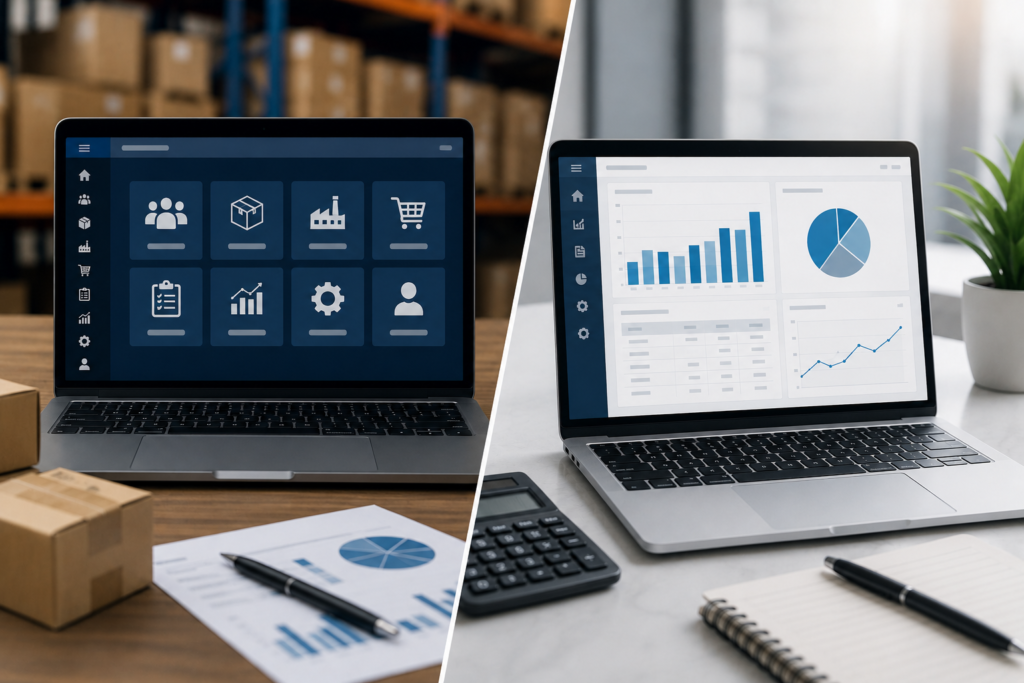
If you’ve started researching business software, you’ve probably run into both terms — ERP and accounting software — often used almost interchangeably in marketing pages. But they’re not the same thing, and choosing the wrong one can mean either overpaying for capabilities you don’t need or outgrowing your system far sooner than expected.
Understanding ERP vs accounting software isn’t just a technical distinction — it directly affects how well your systems support day-to-day operations, compliance, and growth. This guide breaks down exactly what separates the two, when each makes sense, and how to decide which one actually fits your business today.
What Is Accounting Software?
Accounting software is designed specifically to manage a business’s financial transactions. Its core purpose is to record, organize, and report on money moving in and out of the business.
Core Functions of Accounting Software
- Invoicing and billing
- Expense tracking
- Bank reconciliation
- Tax compliance (GST, TDS, etc.)
- Financial reporting (P&L, balance sheet, cash flow)
Modern accounting platforms often extend into related areas like basic inventory tracking or payroll, but the primary focus remains financial management.
What Is ERP Software?
ERP, or Enterprise Resource Planning software, is a broader system designed to manage multiple business functions in one integrated platform — not just finance. It connects departments like finance, inventory, procurement, human resources, and production planning into a single, unified system.
Core Functions of ERP Software
- Financial management (often including full accounting capabilities)
- Inventory and supply chain management
- Procurement and vendor management
- Production and manufacturing planning
- Human resources and payroll
- Cross-department reporting and analytics
In short, accounting software manages your books; ERP software manages your entire business operation, with accounting as just one module among many.
ERP vs Accounting Software: Side-by-Side Comparison
| Factor | Accounting Software | ERP Software |
| Primary focus | Financial transactions | Entire business operations |
| Modules included | Invoicing, tax, reporting | Finance, inventory, HR, procurement, production |
| Best for | Small to mid-sized businesses | Larger or complex, multi-department businesses |
| Implementation time | Days to weeks | Weeks to months |
| Cost | Generally lower | Generally higher |
| Customization | Limited to moderate | Extensive |
| Learning curve | Low to moderate | Moderate to high |
When Accounting Software Is Enough
For many small and growing businesses, dedicated accounting software is not just sufficient — it’s the smarter choice. This is especially true if your business:
- Primarily needs invoicing, expense tracking, and tax compliance
- Has straightforward inventory needs, if any
- Doesn’t require complex cross-department workflows
- Wants to avoid the cost and complexity of a full ERP rollout
Many modern accounting solutions India businesses use today have evolved well beyond basic bookkeeping, offering built-in GST compliance, multi-user access, and even light inventory management — covering most needs of small and medium businesses without ERP-level complexity.
When It’s Time to Consider ERP
ERP systems make more sense once a business’s operations become complex enough that disconnected departmental tools start causing inefficiencies. Common signs include:
- Multiple departments (production, sales, HR, procurement) working with disconnected data
- Complex manufacturing processes requiring detailed production planning
- Multi-location operations needing centralized visibility
- A growing need for cross-department reporting and forecasting
Table: Signs You Might Need ERP vs Accounting Software
| Signal | Likely Fit |
| You just need to manage invoices, expenses, and GST | Accounting Software |
| You manage complex, multi-stage manufacturing | ERP Software |
| You have under 50 employees and simple operations | Accounting Software |
| You need HR, procurement, and finance in one system | ERP Software |
| You operate across multiple locations with shared inventory | ERP or Accounting Software with Inventory Management |
The Middle Ground: Accounting Software With Inventory Management
Many growing businesses don’t need the full complexity of ERP but do need more than basic invoicing. This is where accounting with inventory management becomes a practical middle-ground solution — combining financial tracking with stock management, order tracking, and basic production visibility, without the cost and implementation time of a full ERP system.
This hybrid approach works particularly well for:
- Retail businesses managing multiple product lines
- Small manufacturers with relatively simple production processes
- Trading businesses handling inventory across a few warehouses
GST Compliance: Accounting Software vs ERP
Both accounting software and ERP systems can handle GST compliance, but the depth and integration often differ.
Accounting software typically offers strong, focused GST tools, including automatic tax calculation and return preparation. Some platforms also support advanced compliance features like GSTR-2B reconciliation, which automatically matches purchase records against supplier-filed data to ensure accurate input tax credit claims — a feature particularly valuable for businesses dealing with a high volume of vendors.
ERP systems generally include similar GST functionality within their finance module, but the added complexity of a full ERP may not be justified if GST compliance and reporting are your primary concerns.
Legal Importance of Choosing the Right System
Whether you choose accounting software or ERP, the system directly impacts legal and compliance outcomes for your business.
Why It Matters Legally
- GST and TDS compliance: Both systems, when properly configured, reduce the risk of filing errors and associated penalties.
- Udyam Registration requirements: MSMEs need consistent financial records to retain registration benefits like collateral-free loans and government tenders — a requirement both accounting software and ERP can support if implemented correctly.
- Audit readiness: Both system types offer better audit trails than manual processes, though ERP systems often provide more detailed cross-departmental documentation.
Business Advantages
- Right-sized investment: Choosing accounting software when that’s genuinely sufficient avoids unnecessary cost and complexity.
- Scalability planning: Understanding the difference helps businesses plan a realistic upgrade path as they grow.
- Operational clarity: Matching the system to actual business complexity improves both usability and long-term reporting.
Practical Example: Choosing Between the Two
Consider two businesses:
Business A is a services firm with 15 employees, straightforward invoicing needs, and no physical inventory. Accounting software with strong GST compliance and reporting features covers all of its needs efficiently, without the overhead of ERP implementation.
Business B is a mid-sized manufacturer with multiple production lines, several warehouses, and a growing HR function. As operations became more complex, spreadsheets and standalone accounting software struggled to give leadership a unified view across departments — making ERP a more logical long-term investment despite the higher initial cost and implementation time.
This contrast illustrates why the right choice depends heavily on business complexity, not company size alone.
Choosing Software for Global Business Registration and Expansion
Businesses planning to register or operate internationally should also factor this into their decision. Both accounting software and ERP systems increasingly support:
- Multi-currency invoicing and reporting
- Compliance tracking across different tax jurisdictions
- Integration with global business registration processes, such as incorporating an LLC or subsidiary abroad
- Consolidated reporting across multiple entities or countries
For businesses with relatively simple international operations, accounting software with multi-currency support is often sufficient. Larger, multi-entity operations with complex cross-border supply chains may eventually benefit more from ERP-level integration.
Common Mistakes When Choosing Between ERP and Accounting Software
| Mistake | Consequence |
| Choosing ERP before it’s actually needed | Unnecessary cost and implementation complexity |
| Sticking with basic accounting software too long | Operational bottlenecks as complexity grows |
| Ignoring inventory needs when evaluating options | Mismatched software for product-based businesses |
| Not planning for future scalability | Costly system migration later |
| Underestimating implementation time for ERP | Disrupted operations during rollout |
Final Thoughts
ERP and accounting software solve different problems, even though they sometimes overlap. Accounting software focuses on financial accuracy, compliance, and reporting — and for most small and mid-sized businesses, that’s exactly what’s needed. ERP software takes a broader view, integrating finance with inventory, HR, procurement, and production for businesses with more complex, multi-department operations.
The right choice isn’t about which system is more advanced — it’s about which one genuinely matches your business’s current complexity and growth trajectory. Understanding this distinction early helps MSMEs avoid both underinvesting in necessary tools and overinvesting in unnecessary complexity, setting a stronger foundation for compliant, sustainable growth.
Frequently Asked Questions (FAQs)
- What is the main difference between ERP and accounting software? Accounting software focuses specifically on financial transactions, compliance, and reporting, while ERP software integrates finance with other business functions like inventory, HR, and procurement into a single system.
- Do small businesses need ERP software? Most small businesses don’t need full ERP systems initially; dedicated accounting software, sometimes combined with inventory management features, is usually sufficient until operations become significantly more complex.
- Can accounting software handle GST compliance as well as ERP? Yes, many accounting software platforms offer strong, dedicated GST compliance features, including automated calculations and reconciliation, often matching or exceeding the finance module capabilities of ERP systems for smaller businesses.
- When should a business consider upgrading from accounting software to ERP? Businesses should consider ERP when they have complex, multi-department operations, such as detailed manufacturing processes, multi-location inventory, or a growing need for integrated HR and procurement management.
- Is ERP more expensive than accounting software? Generally, yes. ERP systems typically involve higher costs and longer implementation timelines due to their broader scope, while accounting software tends to be more affordable and quicker to implement.
- Can accounting software or ERP support businesses expanding internationally? Yes, both types of software increasingly support multi-currency transactions and compliance tracking across different tax jurisdictions, making them suitable for businesses managing international operations, though the right choice depends on operational complexity.