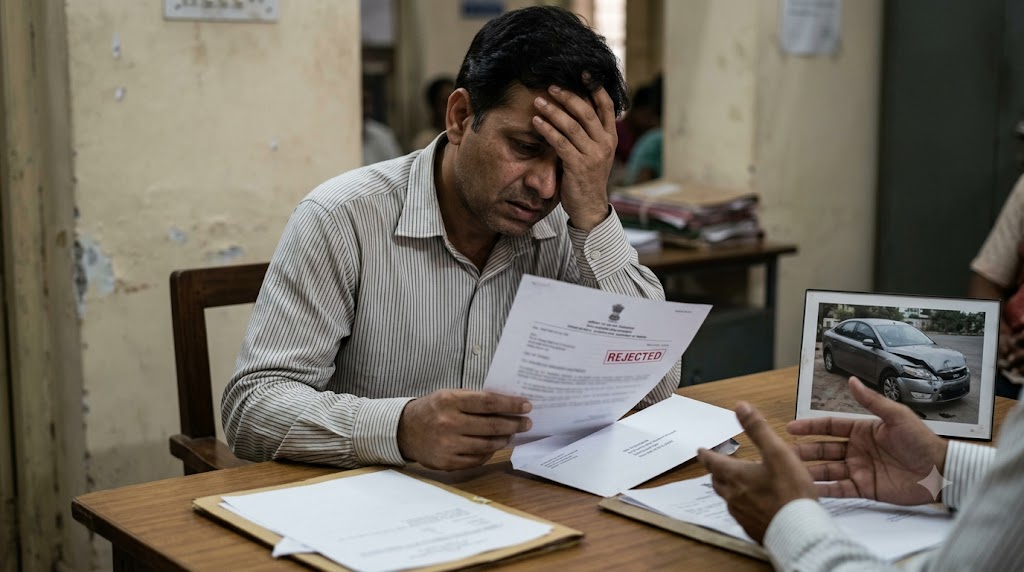
Why Claim Rejection Without Proof Matters: A Consumer Forum Ruling Every Vehicle Owner Should Know
Most first-time vehicle owners assume that if they pay their premium and file a legitimate claim, the insurer pays. A consumer forum ruling from Gujarat, where an insurer was ordered to pay over ₹1.25 lakh after rejecting a claim without proof that the accident had not occurred as described, is a useful reminder that Motor Insurance comes with rights as well as obligations.
What the Case Established
The Gujarat consumer commission examined a claim the insurer had rejected, and found the rejection was not supported by evidence establishing that the incident occurred differently from how the claimant described it. The forum ordered the insurer to pay the claim amount, exceeding ₹1.25 lakh. This highlights the importance of understanding how Motor Insurance claims are assessed and the evidence required when a dispute arises.
The principle underlying the decision is one that recurs across Indian insurance jurisprudence: the burden of justifying a rejection sits with the insurer. An insurer that declines a claim must be able to demonstrate why, with evidence, rather than asserting a reason and leaving the policyholder to disprove it.
Why This Is Not an Isolated Outcome
Indian courts and consumer forums have consistently applied this standard. The Supreme Court has held that mere delay in claim intimation does not justify rejection unless the insurer can show it was actually prejudiced by the delay. The insurance regulator has separately directed insurers not to reject claims on purely technical grounds, instructing them to treat claims on merit rather than mechanically.
The regulator’s own language is notable: it has warned that rejecting claims on technical grounds in a mechanical fashion erodes policyholder confidence and generates excessive litigation.
The Common Grounds Insurers Cite
Understanding what gets rejected helps you avoid the avoidable ones. Delayed intimation is the most frequently cited ground, though as above, it is also the most frequently overturned when the delay has a genuine explanation.
Driving without a valid licence at the time of the incident is a firmer ground and rarely successfully contested. Driving under the influence is similarly difficult to challenge.
Policy lapse at the time of the incident is definitive: if cover was not active, there is no claim regardless of circumstances. Undisclosed vehicle modifications can also justify rejection where the modification relates to the damage claimed.
Incomplete documentation is common but usually curable rather than fatal, since the correct response is to supply what is missing.
What Strengthens Your Position
Documentation at the time of the incident matters more than anything you do afterwards. Photographs of the damage from multiple angles, including the registration plate, taken at the scene, are difficult to dispute later.
Prompt intimation to the insurer, even a brief initial notification before you have full details, creates a timestamped record. An FIR where the incident involves injury, theft, fire or third-party damage is frequently required and always useful.
Consistency across your account, the photographs and the repair estimate matters. Where the described incident, the visible damage and the estimated repair do not align, insurers reasonably query the claim.
If Your Claim Is Rejected
Request the insurer’s written reasons. Regulations require this to be communicated clearly rather than vaguely, and you cannot effectively contest a rejection you do not understand.
Escalate internally first, through the insurer’s grievance redressal officer, which is the required first step. If unresolved within thirty days, the Insurance Ombudsman handles disputes at no cost to the complainant, with binding awards and typically faster resolution than court.
Consumer commissions, as in the Gujarat case, remain available and have shown consistent willingness to rule against unsupported rejections.
Where Declared Value Enters the Picture
One category of dispute that is preventable rather than contestable concerns declared value. If your policy’s Insured Declared Value is set well below your vehicle’s realistic worth, a total loss settlement will be capped accordingly, and that is not a rejection you can appeal, it is the policy working as written.
Running your vehicle’s details through an idv calculator before each renewal, rather than accepting whatever figure carries forward, keeps the declared value anchored to the vehicle’s actual value. This is the single most effective way to avoid a payout shortfall that no forum can help you with.
The Takeaway for New Owners
Insurers are obliged to justify rejections with evidence, and forums enforce that obligation. But the stronger position is the one where the question never arises: accurate details on the policy, prompt intimation, thorough documentation, and a declared value that reflects reality.
Documentation Habits Worth Building
The strongest claim is one assembled at the scene rather than reconstructed afterwards. Photograph the damage from several angles, include the registration plate in at least one frame, and capture the wider scene showing position and surroundings.
Note the time, location and any other vehicles involved. If there are witnesses, their contact details are more useful than most owners expect, particularly where liability is contested.
Intimate the claim promptly even if you do not yet have complete information. A brief initial notification creates a timestamped record and starts the formal process.
What Not to Do
Beginning repairs before the surveyor has inspected the vehicle is the most common self-inflicted problem. It removes the insurer’s ability to assess the damage directly and gives legitimate grounds for disputing the claim.
Exaggerating the extent of damage is the second. Where the described incident, the photographs and the repair estimate do not align, the inconsistency invites scrutiny of the entire claim rather than just the disputed portion.