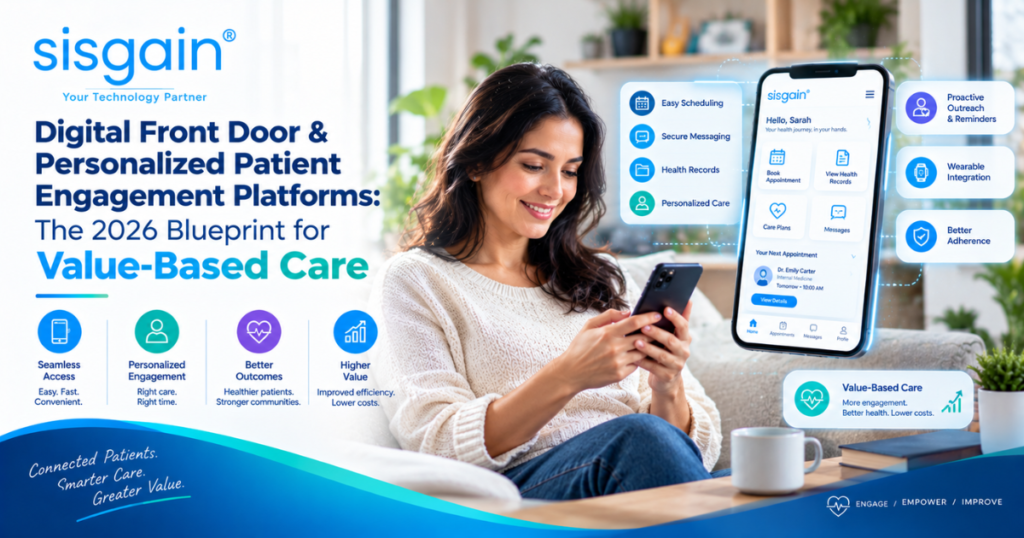
Healthcare’s front door used to be a phone tree and a static patient portal. In 2026, it’s an intelligent, always-on layer that knows who a patient is, what they need, and when they need it — before they even ask. This shift is no longer optional for health systems chasing value-based contracts, lower cost of care, and patients who expect the same seamless experience from their hospital that they get from their bank or airline.
This post walks through what a modern Digital Front Door & Personalized Patient Engagement Platform actually looks like in practice — the architecture, the AI, the risk models, and the build-vs-buy decisions health systems are wrestling with right now.
Why the Digital Front Door Is Now a Strategic Imperative
The numbers tell the story on their own. The U.S. Digital Front Door market $20.37B in 2025 → $48.74B by 2033 — more than doubling in under a decade. That kind of growth doesn’t happen because vendors are good at selling software; it happens because the underlying model of patient engagement has structurally changed, from episodic portal logins to continuous, context-aware interaction.
Health systems are consolidating scheduling, telehealth, remote monitoring, billing, and patient education into a single experience layer that follows the patient across channels instead of forcing them to hunt for the right app or phone number. See our patient engagement solutions for North America for how this consolidation plays out operationally.
The payoff isn’t abstract. Systems that get this right see higher patient satisfaction scores, meaningfully lower call-center volume, and — most importantly for CFOs — measurable gains in value-based care contracts, since proactive engagement closes care gaps before they show up as penalties. Read more in our breakdown of the best population health management platforms of 2026.
Anatomy of a Modern Digital Front Door
Strip away the marketing language and every credible digital front door platform is built from the same core components.
At the center are unified patient apps/portals with AI-driven care nudges, personalized care plans, omnichannel messaging (SMS/email/app). These aren’t glorified appointment reminders — they adapt tone, timing, and channel to the individual patient’s preferences, health literacy, and clinical urgency. Explore our patient engagement and digital front door solutions to see what this looks like when it’s built well.
Around that core sits the infrastructure that makes personalization trustworthy:
- Secure identity, single sign-on, and role-based access so patients, family caregivers, and care teams each see exactly what they should — no more, no less.
- Integrated telehealth, e-prescribing, and self-service workflows for refills, intake forms, and payments, so the “front door” actually replaces phone calls instead of just supplementing them.
The design principle underneath all of it is continuity: one conversation across every channel, where the system remembers history and intent regardless of whether the patient opened the app, replied to a text, or called in. Lose that continuity and you’re back to the fragmented experience patients already hate.
AI-Guided Patient Advice: From Chatbots to EHR-Aware Triage
The most visible proof that this category has matured is Atlantic Health launched PatientGPT (AI-guided patient advice) in Sept 2026, embedding an EHR-aware assistant directly into the MyChart experience so responses are personalized rather than generic. This wasn’t a symbolic chatbot bolted onto a portal — it was built to reason over a patient’s actual chart.
The mechanics are worth understanding because they define the bar every competitor now has to clear: a patient submits a natural language question, and a clinical algorithm cross-references their existing conditions, medications, and allergies before generating tailored guidance — escalating to a virtual or in-person visit when the situation calls for it rather than letting the conversation stall in a chatbot loop.
None of this works without guardrails, and the deployments getting attention in 2026 share the same three: clear disclaimers about what the AI is and isn’t, human-in-the-loop review for anything flagged as high-risk, and audit trails that satisfy both compliance teams and clinical governance committees. Get the guardrails wrong and the trust the platform was built to earn evaporates in a single bad interaction.
Predictive Risk Stratification: Finding High-Risk Patients Before They Crash
Engagement only matters if it’s aimed at the right patients at the right moment, which is where predictive risk stratification earns its place in the stack. Current models are hitting roughly 92% AUC for readmission prediction and around 88% accuracy for flagging emergent chronic patients, built on blended EHR, claims, and social determinants of health data. See the underlying population health management risk stratification research for the full methodology.
Layering remote monitoring data on top sharpens those signals considerably — abnormal vitals, medication non-adherence patterns, and drifting symptom trends all become triggers for timely outreach rather than being buried in a dashboard nobody checks until the next visit.
The operational upshot is that care teams stop spreading attention evenly across a population and start concentrating it where it actually changes outcomes — closing care gaps and preventing avoidable utilization instead of reacting after a patient has already ended up in the ED. Our population health platform guide covers how to operationalize this without overwhelming care managers with false-positive alerts.
Health Systems Deploying Unified Patient Apps for Scheduling, Telehealth, RPM Data
The organizations pulling ahead are the ones health systems deploying unified patient apps for scheduling, telehealth, RPM data as a single orchestration layer, rather than stitching together separate vendor logins for each function. Learn more about how this consolidation is structured on our unified patient app and RPM integration page.
The typical stack looks like this:
- A patient app or portal handling self-service scheduling, results delivery, and secure messaging
- A telehealth module covering video visits and e-prescribing
- RPM ingestion pulling in wearable and home-device data, paired with alerting logic and dynamic care plans
Systems that consolidate this way consistently report fewer no-shows, faster time-to-appointment, and higher adherence, simply because the friction of switching tools or remembering multiple logins disappears.
Personalized Chronic Care Nudges Based on EHR + RPM Data
Generic reminders — “don’t forget your appointment” — are on their way out. Personalized chronic care nudges based on EHR + RPM data are replacing them with context-aware, behaviorally informed prompts that reflect what’s actually happening with a specific patient. Our chronic care management and digital therapeutics page goes deeper on the clinical logic behind this.
A couple of concrete examples make this tangible:
- Hypertension: blood pressure trends combined with medication history drive tailored coaching, diet suggestions, and an automatic clinician follow-up if thresholds are breached.
- Diabetes: glucose patterns and recent lab results feed adaptive education content, foot-care check reminders, and appointment nudges timed to when adherence tends to slip.
None of this works if the platform can’t be smart about delivery — sending nudges via SMS, email, or in-app messaging depending on the patient’s stated preference and the clinical urgency of the message, with frequency capping built in so patients don’t tune everything out from message fatigue.
Predictive Outreach for High-Risk Patients Before ER Visits
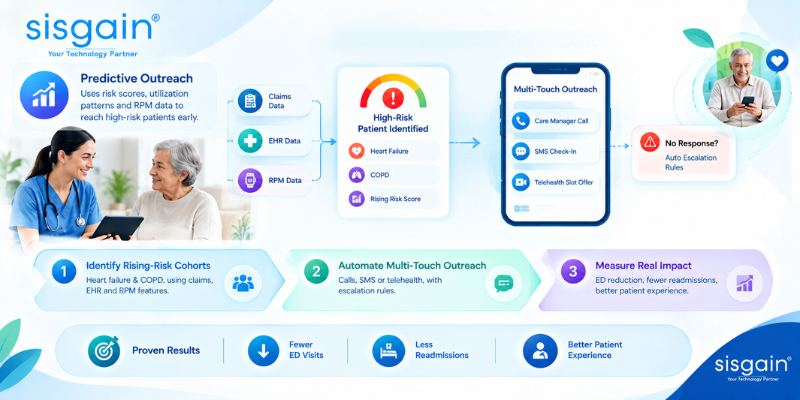
Risk scores are only useful if they trigger action, which is the entire premise behind predictive outreach for high-risk patients before ER visits. The approach combines risk scores, recent utilization patterns, and RPM anomalies into a single trigger for proactive contact — see our high-risk outreach and care management services for how this is typically structured.
A working playbook usually follows three steps:
- Identify rising-risk cohorts — heart failure and COPD populations are common starting points — using blended claims, EHR, and RPM features.
- Automate multi-touch outreach: a care manager call, an SMS check-in, or a telehealth slot offer, with clear escalation rules if the patient doesn’t respond.
- Measure impact directly against ED visit reduction, readmission avoidance, and patient-reported experience — not just outreach volume.
Programs that get the timing and personalization right are reporting double-digit reductions in avoidable ED use, which is the kind of number that gets a CFO’s attention as quickly as it gets a CMO’s.
Building Blocks: Data, Interoperability, and Governance
None of the above works without a solid data foundation underneath it. That means FHIR-based aggregation of EHR, claims, lab, pharmacy, and RPM data into a single, coherent patient profile — see our Epic MyChart integration guide for one common implementation path.
Interoperability extends that foundation outward: SMART on FHIR apps, HIE connections, and payer data feeds are what let a platform actually close care gaps and support value-based contracts instead of operating on an incomplete picture of the patient.
Governance is the part that’s easy to underinvest in and expensive to fix later. Consent management, data minimization, bias testing for any AI models in the loop, and clear clinical oversight for automated recommendations all need to be designed in from day one — not retrofitted after a compliance review flags a gap.
Technology Choices: Buy, Build, or Hybrid?
Every health system eventually faces the same decision, and there’s no universally right answer — only the right answer for a given organization’s scale, differentiation needs, and internal engineering capacity.
Buy makes sense when speed and ecosystem fit matter most — enterprise platforms like Epic MyChart, athenaOne, and Oracle Health cover a lot of ground quickly and plug into existing workflows with minimal friction.
Build becomes the better path when an organization needs genuine differentiation, has unusually complex workflows, or needs to aggregate across multiple disparate systems that off-the-shelf platforms weren’t built to unify — this is where custom unified patient apps/portals earn their cost.
Hybrid is increasingly the pragmatic middle ground: a core portal paired with best-of-breed modules for RPM, AI triage, or omnichannel messaging, all integrated via APIs and FHIR rather than forcing a single vendor to do everything adequately instead of a few things well.
Where Remote Patient Monitoring Software Fits In
If the digital front door is the experience layer, remote patient monitoring software is the sensing layer underneath it — the thing that turns passive data into active, timely care through continuous vitals, symptom checks, and adherence signals. Our RPM product and services page covers device and integration options in more detail.
The integration pattern that works best is straightforward in concept, harder in execution: device data flows into FHIR Observation resources, feeds a risk engine, and from there triggers both care team alerts and patient-facing nudges — all without a human manually reconciling data between systems. Billing-ready workflows for RPM and CCM, with properly documented time and clinical review, are what turn this from a clinical nice-to-have into a financially sustainable program.
When evaluating RPM vendors, the criteria that actually matter are device ecosystem breadth, EHR write-back capability, how configurable the alerting is, and the vendor’s HIPAA and security posture — not just the sleekness of the patient-facing app.
Partnering with the Right Healthcare Software Development Company
Few health systems build every layer of this stack in-house, which makes vendor selection one of the highest-stakes decisions in the whole initiative. When evaluating a healthcare software development company, look for a few specific things rather than a generic capabilities pitch — our company overview and capabilities page lays out what we consider table stakes.
Specifically:
- A proven portfolio in Custom EHR, EMR & PHR Software Development, with genuine FHIR and HL7 expertise, not just a checkbox mention of standards compliance
- Real experience building unified patient apps/portals and omnichannel engagement layers, ideally with reference deployments you can actually speak to
- Demonstrated RPM integration work, AI/ML pipeline experience, and familiarity with value-based care analytics
The delivery model matters as much as the technical checklist. Co-design with clinical stakeholders from the start, iterative pilots rather than a single big-bang launch, and outcome-based SLAs tend to separate partners who deliver from ones who just ship features.
Custom EHR, EMR & PHR Software Development for Engagement-First Care
Off-the-shelf EHR modules weren’t designed with patient engagement as a first-class concern — they were designed for documentation and billing. That’s why Custom EHR, EMR & PHR Software Development is increasingly framed around engagement outcomes rather than just clinical workflow. Our EHR/EMR/PHR services page covers this framing in more depth.
In practice, that means embedding care plans, task lists, and patient-reported outcomes directly into the clinician’s existing workflow instead of a separate system nobody checks. It means giving patients PHR access that surfaces actionable insight rather than a wall of scanned documents. And it means closed-loop referrals and care coordination that actually span specialties and community resources instead of dropping off after a single handoff.
None of this delivers value in isolation — it depends on write-back to hospital systems, payer APIs, and HIEs to maintain a genuinely 360-degree view of the patient, referenced in the Epic MyChart integration guide mentioned earlier.
Hospital Management Software Development Company for Modern Healthcare
The digital front door doesn’t stop at the ambulatory setting. A Hospital Management Software Development Company for Modern Healthcare extends the same engagement-first thinking into inpatient workflows, discharge planning, and post-acute follow-up — see our HMIS and hospital management solutions for the full scope.
The modules that matter here include bed management, pharmacy, lab, billing and revenue cycle management, and care transitions — all integrated with the same digital front door patients already use for outpatient care, rather than a separate inpatient-only system with its own login and its own gaps.
Done well, this shows up in shorter length of stay, smoother discharges, and fewer readmissions, driven by coordinated follow-up and RPM enrollment that begins before the patient even leaves the building.
Implementation Playbook: From Pilot to System-Wide Scale
Getting from concept to a system-wide deployment tends to follow a consistent sequence, regardless of which vendor or build path an organization chooses.
Step 1 — Define scope. Identify target populations (chronic disease, post-acute, high-risk cohorts) and the specific success metrics that will define whether the program worked — ED visits, readmissions, and engagement rates are the usual starting set.
Step 2 — Build the data spine. Stand up FHIR-based data aggregation and RPM ingestion, along with the engagement orchestration layer across SMS, email, and app channels, before layering AI or predictive models on top.
Step 3 — Pilot with discipline. Run a controlled pilot with A/B tested nudges and clearly defined escalation rules, then iterate on content, timing, and channel mix based on what the data actually shows rather than assumptions carried over from the planning phase.
Step 4 — Scale with governance. Expand system-wide only once clinical oversight, model monitoring, and continuous improvement loops are in place — scaling before governance is mature is how these programs end up in a compliance review instead of a case study.
Measuring What Matters: KPIs for Digital Front Door Success
A digital front door program without clear KPIs is just an app with good intentions. The metrics worth tracking fall into four buckets:
- Access: time-to-appointment, no-show rate, and portal activation rate
- Outcomes: readmissions, ED visits, care gap closure, and HEDIS/Star ratings performance
- Experience: CSAT/NPS scores, message response times, and the rate of issues resolved without a live agent
- Financial: total cost of care, RPM/CCM reimbursement capture, and denial reduction
Tracking all four matters — a platform that improves patient satisfaction but does nothing for readmissions, or one that cuts costs but tanks the patient experience, isn’t actually succeeding by the standard value-based care demands.
The Road Ahead: Proactive, Personalized, and Interoperable Engagement
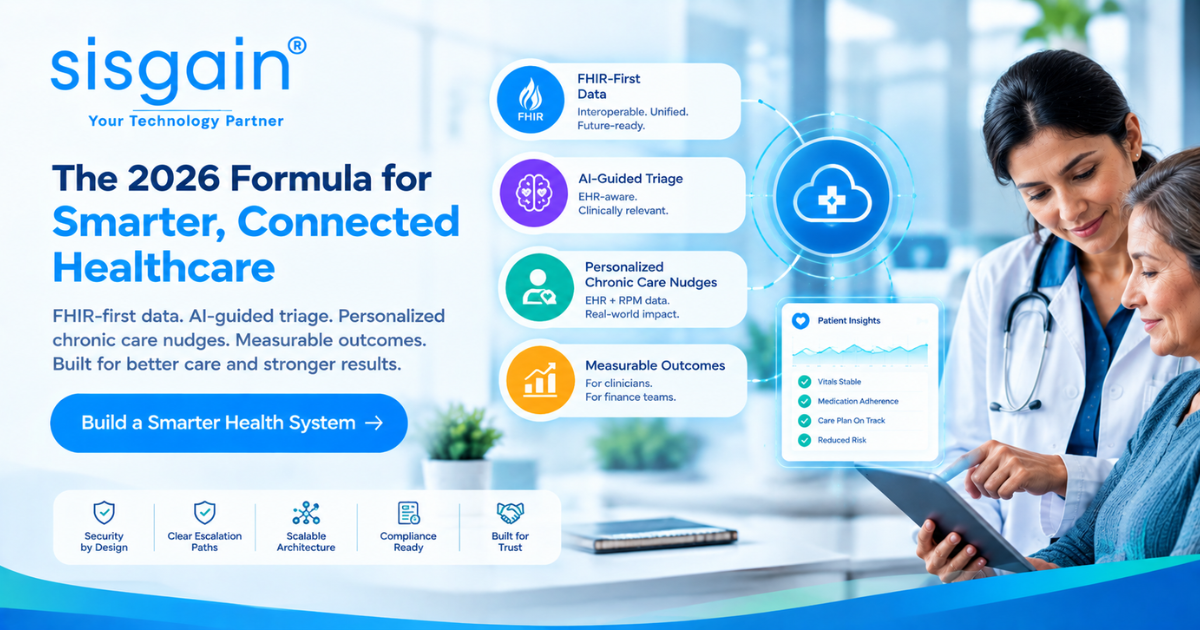
The health systems pulling ahead in 2026 share a formula rather than a single vendor or feature: FHIR-first data as the foundation, AI-guided triage that’s actually EHR-aware rather than generic, and personalized chronic care nudges based on EHR + RPM data tied to metrics that matter to both clinicians and finance teams.
What separates the leaders from everyone else isn’t a flashier chatbot — it’s security-by-design, clear and well-tested escalation paths for every AI-driven interaction, and an architecture that can scale elastically without fracturing compliance or eroding the patient trust the entire program depends on. That’s the real blueprint, and it’s a lot less about any single piece of technology than it is about building all of these pieces to work together, deliberately, from the start.