Introduction
Noise is present in factories, construction sites, offices, workshops, roads, generators, HVAC systems, vehicles, and many other environments. While some sound is normal, excessive noise can affect comfort, communication, equipment monitoring, and workplace conditions.
A dB test is used to measure sound intensity in decibels, commonly written as dB. The test helps users understand how loud an environment, machine, or piece of equipment is at a particular time.
A sound level meter is commonly used to perform a dB test. It converts sound pressure into a numerical reading so technicians, engineers, safety teams, and maintenance professionals can evaluate noise levels more accurately.
What Is a dB Test?
A dB test is the process of measuring sound or noise level in decibels. Decibels provide a standardized way of expressing sound intensity.
Instead of depending on human hearing alone, a dB test provides a measurable value that can be recorded, compared, and monitored.
A dB test can be useful for:
- Industrial machinery
- Generators and DG sets
- HVAC systems
- Automotive testing
- Construction equipment
- Manufacturing areas
- Commercial spaces
- Environmental noise surveys
- Equipment maintenance
Using a proper measuring instrument helps improve consistency compared with estimating sound levels by ear.
What Is a Sound Level Meter?
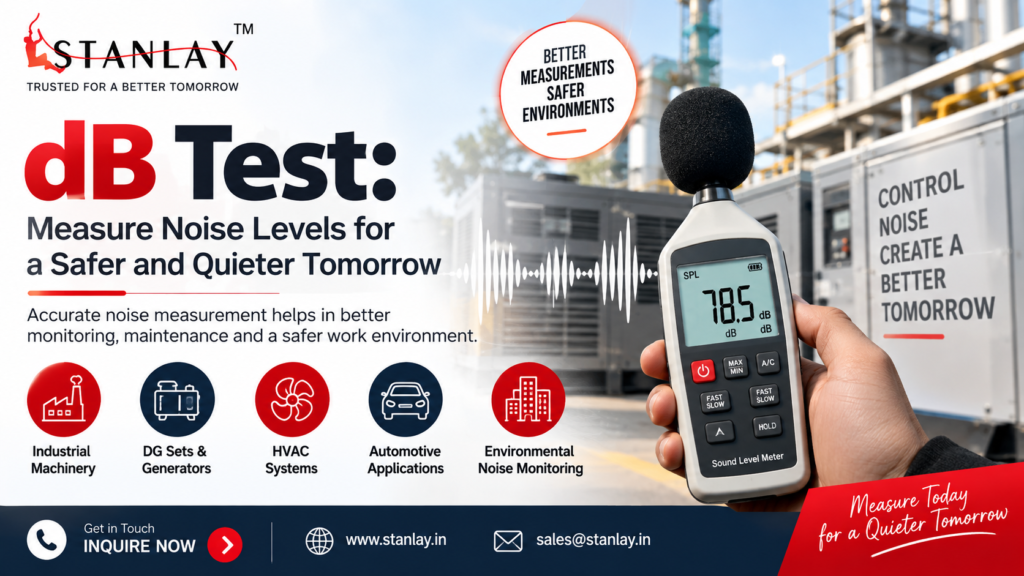
A sound level meter is an electronic instrument designed to measure sound pressure levels. It usually includes a microphone, signal processing system, display, and controls for selecting measurement settings.
The microphone detects sound waves and converts them into electrical signals. The instrument then processes these signals and displays the result in decibels.
A sound level meter may also be called:
- dB meter
- Decibel meter
- Noise level meter
- Sound meter
- Noise testing meter
For professional applications, the correct instrument should be selected according to the required measurement range and testing environment.
Why Is a dB Test Important?
A dB test helps professionals understand whether noise levels are normal, increasing, or unusually high.
It can support several practical activities.
Equipment Condition Monitoring
Unusual noise from machinery may indicate vibration, loose parts, bearing wear, alignment problems, or other mechanical issues. Regular dB testing can help maintenance teams notice changes in sound levels.
Workplace Noise Assessment
Factories, workshops, construction sites, and industrial areas can have multiple noise sources. A dB test helps measure actual noise levels instead of relying on estimates.
Product Testing
Manufacturers may need to evaluate the sound produced by motors, fans, pumps, vehicles, electrical equipment, or appliances.
Environmental Monitoring
Noise measurement can also be used around roads, construction areas, commercial properties, industrial facilities, and public spaces.
How to Perform a dB Test
Performing a dB test is relatively straightforward, but correct measurement practices are important.
1. Select the Right Sound Level Meter
Choose a meter that offers the measurement range needed for your application. Industrial machinery may require a different range from quiet indoor spaces.
2. Check the Instrument
Before testing, inspect the meter and microphone for visible damage. Ensure that the battery is sufficiently charged and the display is functioning correctly.
3. Select the Measurement Settings
Set the meter according to the type of noise being tested. Depending on the instrument, settings may include frequency weighting and response speed.
4. Position the Meter Correctly
Hold or mount the sound level meter at the required measurement location. Avoid covering the microphone or placing the meter too close to surfaces that may reflect sound.
5. Take the Reading
Allow the reading to stabilize before recording the value. For changing noise conditions, take several measurements rather than depending on one reading.
6. Record the Results
Note the dB value along with important information such as:
- Location
- Time
- Equipment being tested
- Distance from noise source
- Operating condition
- Measurement settings
This makes future comparisons more useful.
Factors That Can Affect a dB Test
Several conditions may influence sound measurements.
Distance from the Sound Source
Noise level generally changes as the distance between the meter and the source changes. For comparison testing, keep the measurement distance consistent.
Background Noise
Nearby machinery, vehicles, conversations, alarms, or other equipment can affect readings. When possible, identify and control unrelated noise sources.
Reflections
Walls, metal surfaces, buildings, and enclosed spaces can reflect sound. This may influence the measured value.
Wind
Outdoor air movement can create noise around the microphone. Appropriate measurement techniques may be required for outdoor testing.
Equipment Operating Condition
Machinery noise can vary depending on load, speed, temperature, and operating mode. Compare readings under similar conditions.
dB Test for Industrial Machinery
Industrial equipment can produce different sound levels depending on its design and condition.
A dB test may be performed on:
- Motors
- Pumps
- Compressors
- Generators
- Fans
- Production machines
- Power equipment
- HVAC units
Regular sound measurement can help maintenance teams establish baseline readings. If the measured level changes significantly over time, further inspection may be useful.
A dB test should not be treated as the only diagnostic method, but it can provide valuable supporting information during preventive maintenance.
dB Test for DG Sets and Generators
Generators and DG sets can produce significant operating noise. A dB meter can help measure noise at different distances and operating loads.
Measurements may be taken:
- Near the generator
- Outside the enclosure
- At the site boundary
- At nearby work areas
Keeping measurement conditions consistent makes it easier to compare readings over time.
dB Test for HVAC and Air-Conditioning Systems
Air-conditioning and ventilation systems contain fans, motors, compressors, ducts, and moving air. These components can produce noise during normal operation.
A dB test can help measure sound from:
- Indoor AC units
- Outdoor condenser units
- Ventilation fans
- AHUs
- Exhaust systems
- Cooling equipment
If noise levels change compared with earlier readings, maintenance teams can investigate the source.
dB Test for Automotive Applications
Automotive testing can also involve noise measurement. A sound level meter may be used to measure noise from engines, exhaust systems, vehicle cabins, mechanical components, and other systems.
For meaningful comparisons, tests should be carried out under consistent conditions such as similar engine speed, location, and meter distance.
Choosing the Right dB Meter
When selecting a meter for a dB test, consider:
- Measurement range
- Accuracy
- Display readability
- Frequency weighting options
- Fast/slow response settings
- Data hold function
- Portability
- Battery life
- Build quality
- Suitability for field use
The right meter depends on whether the application is general maintenance, industrial testing, environmental monitoring, automotive testing, or another use case.
Common Mistakes During a dB Test
Avoid these common errors:
- Measuring at different distances each time
- Covering the microphone
- Ignoring background noise
- Taking only one reading
- Comparing readings taken under different machine loads
- Using an unsuitable measurement range
- Failing to record test conditions
- Measuring too close to reflective surfaces
Consistent testing procedures improve the usefulness of recorded results.
Using a Sound Level Meter for dB Testing
Stanlay provides electrical test and measurement equipment for professional field and industrial applications. A suitable sound level meter can help technicians and engineers perform dB testing for machinery, noise pollution, DG sets, air-conditioning systems, automotive applications, and general sound-level measurement.
When selecting a sound level meter, users should consider the required dB range, testing environment, accuracy needs, and operating conditions.
Conclusion
A dB test provides a simple and practical way to measure sound and noise levels. It can support industrial maintenance, equipment testing, workplace assessments, HVAC checks, generator testing, automotive applications, and environmental monitoring.
Using a sound level meter allows professionals to replace subjective noise judgments with measurable data. Accurate results depend on proper instrument selection, consistent measurement distance, suitable test settings, and careful recording of conditions.
Regular dB testing can also help identify changes in equipment noise and support better maintenance and monitoring decisions.
FAQs
What is a dB test?
A dB test measures the level of sound or noise in decibels using a sound level meter.
Which instrument is used for a dB test?
A sound level meter, also known as a dB meter or decibel meter, is commonly used.
What does dB mean?
dB stands for decibel, a unit used to express sound level.
Where is a dB test used?
It is used in industrial machinery, generators, HVAC systems, automotive testing, workplaces, construction sites, and environmental noise monitoring.
Can a dB meter measure machinery noise?
Yes. A suitable sound level meter can measure machinery noise and help compare sound levels under different operating conditions.
Why should multiple dB readings be taken?
Multiple readings help account for changes in sound over time and provide a more useful understanding of the noise level.