Why Are SOC Alerts Alone Not Enough for Enterprise Security?
SOC alerts tell you that something suspicious happened. They do not tell you how much it matters, whether it touches your most important systems, or what to fix first. For a growing enterprise, that gap is where real risk lives.
Threats are multiplying across cloud platforms, remote endpoints, and third-party connections. A Security Operations Center can process thousands of signals a day, but a signal is not the same as a risk decision. IT leaders need to know which exposures could hurt the business, which ones can wait, and whether the controls they paid for are actually working. Monitoring is necessary. On its own, it is not enough.
What Are the Limits of Traditional SOC Alerts?
Traditional alert-based monitoring has three well-known weak points.
What Is Alert Fatigue, and Why Does It Matter?
When analysts receive a flood of notifications, many of them low-value or duplicated, important signals get lost. Teams start to triage by habit instead of by impact. A critical alert on a payroll server can sit in the same queue as a routine failed login from a test device.
Why Does Missing Business Context Create Problems?
An alert usually describes a technical event: a process ran, a port opened, a login failed. It rarely says whether the affected asset holds customer data, supports revenue operations, or sits under a regulatory obligation. Without that context, prioritization becomes guesswork.
Why Is Reactive Security a Risk in Itself?
Alert-driven operations respond after something has already happened. That is useful for containment, but it does little to reduce the chance of the next incident. Mature programs also look upstream, at the weaknesses that make attacks possible in the first place.
For organizations looking for help with this shift, many teams evaluate managed SOC services Dubai or managed SOC Dubai providers that combine monitoring with risk-focused reporting, rather than treating the SOC as an isolated alert desk.
Which Enterprise Security Risks Should IT Leaders Not Ignore?
Four categories come up repeatedly in enterprise environments, and each one tends to be under-measured by alert counts alone.
How Do Unpatched Vulnerabilities and Misconfigurations Create Exposure?
Known vulnerabilities remain one of the most common paths into corporate networks. Misconfigured firewalls, exposed storage buckets, and default credentials create openings that no alert will flag until someone exploits them. The question for leaders is not just “how many vulnerabilities do we have?” but “which of them are reachable from the internet and attached to critical systems?”
Why Are Identity-Based Threats and Excessive Privileges Dangerous?
Attackers increasingly log in rather than break in. Compromised credentials, stale accounts, and users with more access than their roles require can let an intruder move quietly through the environment. Identity deserves its own risk category, not just a line in the SOC dashboard.
What Gaps Appear in Cloud and Hybrid Infrastructure?
Hybrid environments create blind spots. Workloads spin up and disappear, permissions drift, and responsibilities are split between internal teams and cloud providers. Security teams that cannot see the full estate cannot protect it consistently.
How Do Third-Party and Supply Chain Risks Affect the Enterprise?
Your security posture now includes your vendors, their vendors, and every software component you depend on. A breach at a supplier with network access can become your incident. Leaders need to assess these relationships before a problem appears, not after.
For teams building out this kind of coverage, cybersecurity services Dubai offerings that include third-party risk review and vulnerability assessment can close several of these gaps at once.
ALSI READ – Why Managed SOC, IT Risk, and Zero Trust Work Better as One Program
Why Should IT Leaders Adopt a Risk-Based Approach?

A risk-based approach asks a simple question for every finding: how likely is this to be exploited, and how bad would it be if it were?
How Do You Prioritize Risks by Business Impact?
Start by ranking assets according to what they do for the business. A customer-facing payment system and a test server in a lab do not deserve the same urgency. Combine asset criticality with exploitability and exposure, and the priority list starts to reflect reality.
Why Does Threat Intelligence Need Asset Visibility?
Threat intelligence tells you which vulnerabilities attackers are actively using. Asset visibility tells you whether you have those vulnerabilities. You need both. A headline-grabbing exploit means little if the affected software is not in your environment, and a quiet vulnerability matters a great deal if it sits on an internet-facing server.
How Do You Move From Detection to Prevention?
Detection finds problems. Prevention reduces the number of problems that can be found. This means tightening configurations, removing unnecessary access, applying patches on a defined schedule, and testing controls regularly. Detection stays important, but prevention lowers the volume of incidents the SOC has to handle.
Organizations that want structured guidance here often begin with a formal IT risk assessment Dubai or work with providers offering IT risk management services, which translate technical findings into decisions leadership can act on.
Which Capabilities Go Beyond SOC Alerts?
Moving past alerts does not mean replacing the SOC. It means adding the capabilities that give the SOC direction.
What Does Continuous Monitoring Look Like?
Good monitoring gives you a single view across endpoints, networks, identities, and cloud services. It also means monitoring is continuous, not limited to business hours or periodic scans. Managed SOC capabilities support this by keeping coverage consistent and by feeding findings into a broader risk picture.
How Does Vulnerability and Exposure Management Help?
Exposure management goes beyond running scans. It identifies assets, assesses weaknesses, and ranks them by how reachable and valuable the target is. The output should be a remediation list that teams can actually work through.
Why Is Correlation Important for Risk Prioritization?
A single suspicious login might be nothing. The same login followed by an unusual data transfer from a privileged account is a different story. Correlating signals across tools reveals patterns that individual alerts hide, and it helps teams focus on the events with the highest potential impact.
Can Automation Speed Up Response?
Yes, when it is applied carefully. Automated playbooks can isolate a compromised endpoint, disable a suspicious account, or open a ticket with the right owner within seconds. Automation should handle repetitive steps so analysts can spend their time on judgment calls. Each automated action still needs clear approval rules and regular review.
What Does Threat Hunting Add?
Threat hunting looks for attackers who have not triggered an alert. Hunters search for unusual behavior, map possible attack paths, and test assumptions about how an intruder could move from a foothold to a crown-jewel system. This work is slower than alert triage, but it finds the threats that matter most.
For organizations building this layer, cybersecurity solutions Dubai providers that combine monitoring, hunting, and remediation workflows can simplify vendor management.
READ MORE – Cybersecurity, IT Risk, and Zero Trust in 2026: A Cost and Roadmap Guide for Dubai and UAE Businesses
How Can Zero Trust Strengthen Enterprise Security?
Zero Trust starts from a simple principle: never assume a request is safe just because it comes from inside the network. Every user, device, and access request should be verified.
What Are Identity-Centric Access Controls?
Identity becomes the main control point. Strong authentication, multi-factor verification, and device health checks determine who can reach which resources. This reduces the value of a stolen password, because it is no longer enough on its own.
Why Does Least-Privilege Access Matter?
Users, applications, and service accounts should receive only the access they need for their current role. Regular access reviews remove permissions that have accumulated over time. This limits how far an attacker can travel after gaining a foothold.
How Do You Keep Verifying Access Over Time?
Verification should not stop at login. Session behavior, location changes, device posture, and unusual data requests can all trigger step-up checks or access revocation. Continuous verification turns access from a one-time decision into an ongoing one.
How Should Zero Trust Connect to Monitoring?
Zero Trust generates useful telemetry: authentication logs, policy decisions, and access anomalies. Feeding that data into the SOC gives analysts better context and helps them distinguish a legitimate user working late from a compromised account. The two approaches reinforce each other.
Teams exploring this approach often look at zero trust security solutions and zero trust Dubai providers that can handle both the architecture and the operational side.
How Can IT Leaders Build a Proactive Security Strategy?
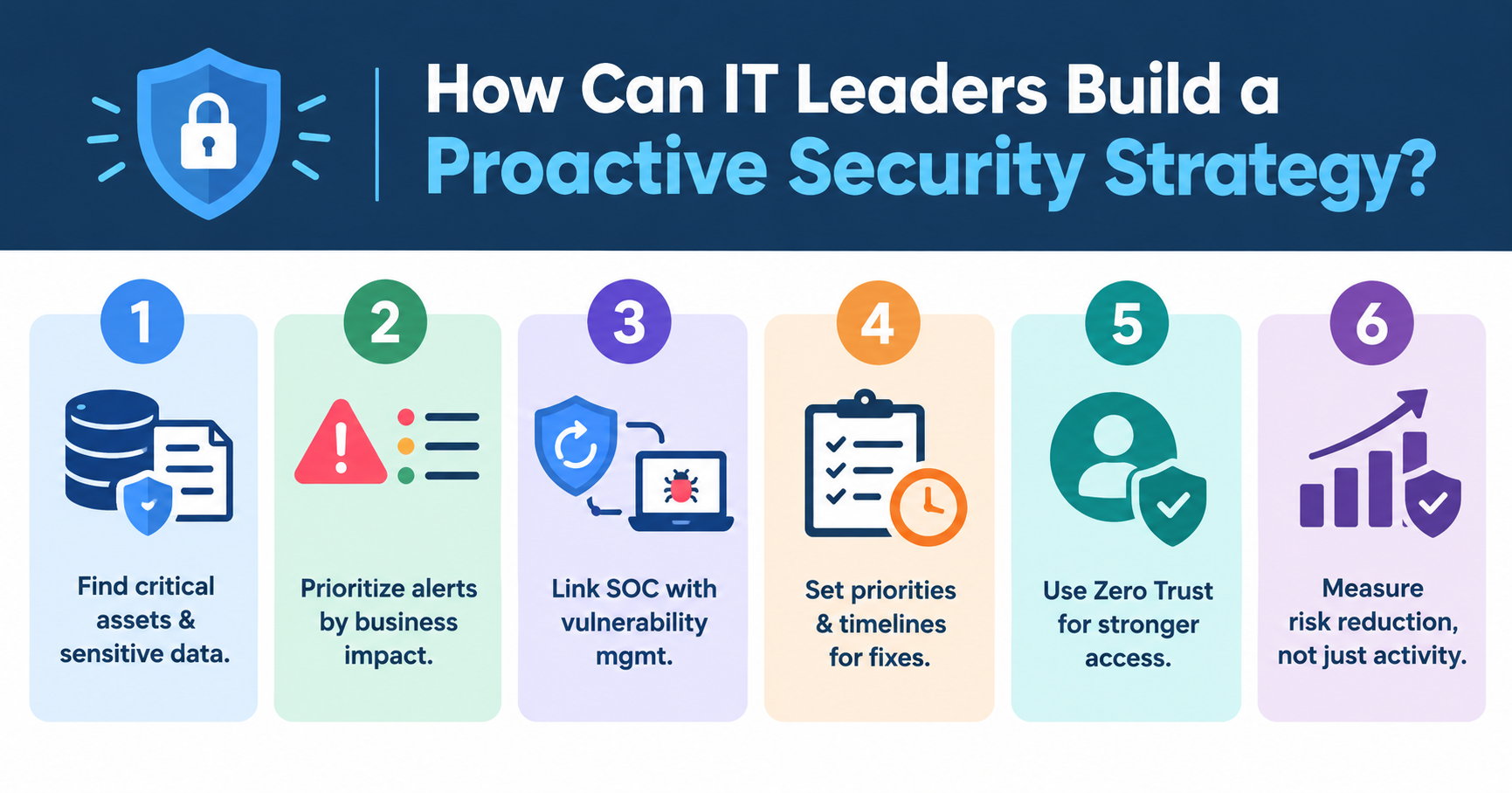
A practical strategy usually follows six steps:
- Identify critical business assets and the sensitive data they hold.
- Prioritize alerts and findings based on business impact and asset criticality.
- Connect SOC monitoring with vulnerability and exposure management.
- Set remediation priorities and realistic timelines for each risk tier.
- Strengthen access controls using Zero Trust principles.
- Measure performance with metrics that reflect risk reduction, not just activity.
Each step builds on the last. Without an asset inventory, prioritization is guesswork. Without remediation deadlines, findings pile up. Without metrics, leadership cannot tell whether the program is improving.
Which Security Metrics Matter More Than Alert Volume?
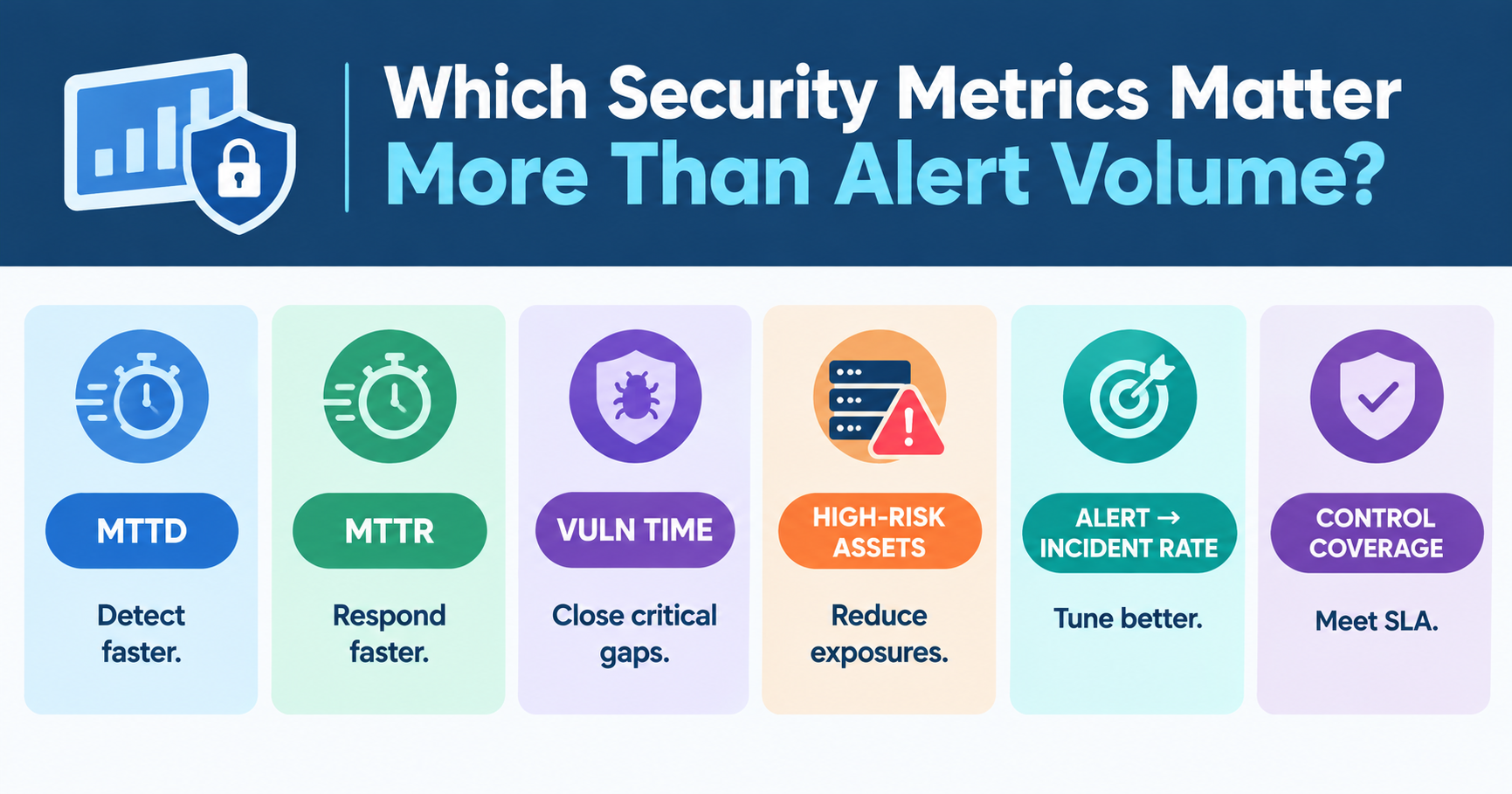
Alert counts measure activity. Leaders need metrics that measure outcomes. Useful ones include:
- Mean Time to Detect (MTTD): how quickly a real threat is identified.
- Mean Time to Respond (MTTR): how quickly the team contains and resolves it.
- Critical vulnerability remediation time: how long high-severity issues stay open.
- High-risk assets with unresolved exposures: how many important systems still carry known weaknesses.
- Alert-to-incident conversion rate: how often alerts turn out to be real incidents, which indicates tuning quality.
- Control coverage and remediation SLA compliance: how much of the environment is protected and how often deadlines are met.
Track these over time and report them in business terms. A trend line showing faster remediation on critical assets says more to a board than a count of processed alerts.
What Makes Moving Beyond Alerts Difficult?
Most organizations face the same obstacles.
Tool sprawl and data silos. Identity, endpoint, cloud, and network tools often store data separately. Analysts end up stitching together context by hand.
Limited team capacity and skills. Security talent is scarce, and many teams are stretched thin. Advanced work like threat hunting and exposure analysis competes with daily operations.
Unclear risk ownership. When nobody owns a specific risk, it stays open. Each risk needs a named business owner and a technical owner.
Hard-to-measure outcomes. If success is defined only as “no incidents,” it is impossible to prove value. Defining measurable outcomes at the start solves this.
What Role Do Integrated Security Solutions Play?
Integrated solutions connect visibility, assessment, and response. The goal is a workflow where a finding in one area automatically informs priorities in another.
When evaluating options, leaders should look at four things: how well the solution scales as the environment grows, how easily it integrates with existing tools, how clearly it reports risk to non-technical stakeholders, and whether it combines proactive controls with continuous monitoring rather than treating them as separate projects.
Conclusion
SOC alerts remain essential. They are how threats get detected. But detection is only one part of managing enterprise risk. IT leaders also need business context, prioritization, remediation discipline, and clear metrics.
A proactive approach brings these pieces together. It treats alerts as one input among many, connects them to what the business cares about, and measures whether risk is actually going down. That shift turns the SOC from a stream of notifications into a source of decisions.
Frequently Asked Questions
What are SOC alerts, and why do they matter?
SOC alerts are notifications generated when monitoring tools detect activity that may indicate a security issue. They matter because they are often the first sign of an attack, but they need context before teams can act on them effectively.
Why are SOC alerts alone insufficient for enterprise security?
Alerts describe technical events without explaining business impact, exposure, or priority. They also tend to be reactive, so they do little to reduce the number of weaknesses attackers can exploit.
How can IT leaders prioritize security risks effectively?
Rank risks by a combination of asset criticality, likelihood of exploitation, and potential business impact. Assign owners and deadlines to each priority tier so the list leads to action.
What is the difference between threat detection and risk management?
Threat detection identifies suspicious or malicious activity as it happens. Risk management looks at the broader picture: which weaknesses exist, how likely they are to be exploited, what they would cost, and what the organization is doing to reduce them.
How does vulnerability management complement SOC monitoring?
Vulnerability management identifies weaknesses before attackers use them. SOC monitoring spots active threats. Together, they reduce both the number of openings and the time it takes to respond when something gets through.
How can Zero Trust improve enterprise security?
Zero Trust verifies every user, device, and access request instead of trusting anything inside the network by default. This limits how far an attacker can move after gaining access and gives the SOC richer data for spotting unusual behavior.