Automotive Water Valve positioning in the engine bay requires strategic placement near primary coolant hoses. Installing it in accessible areas simplifies maintenance procedures and shortens line routing to the heater core. Proper orientation prevents air pockets from forming inside the valve chamber during system refills. Good spatial design ensures both maximum operational efficiency and hassle-free serviceability.
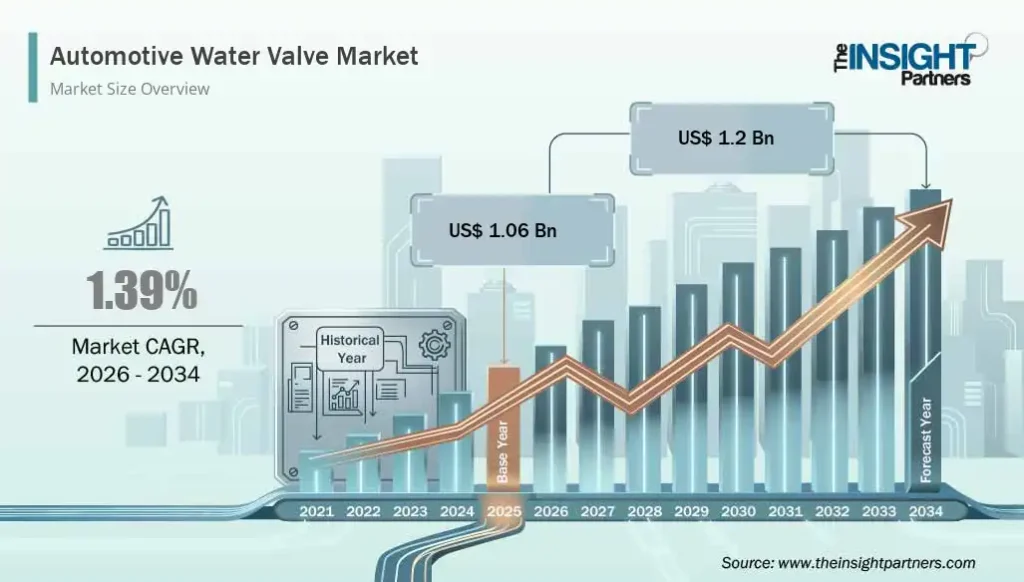
The global Automotive Water Valve Market is entering a critical phase of transformation, underscored by rapid advancements in vehicle cooling systems, electric vehicle (EV) thermal management, and strict emissions regulations. According to the latest comprehensive market intelligence report, the global Automotive Water Valve Market was valued at US$ 1.06 billion in 2025 and is projected to reach US$ 1.2 billion by 2034, recording a compound annual growth rate (CAGR) of 1.39% during the forecast period from 2026 to 2034.
Automotive water valves play a pivotal role in regulating coolant circulation across engines, electric drivetrains, battery modules, and power electronics. As automotive manufacturers transition toward hybrid and fully electric propulsion systems, the demand for high-precision multi-way electronic water valves and solenoid-actuated flow controls has intensified. Modern vehicle architectures require sophisticated liquid cooling loops to maintain optimal operating temperatures for high-voltage batteries and inverter units, making water valves central to vehicle efficiency, safety, and operational longevity.
Key Market Drivers & Growth Factors
-
Surge in Electric and Hybrid Vehicle Production: Unlike traditional internal combustion engine (ICE) vehicles that rely primarily on basic mechanical thermostats, modern hybrid and electric vehicles utilize multiple electronic water valves (such as 3-way, 4-way, and multi-channel valves). These valves dynamically switch cooling routes between the battery pack, cabin heating, electric motor, and inverter circuits.
-
Integration of Smart Thermal Management Systems: Automakers are increasingly integrating intelligent automotive water valves equipped with embedded microcontrollers and LIN/CAN bus interfaces. These smart valves adjust fluid flow precisely based on real-time sensor feedback, reducing parasitic power losses and enhancing overall vehicle energy efficiency.
-
Stringent Environmental Standards and Fleet Efficiency: Regulatory mandates globally continue to push OEMs toward lowering carbon emissions and maximizing energy utilization. Enhanced thermal management facilitated by advanced coolant control valves helps reduce warm-up times, lower aerodynamic drag via optimized radiator usage, and extend electric driving ranges.
Get a PDF Sample- https://www.theinsightpartners.com/sample/TIPRE00021980
Competitive Landscape and Key Players
The global market is characterized by a mix of established automotive Tier-1 suppliers and specialized valve manufacturers focusing on innovation, lightweight materials, and modular thermal architectures. Key industry players driving innovation and holding prominent positions in the market include:
-
Johnson Electric Holdings Limited
-
MAHLE GmbH
-
Rotex Automation
-
VOSS Automotive GmbH
-
Jaksa Solenoid Valves
-
Bitron Industrie S.p.A
-
Hanon Systems
-
BorgWarner Inc.
-
Woco Industrietechnik GmbH
-
Vernet
These industry leaders are actively investing in strategic partnerships, product customization, and next-generation solenoid and actuator designs to meet the evolving demands of global OEMs.
Future Outlook (2026–2034)
Looking ahead, the Automotive Water Valve market is poised for key architectural shifts over the next decade:
-
Shift Toward Multi-Way and Integrated Valve Modules: The industry is moving rapidly from standalone single-function valves to compact, highly integrated thermal control modules. Combining coolant pumps, expansion valves, and multi-port water valves into unified manifolds reduces tubing complexity, lowers assembly weight, and optimizes vehicle under-hood space.
-
Expansion of High-Voltage 800V EV Architectures: As the automotive sector shifts toward 800V fast-charging architectures, battery heat dissipation during rapid charging cycles becomes crucial. High-flow, fast-responding electronic water valves capable of withstanding higher thermal loads and pressures will see increased adoption.
-
Material Innovations for Weight Reduction: To support lightweighting initiatives, manufacturers are replacing traditional metal housing materials with high-performance engineering thermoplastics and composite materials. These lightweight polymers offer exceptional chemical resistance to modern coolant additives while significantly cutting vehicle kerb weight.
-
Growing Focus on Commercial Vehicle Electrification: While passenger cars account for a large portion of market volume, medium- and heavy-duty commercial EVs (including buses and delivery trucks) present a major long-term growth frontier for heavy-duty, high-durability coolant control valves.
About The Insight Partners
The Insight Partners is a leading market research and consulting firm delivering actionable insights through in-depth industry analysis and strategic intelligence. The firm supports clients across various industries in making informed business decisions by providing comprehensive market forecasts, competitive assessments, and growth opportunities.
Contact Us:
If you have any queries about this report or if you would like further information, please contact us:
Contact Person: Ankit Mathur
E-mail: sales@theinsightpartners.com
Phone: +1-646-491-9876
Also Available in : Korean| German| Japanese| French| Chinese| Italian| Spanish