MARKET OVERVIEW
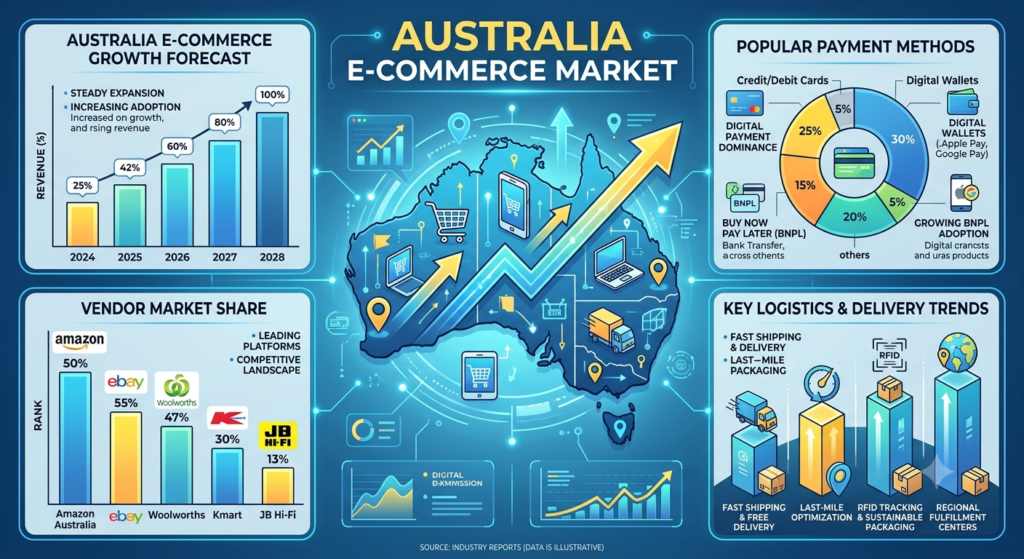
The Australia e-commerce market size was valued at USD 604.1 Billion in 2025. Looking forward, the market is expected to reach USD 1,683.9 Billion by 2034, exhibiting a compound annual growth rate (CAGR) of 12.07% from 2026-2034. Growing reliance on smartphones for shopping, the integration of artificial intelligence (AI) for personalized recommendations, fast digital payments, rapid growth of online marketplaces, and heavy investment in fulfilment and delivery are shaping the Australia e-commerce market share and outlook through 2034. Australians are shopping online more often and in more categories, although smaller baskets show that shoppers are watching every dollar, which is increasing the importance of value, speed, and convenience.
MARKET SUMMARY
- Online retail keeps growing at double digits. Australia Post’s annual eCommerce Report found online shopping reached a record $82.6 billion in 2025, up 13.9% year on year. That was around 24% of all retail, with 9.8 million households, or 82% of Australian homes, shopping online.
- Momentum continued into 2026. Australians spent $25 billion online in the September quarter of 2026, up 17% from a year earlier, while the average basket fell 6.8% to $90.
- Marketplaces are the biggest category. Australians spent $19 billion on platforms such as Amazon and Temu in 2025, accounting for 23% of total online spend. Marketplaces grew 17% and account for 42% of all online transactions.
- Global platforms are gaining share. Amazon, Temu, and Shein are forecast to control 36% of e-commerce revenue nationally in 2026.
- Online grocery is scaling. Coles’ supermarket e-commerce sales rose 26.4% in its 2026 full-year results, and its two Ocado fulfilment centers turned EBITDA positive in their second year.
- The market is segmented by type, transaction, and region, with forecasts for 2026-2034.
MARKET GROWTH DRIVERS
Smartphones, Digital Payments, AI, and Social Commerce
Mobile shopping lets people buy anytime and anywhere, and IMARC notes that mobile apps and mobile-optimized sites are simplifying online purchases. New digital wallets allow contactless and instant payments for online purchases, and IMARC’s data show the Australia digital payment market reached USD 118.0 Billion in 2024. AI is changing the shopping journey by recommending products from browsing history, powering chatbots that cut wait times, and supporting augmented reality tools that let customers “try” clothing, accessories, and furniture before buying. Social media adds discovery and conversion, as businesses use Instagram, Facebook, and TikTok to build awareness and sell directly through shopping features. AI is becoming a channel in its own right: the Australia Post eCommerce Report 2026 covers agentic AI, and its action plan urges retailers to get ready for agentic commerce. Content-led shopping is also moving up the agenda for brands.
Logistics, Fulfilment, and Delivery Speed
Australian consumers expect fast, reliable, and transparent delivery, and retailers are investing to meet it. IMARC notes that same-day and next-day delivery, metro fulfilment hubs, and micro-warehousing are becoming common, and that click-and-collect has grown in importance for major retailers. Speed pays off: retailers offering same-day or next-day delivery outperformed peers by 3.5% to 4% over Black Friday and Cyber Monday. Grocers lead the automation push. Coles’ online sales reached A$2.8 billion in the first half of 2026, up 27%, and Woolworths’ online sales grew 15.3% to exceed A$5 billion. Woolworths now operates seven Customer Fulfilment Centres across the country. Infrastructure spending is rising as well: Australia Post is developing a USD 134 million Brisbane parcel hub able to sort 250,000 parcels a day, and Amazon’s USD 502.5 million Logan megacenter expands high-throughput capacity. Parcel lockers are also gaining traction, with around 80% year-on-year growth in locker deliveries among existing and returning customers.
Marketplaces, Cross-Border Shopping, and Value-Seeking Behavior
Marketplaces give shoppers wide choice at competitive prices and give sellers built-in audiences, logistics, and payments. IMARC highlights that Australian consumers frequently shop on international sites such as Amazon US, AliExpress, ASOS, and Shein for selection, price, and brands not available locally, and that some sellers include prepaid duties and taxes to simplify checkout. The shift is large: Roy Morgan estimates Amazon generated $7.1 billion in Australian retail sales in 2025, and Amazon, Temu, and Shein together generated close to $12 billion. Cost-of-living pressure is shaping behavior, as 59% of shoppers say they never buy at full price anymore, and 44% look forward to Black Friday and Cyber Monday. Subscription models add recurring revenue in groceries, personal care, supplements, and pet supplies, with brands such as HelloFresh and PetCircle building loyalty through flexible delivery. These trends favor retailers that combine clear value, fast delivery, and strong loyalty programs.
Request a Sample Report for In-Depth Market Insights: https://www.imarcgroup.com/australia-e-commerce-market/requestsample
PORTER’S FIVE FORCES ANALYSIS
Competitive Rivalry: High
- Amazon, Temu, Shein, eBay, large domestic retailers, supermarkets, and thousands of small online sellers compete on price, range, and delivery speed.
- Global platforms are raising expectations, and more than one in two Australians said Amazon had increased their expectations of other retailers.
- Delivery speed, price, loyalty programs, return policies, and content are the key differentiators.
Supplier Power: Moderate
- Couriers, parcel networks, and cloud and ad platforms hold meaningful leverage, particularly for regional delivery and peak periods.
- Large retailers reduce exposure by building their own fulfilment centers and negotiating with multiple carriers.
- Brands face pressure from marketplaces and private-label strategies, which can change their bargaining position with retailers.
Buyer Power: High
- Shoppers compare prices constantly and switch easily, and Gen Z shoppers are described as highly price sensitive and willing to wait for sales.
- Falling basket sizes and rising purchase frequency show that buyers are managing budgets carefully.
- Low switching costs and wide choice keep pressure on margins, though loyalty and subscription programs create some stickiness.
Threat of Substitutes: Low to Moderate
- Physical stores remain the main alternative, as online accounts for roughly a quarter of retail spend.
- Click-and-collect and in-store pickup blend channels, reducing the substitution gap.
- Social and AI-led discovery can substitute for traditional search and marketplace browsing.
Threat of New Entrants: Moderate
- Online storefronts, social selling, and marketplaces make it easy for small sellers and niche brands to start.
- Scale in logistics, advertising, and customer acquisition is a high barrier to becoming a national leader.
- Rising advertising costs and customer acquisition costs make growth more expensive for new entrants.
MARKET SEGMENTATION
Type Insights
- Home Appliances
- Apparel, Footwear and Accessories
- Books
- Cosmetics
- Groceries
- Others
Transaction Insights
- Business-to-Consumer
- Business-to-Business
- Consumer-to-Consumer
- Others
Regional Insights
- Australian Capital Territory and New South Wales
- Victoria and Tasmania
- Queensland
- Northern Territory and South Australia
- Western Australia
REGIONAL ANALYSIS
Australian Capital Territory and New South Wales: This region holds a notable market share, driven by a tech-savvy population, strong internet penetration, and Sydney’s role as a commercial hub. Established logistics networks along the coast support fast delivery and strong online participation among affluent consumers.
Victoria and Tasmania: Victoria has a large consumer base and a technology-friendly culture, and Melbourne hosts major fulfilment infrastructure such as Coles’ Ocado-powered fulfilment center in Truganina, which can process 10,000 online orders a day. Tasmania’s online growth is supported by demand for niche and organic products, and by a focus on innovation and sustainability.
Queensland: Queensland is growing quickly with population growth and the expansion of Brisbane. Mackay and Toowoomba were among the top locations by parcel volume in the first quarter of fiscal 2027, which shows strong regional demand. Infrastructure investment includes Australia Post’s new Brisbane parcel hub and Amazon’s Logan megacenter.
Northern Territory and South Australia: Rising internet access and digitization are extending e-commerce in this region, and people in remote areas rely on online platforms for daily essentials. Urban centers such as Adelaide drive demand across diverse categories.
Western Australia: Perth’s isolated location and economic activity make online shopping a convenient option, particularly in groceries, fashion, and electronics. Bullsbrook and Pinjarra were among the fastest-growing hubs for parcel deliveries in the September 2026 quarter, showing growth in outer Perth and regional centers.
COMPETITIVE LANDSCAPE
The Australia e-commerce market features global marketplaces, domestic retail groups, supermarkets, specialist online retailers, logistics providers, and technology platforms. Competition is being shaped by AI-driven personalization, fast delivery, automated fulfilment, loyalty and retail media, and sustainable packaging. Retailers are also forming partnerships and acquiring capabilities to build their online presence: IMARC notes that EssilorLuxottica partnered with e-commerce brand Pattern in 2024 to improve the online presence of Ray-Ban and Oakley in Australia. Marketplaces are changing retail structure, since brands removed from a retailer’s range through housebrand strategies can still reach consumers through the rapidly growing marketplaces. The report covers market structure, key player positioning, top winning strategies, competitive dashboard, and company evaluation quadrant, along with detailed profiles of all major companies.
Key players include:
- Amazon Australia
- Woolworths Group
- Coles Group
- Wesfarmers
- Temu
- Shein
RECENT INDUSTRY DEVELOPMENTS
November 2026: CommBank iQ data in Australia Post’s latest report showed Australians spent $25 billion online in the September quarter, up 17%, with an average basket of $90 and online share of total retail reaching 26%.
October 2026: Australia Post’s quarterly update showed Gen Z online spend of $4.6 billion, up 17.2% year on year, and highlighted parcel locker growth ahead of the peak sale season.
August 2026: Coles reported full-year results on 25 August with supermarket e-commerce sales up 26.4% and both Ocado fulfilment centers EBITDA positive.
July 2026: Australia Post’s quarterly update showed Australians spent $21.9 billion online in the June quarter, up 14%, with online share of retail at 25%.
March 2026: Australia Post released its 2026 eCommerce Report on 18 March, showing record online spend of $82.6 billion in 2025.
February 2026: Shippit’s 2026 Commerce Delivery Report found same-day and next-day delivery gave retailers a measurable advantage during Black Friday and Cyber Monday.
January 2025: Binny Bansal launched “OppDoor,” an e-commerce startup offering end-to-end services for e-commerce businesses, targeting markets including Australia.
September 2024: Coles opened its first automated customer fulfilment center in Truganina, Victoria, using Ocado technology, and Alibaba’s grocery chain Freshippo entered Australia in partnership with online Asian supermarket Ebest.
August 2024: CIRRO E-Commerce launched cross-border shipping services from Australia to international destinations.
December 2023: Australia Post partnered with Myer to improve delivery speed and offer over 4,700 collection points across major cities.
KEY ASPECTS REQUIRED FOR THE AUSTRALIA E-COMMERCE MARKET
Market Performance: The market was valued at USD 604.1 Billion in 2025 and is projected to reach USD 1,683.9 Billion by 2034, driven by mobile shopping, digital payments, AI, and marketplace growth.
Market Outlook: A 12.07% CAGR during 2026-2034 reflects strong expansion supported by rising online penetration, fulfilment investment, and growth in grocery, marketplaces, and cross-border shopping.
Growth Drivers: Smartphones, digital payments, AI, and social commerce; logistics, fulfilment, and delivery speed; and marketplaces, cross-border shopping, and value-seeking behavior.
Competitive Landscape: Amazon Australia, Woolworths Group, Coles Group, Wesfarmers, Temu, and Shein compete on price, range, delivery speed, and loyalty.
Value Chain Analysis: The value chain runs from brands, manufacturers, and importers through marketplaces and retailer platforms, payment providers, fulfilment centers, and couriers, to consumers and businesses across Australian states and territories.
Industry Trends: Marketplace growth; faster delivery and parcel lockers; automated grocery fulfilment; AI and agentic commerce; social and content-led shopping; smaller baskets with higher purchase frequency; and growth in recommerce and subscriptions.
Strategic Recommendations: Offer fast and flexible delivery, including same-day and locker or pickup options; make value clear through bundles, loyalty perks, and transparent pricing; use marketplaces alongside owned channels to protect margin and brand; invest in AI-driven personalization and content; plan peak-season capacity around Black Friday and Cyber Monday; and build regional delivery partnerships to serve growing regional demand.
Note: If you need any specific information that is not covered currently within the scope of the report, we will provide the same as a part of customization.
Speak to an analyst: https://www.imarcgroup.com/request?type=report&id=21967&flag=E
FREQUENTLY ASKED QUESTIONS
- How big is the e-commerce market in Australia?
The Australia e-commerce market was valued at USD 604.1 Billion in 2025. - What is the forecast for the e-commerce market in Australia?
IMARC estimates the market to exhibit a CAGR of 12.07% during 2026-2034. - What is the future outlook of the e-commerce market in Australia?
The Australia e-commerce market is expected to reach a value of USD 1,683.9 Billion by 2034. - What factors are driving the growth of the Australia e-commerce market?
The market is driven by increased internet penetration, mobile shopping trends, and the growing user preference for convenience. Enhanced logistics infrastructure, widespread adoption of digital payment systems, and the rising demand for diverse product categories also support the market growth. - What are the key trends in the Australia e-commerce market?
The market is witnessing growth in mobile shopping, fast delivery options, and subscription services. Social commerce and influencer-driven sales are rising, along with demand for sustainable products. Brands are focusing on personalization, while many shift to direct-to-consumer models to reduce reliance on third-party marketplaces.
ABOUT US
IMARC Group is a global management consulting firm that helps the world’s most ambitious changemakers to create a lasting impact. The company provides a comprehensive suite of market entry and expansion services. IMARC offerings include thorough market assessment, feasibility studies, company incorporation assistance, factory setup support, regulatory approvals and licensing navigation, branding, marketing and sales strategies, competitive landscape and benchmarking analyses, pricing and cost research, and procurement research.
CONTACT US
IMARC Group
134 N 4th St., Brooklyn, NY 11249, USA
Email: sales@imarcgroup.com
Tel No: (D) +91 120 433 0800
United States: +1-631-791-1145