Air Data Systems have evolved significantly from mechanical gauges to sophisticated digital air data computers. Older mechanical instruments used pneumatic linkages and diaphragms to display pressure directly on dial faces. Contemporary systems digitize these pneumatic inputs instantly for integration with glass cockpit displays. This digital transformation has drastically reduced weight, maintenance overhead, and pilot workload.
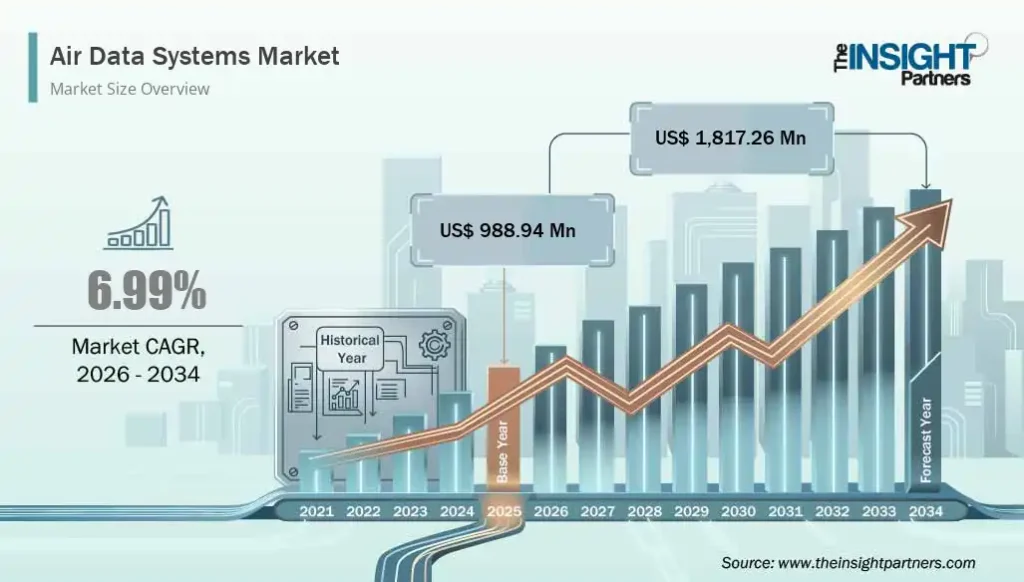
The global Air Data Systems Market is poised for substantial growth, driven by the expansion of modern commercial aviation fleets, rising military defense modernization programs, and the accelerated integration of next-generation sensor technologies across unmanned aerial vehicles (UAVs). According to comprehensive industry analysis, the global Air Data Systems Market size is projected to reach US$ 1,817.26 million by 2034 from US$ 988.94 million in 2025. The market is anticipated to register a CAGR of 6.99% during the forecast period 2026-2034.
Air data systems perform a crucial role in modern aerospace architecture by providing real-time critical flight parameters including pitot-static pressure, airspeed, angle of attack, total air temperature, and barometric altitude. These systems enable flight management systems, electronic flight displays, and automatic flight control units to operate safely and effectively across all flight regimes.
Key Market Drivers & Growth Catalysts
The continuous evolution of air data monitoring architecture is being propelled by several key market dynamics:
-
Rising Aircraft Production & Fleet Modernization: Surging global passenger traffic and rising air cargo demands are prompting major aircraft manufacturers to expand production rates. Modern commercial, business, and military platforms require increasingly integrated air data computers (ADCs) to enhance fuel efficiency and operational reliability.
-
Expansion of Unmanned Aerial Systems (UAS): The rapid adoption of autonomous military drones, urban air mobility (UAM) concepts, and eVTOL (electric vertical takeoff and landing) aircraft requires compact, lightweight, and highly precise air data sensors capable of delivering reliable performance in complex environments.
-
Safety Regulations & Redundancy Demands: Global aviation safety authorities continue to enforce stringent standards for flight instrumentation. To safeguard against air data sensor anomalies or adverse weather hazards, aircraft manufacturers are equipping modern platforms with multi-channel redundant air data systems.
Get a PDF Sample- https://www.theinsightpartners.com/sample/TIPRE00017349
Prominent Industry Players
The competitive landscape of the Air Data Systems Market features established avionics leaders alongside specialized air data sensor manufacturers. Industry leaders are focusing on research and development to create lighter, highly reliable, and ice-resistant sensing solutions.
Key market players leading the global Air Data Systems market include:
-
Aeroprobe
-
AMETEK.Inc
-
Astronautics Corporation of America
-
Collins Aerospace, a Raytheon Technologies company
-
Curtiss-Wright Corporation
-
Honeywell International
-
Lockheed Martin Corporation
-
Meggitt PLC
-
Shadin Avionics
-
Thommen Aircraft Equipment Ltd
These prominent entities offer a comprehensive portfolio ranging from pitot-static probes, total air temperature sensors, and angle-of-attack transmitters to integrated air data computers tailored for commercial transports, military fighters, helicopters, and general aviation aircraft.
Segment Overview & Product Portfolio
The air data systems market encompasses several core component categories and aircraft platform segments:
-
Air Data Computers (ADCs): Central processing units that calculate calibrated airspeed, Mach number, altitude, and air temperature parameters from raw sensor inputs.
-
Probes and Sensors: Smart pitot-static tubes, total air temperature (TAT) sensors, and multi-function probes engineered to withstand extreme atmospheric conditions and icing.
-
Platform Applications: Broad implementation spanning commercial passenger jets, military platforms, business aviation, rotary-wing aircraft, and advanced unmanned aerial vehicles.
Future Outlook:
Looking ahead across the 2026–2034 forecast period, the Air Data Systems Market is set to undergo meaningful technological transformation. The future landscape will be heavily defined by the development of multi-function “smart” air data probes that integrate sensing and processing directly at the probe point, significantly reducing system wiring, weight, and aerodynamic drag.
Furthermore, as autonomous flight systems and advanced air mobility platforms move closer to commercial scale, demand for ultra-compact, low-power air data systems will surge. Advances in optical air data sensing, optical air data systems (OADS), and enhanced anti-icing sensor coatings will improve reliability in severe weather conditions. Coupled with steady defense investments globally, these innovations ensure robust growth and continuous market expansion through 2034.
Related Reports–
Drone Data Link System Market Growth, Share & Trends by 2034
About The Insight Partners
The Insight Partners is a leading market research and consulting firm delivering actionable insights through in-depth industry analysis and strategic intelligence. The firm supports clients across various industries in making informed business decisions by providing comprehensive market forecasts, competitive assessments, and growth opportunities.
Contact Us:
If you have any queries about this report or if you would like further information, please contact us:
Contact Person: Ankit Mathur
E-mail: sales@theinsightpartners.com
Phone: +1-646-491-9876
Also Available in : Korean| German| Japanese| French| Chinese| Italian| Spanish