Choosing Digital Solutions for Business Growth
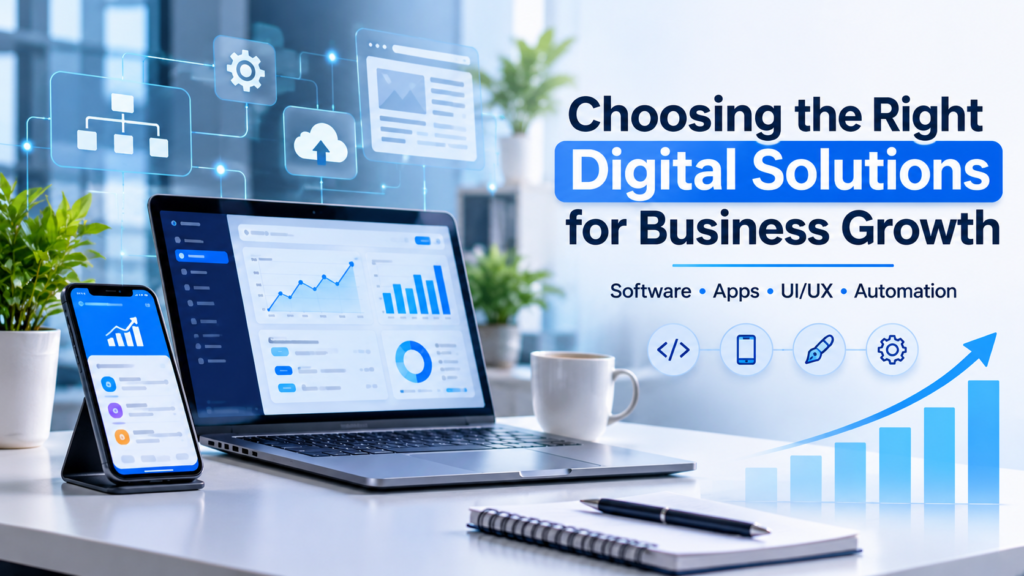
Choosing the Right Digital Solutions for Business Growth
Running a business today involves much more than selling products or providing services. Companies also need to manage customer information, coordinate teams, handle daily operations, and deliver a smooth digital experience. When these activities become difficult to manage manually, the right technology can make a real difference.
However, not every business needs the same solution. Some companies need a better website, while others may benefit more from a mobile application, customized software, or automated workflows. Understanding these options makes it easier to invest in technology that supports actual business goals.
Start by Identifying Your Business Challenges
Before investing in any digital solution, businesses should look closely at their current operations. Which tasks take too much time? Where do communication gaps occur? Are customers struggling to access services? Are employees switching between several systems to complete simple tasks?
Answering these questions helps identify the areas where technology can provide practical value.
For example, a service-based company might need a centralized platform to manage customer requests, while a growing retailer may require better inventory tracking. A business with a large mobile audience might prioritize an application that makes its services easier to access.
Defining the problem first also helps avoid spending money on features that employees and customers may never use.
Custom Software Development for Specific Requirements
Ready-made software can be useful for businesses with standard requirements, but it may not always support specialized workflows. In these situations, custom software development provides an opportunity to build a solution around the company’s processes.
A customized system can bring different activities together, improve access to information, and reduce repetitive administrative work. Depending on the project, it may include customer relationship management, reporting tools, employee management, inventory functions, or integrations with existing platforms.
Businesses should consider scalability from the beginning. A solution that works for a small team should ideally be designed with future requirements in mind, without making the initial system unnecessarily complicated.
Security, documentation, testing, and ongoing maintenance should also be part of the planning process.
Mobile App Development and Customer Convenience
Mobile applications allow businesses to offer services through a device that customers already use every day. From appointment scheduling and online shopping to account management and service bookings, apps can make common activities more convenient.
Successful app development starts with understanding the intended users. Businesses should decide what the application needs to accomplish, which features are essential, and how users will navigate between them.
Performance is another important consideration. Slow loading times, confusing navigation, and frequent errors can discourage people from using an application. Testing across relevant devices and maintaining the app after launch help provide a more reliable experience.
Rather than adding every possible feature at once, businesses can prioritize the core functionality and improve the application based on genuine user feedback.
Why UI/UX Design Should Not Be Overlooked
The usefulness of a digital product depends partly on how easily people can use it. A platform may contain powerful features, but those features have limited value if users cannot find them or understand how they work.
UI/UX design helps address this challenge. User interface design focuses on visual elements such as buttons, layouts, typography, and consistency. User experience design considers the wider journey, including navigation, accessibility, and how easily people complete their tasks.
Wireframes and prototypes allow teams to review a proposed design before full development begins. This can help identify confusing steps early and reduce the need for costly changes later.
A clear, consistent interface makes digital products easier to learn and can help businesses provide a better overall customer experience.
Business Automation and More Efficient Workflows
Many companies spend valuable time on repetitive tasks, including updating records, assigning requests, sending reminders, and preparing routine reports. When these activities are handled manually, mistakes and delays can become more common as the business grows.
Business automation can simplify suitable workflows by allowing software to perform predefined actions automatically. For instance, a system might send a notification when a request is received or update a record when a particular task is completed.
The key is to choose processes carefully. Businesses should map their existing workflows, identify unnecessary steps, and determine where automation would provide the greatest benefit. Human review should remain in place wherever judgment, approval, or sensitive decisions are required.
Finding a Technology Partner That Understands Your Goals
Choosing a development partner involves more than comparing prices or looking at technical features. Businesses should consider whether a team understands their requirements, explains its recommendations clearly, and can provide support beyond the initial launch.
Project planning, transparent communication, quality assurance, security practices, and maintenance arrangements are all worth discussing before work begins.
Companies exploring professional technology services can visit Innovador Solutions to learn more about its digital solutions and discuss their development requirements.
A useful partnership should focus on solving business problems, setting realistic expectations, and building solutions that can adapt as requirements change.
Making Technology a Long-Term Business Investment
Digital improvement works best when it follows a clear plan. Businesses can begin by identifying one important challenge, selecting an appropriate solution, and measuring whether the change has improved efficiency or customer experience.
The results can then guide future decisions. A company might begin with workflow automation and later introduce a customer portal or mobile application as its needs expand.
The most effective technology investment is not necessarily the largest or most expensive one. It is the solution that addresses a genuine requirement, works reliably, and supports the company’s long-term direction.
With careful planning, suitable software, thoughtful design, and ongoing improvement, businesses can build digital systems that support more organized operations and sustainable growth.