Aerobatic aircraft frequently employ smoke systems that inject paraffin-based oil directly into the hot exhaust manifolds. This process vaporizes the oil instantly, producing thick trails of white smoke that trace the plane’s exact flight path. Beyond entertaining airshow crowds, smoke trails help judges evaluate the symmetry and accuracy of competitive aerial figures. The smoke also acts as a crucial safety feature, making small, fast-moving planes highly visible in busy airspace.
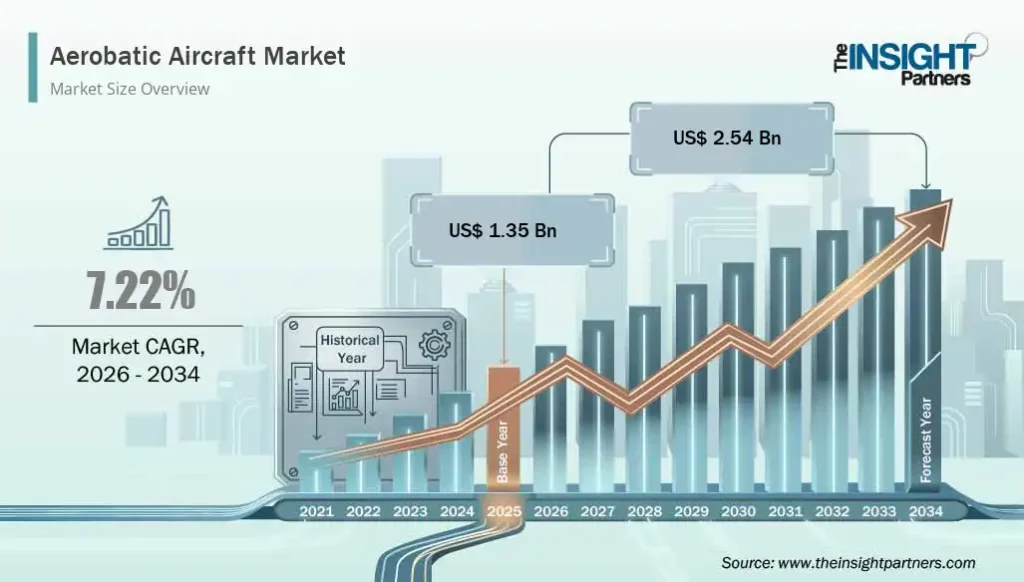
The global aerobatic aircraft market is experiencing sustained momentum, driven by surging enthusiasm for competitive air sports, expanding private aviation ownership, and heightened demand for specialized upset-prevention and recovery pilot training. According to recent industry projections, the Aerobatic Aircraft Market size is expected to reach US$ 2.54 Billion by 2034 from US$ 1.35 Billion in 2025. The market is anticipated to register a CAGR of 7.22% during the forecast period 2026–2034.
Market Overview and Growth Drivers
Aerobatic aircraft are engineered with reinforced airframes, high power-to-weight ratios, symmetrical airfoils, and advanced avionics capable of enduring extreme positive and negative G-forces.Traditionally favored by competitive stunt pilots and international airshow demonstration teams, these agile platforms have secured a vital role across commercial, military, and recreational aviation sectors.
A primary catalyst behind the market’s expansion is the growing global popularity of air sports, international aerobatic championships, and major aviation festivals, which continually attract spectators, sponsors, and private buyers.Simultaneously, rising disposable incomes among high-net-worth individuals and streamlined pilot certification pathways have accelerated recreational and sport-flying adoption.
Get a PDF Sample- https://www.theinsightpartners.com/sample/TIPRE00017693
Furthermore, commercial airlines, business-jet operators, and defense organizations are increasingly integrating purpose-built aerobatic aircraft into formal flight-training curricula.Upset-prevention and recovery training (UPRT) has become a critical safety benchmark for teaching pilots precise aircraft handling, spatial orientation, and emergency maneuver recovery under high-stress conditions reinforcing steady institutional procurement.
Key Market Players
The competitive landscape of the global aerobatic aircraft industry is characterized by specialized manufacturers focused on aerodynamic precision, lightweight composite construction, and cockpit modernization. Key players operating in the market include:
-
American Champion Aircraft
-
Blackwing Sweden
-
Breezer Aircraft GmbH and Co. KG
-
Extra Flugzeugproduktions
-
OSKBES MAI
-
Pacific Aerospace
-
Sukhoi Company
-
Tomas Podesva Air
-
Vans Aircraft
-
Waco Aircraft Corporation
These leading manufacturers continue to invest in carbon-fiber airframe engineering, ergonomic cockpit layouts, and digital glass avionics to enhance structural durability, pilot comfort, and flight safety during complex routines.
Market Restraints and Challenges
Despite strong demand across training and recreational segments, the market faces notable headwinds due to the high capital costs associated with aircraft design, certification, and acquisition.Because aerobatic platforms must endure repetitive structural fatigue, they require specialized materials, rigorous inspection schedules, and frequent component replacements, resulting in elevated ongoing maintenance and operational expenses.Additionally, strict regulatory compliance and a shortage of specialized aerobatic maintenance technicians can pose barriers for smaller flight schools and individual owners.
Future Outlook
Looking ahead through 2034, the aerobatic aircraft market is poised for transformative technological and regulatory evolution. Advancements in lightweight carbon-composite manufacturing and next-generation avionics are expected to improve fuel efficiency, roll rates, and structural longevity while lowering lifecycle operating costs.
Sustainability and propulsion innovation will also play an increasingly prominent role over the coming decade. Manufacturers and aerospace innovators are actively exploring hybrid-electric and fully electric propulsion architectures for short-duration aerobatic training circuits and airshow performances.These developments promise to reduce noise footprints and per-flight-hour fuel expenses, making operations at suburban airparks more viable.
Related Reports-
Electric Aircraft Market Size, Growth & Demand by 2034
Aircraft Aerostructures Market Trends, Size & Growth by 2034
About The Insight Partners
The Insight Partners is a leading market research and consulting firm delivering actionable insights through in-depth industry analysis and strategic intelligence. The firm supports clients across various industries in making informed decisions by providing comprehensive market forecasts, competitive assessments, and growth opportunities.
Contact Us:
If you have any queries about this report or if you would like further information, please contact us:
Contact Person: Ankit Mathur
E-mail: sales@theinsightpartners.com
Phone: +1-646-491-9876
Also Available in : Korean| German| Japanese| French| Chinese| Italian| Spanish