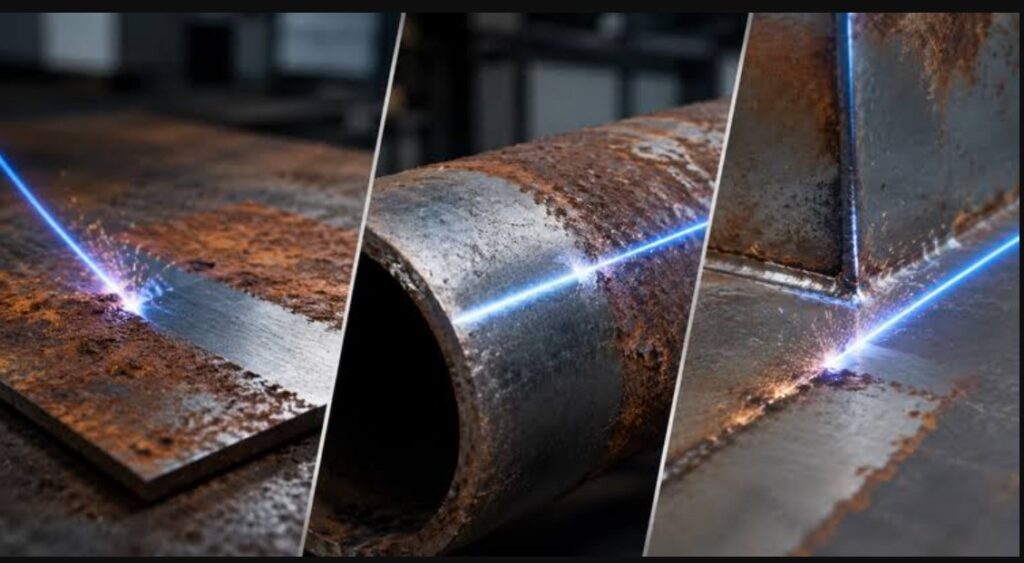
Rust never arrives politely. It creeps across stored steel, blooms on neglected machinery, and settles into the corners of gates, railings, and vehicle panels. For years, removing it meant hauling the affected part to a fixed workstation, or bringing in abrasive blasting equipment that left dust, debris, and a considerable mess behind. Portable laser equipment has changed that calculation. A compact unit can now be carried to the work instead of the other way around, and the cleaning happens with a focused beam rather than grit or chemicals. That shift matters most for workshops and maintenance teams that deal with rust in place, on installed equipment, or on items too large to move.
Why Rust Removal Needs a Mobile Approach
Most rust does not live in convenient places. It forms on stair rails bolted to walls, on farm machinery parked in sheds, on boat fittings, on structural steel inside buildings, and on classic cars that cannot easily be stripped down. Taking these items to a cleaning bay is often impractical, and dismantling them adds hours of labour and the risk of damage. A mobile approach avoids both problems. The operator brings the cleaning tool to the rust, works on the item where it stands, and leaves the surrounding structure untouched. That is a practical advantage in maintenance work, where time on site is expensive and every extra step is another chance for something to go wrong.
There is also the question of mess. Traditional rust removal throws material everywhere: wire brushes shed bristles and dust, grinding discs throw sparks and remove healthy metal along with the rust, and chemical treatments leave residues that must be collected and disposed of. Laser cleaning works differently. The beam heats the rust layer so that it lifts away, and the residue can be captured with extraction equipment at the point of work. The surface underneath is left largely intact, which matters when the part must keep working for years. For workshops that take pride in careful work, that precision is a strong selling point.
What Makes a Portable Unit Practical
Portability is not only about weight. A genuinely useful portable unit needs a power supply that matches the sites where it will work, a cable or fibre length that lets the operator reach the job, and controls simple enough to use while wearing protective gear. The best designs balance cleaning ability against the realities of carrying the equipment up stairs, across yards, and into tight spaces. Operators also need ventilation and eye protection, because a laser is not a tool to use casually. Training matters, and a responsible supplier will make that clear before a unit ever leaves the showroom.
When a workshop is comparing options, the specification sheet only tells part of the story. The real test is how the equipment behaves on a rusted hinge, a corroded bracket, or a painted panel that needs stripping back to bare metal. That is why many buyers start by looking at a portable laser rust remover and then arrange a demonstration on their own typical work. Seeing the beam lift rust from a familiar part answers more questions than any brochure. It also shows how quickly an operator can move from one spot to the next, which is where the time savings of a portable design really add up.
Safety and preparation deserve attention before any cleaning begins. The work area should be clear of flammable material, bystanders should be kept at a distance, and the operator needs proper eye protection rated for the laser in use. Surfaces should be checked for coatings that might release fumes when heated, and extraction should be arranged where dust or vapour could accumulate. None of this is complicated, but skipping it turns a clean, controlled process into a hazard. Workshops that build these checks into their routine get consistent results.
Choosing the Right Approach for the Job
Choosing the right approach starts with the job itself. Light surface rust on a flat panel is a quick task, while deep corrosion on an uneven casting takes longer and may need more than one pass. Painted surfaces add another variable, since the beam must remove the coating before it can reach the rust beneath. A thoughtful operator tests a small area first, adjusts the settings, and then works across the whole surface. That habit saves time in the long run and protects parts that would be expensive to replace.
Cost is another factor buyers weigh carefully. A portable laser unit is a significant purchase, and it only earns its keep if it is used regularly. Workshops with a steady flow of restoration, maintenance, or fabrication work will see the benefit quickly, while occasional users may be better served by hiring the service instead. The calculation is not only about the purchase price. It includes time saved on each job, fewer consumables, and work that can now be done on site rather than outsourced.
Frequently Asked Questions
1. Can a portable laser unit remove heavy rust?
It can handle a wide range of rust, from light surface bloom to heavier corrosion, although very deep pitting may need more than one pass and some hand finishing. The key is matching settings to the metal and testing a small area first.
2. Does laser cleaning damage the metal underneath?
When used correctly, the beam targets the rust layer and leaves the base metal largely untouched. Problems usually come from incorrect settings or rushing the job, which is why operator training and a test patch are so important.
3. Is a portable unit suitable for outdoor work?
Yes, in most cases, provided there is a suitable power supply and the work area can be kept safe and clear. Wind and dust can affect visibility and extraction, so outdoor jobs need a little extra planning.
Conclusion
Portable laser cleaning has earned its place in the modern workshop by solving a simple problem: rust rarely waits in a convenient spot. Bringing the cleaning tool to the work saves time, reduces mess, and protects the parts that matter. As with any professional tool, the results depend on choosing the right equipment, learning to use it properly, and respecting the safety rules that go with it. For teams that deal with rust every week, that combination is hard to beat.