Purchase Fake ID: What Modern Verification Systems Actually Check
A search for purchase fake id can sound like a request for a physical document. From a document-security perspective, however, the more useful question is what happens after a questionable credential reaches a verification checkpoint.
A bartender may inspect an identification card under ordinary lighting. A financial institution may capture an image of an identity document and compare its data with reference information. A government process may validate evidence against an issuing source and then establish whether the person presenting it is actually associated with that identity.
Those are different environments, but they share a basic problem: a document is only one piece of evidence in an identity decision.
That distinction matters because a credential can appear convincing while still producing conflicting signals elsewhere in the verification process. Modern identity systems increasingly combine document characteristics, machine-readable data, databases, digital signatures, and sometimes biometric evidence. NIST’s current Digital Identity Guidelines, SP 800-63-4, describe identity proofing as a process for establishing confidence that evidence reliably identifies an applicant.
What a “purchase fake id” search misses about verification
The physical appearance of an identification card is only one part of the problem defenders are trying to solve.
A document-authentication system may examine whether presented evidence is genuine, whether information is internally consistent, whether the claimed identity exists, and whether the person presenting the evidence is actually associated with it. NIST’s identity-proofing resources separate these concepts rather than treating “looks real” as the same thing as “proves identity.”
That creates an important security distinction between document authenticity and identity verification.
Document authenticity asks questions about the credential itself. Identity verification asks whether the person presenting that credential can be linked to the identity represented by the evidence.
A security architecture can therefore reject an identity claim without relying on a single visible defect in the document. A mismatch between data fields, a failure to validate evidence, an unsuccessful biometric comparison, or an unavailable issuing-source check can change the result.
This is why online discussions that focus exclusively on card appearance often miss how contemporary verification actually works.
Physical security features provide evidence, not certainty
Physical identity documents can contain multiple security elements designed to make unauthorized reproduction or alteration more difficult and to give trained examiners additional evidence.
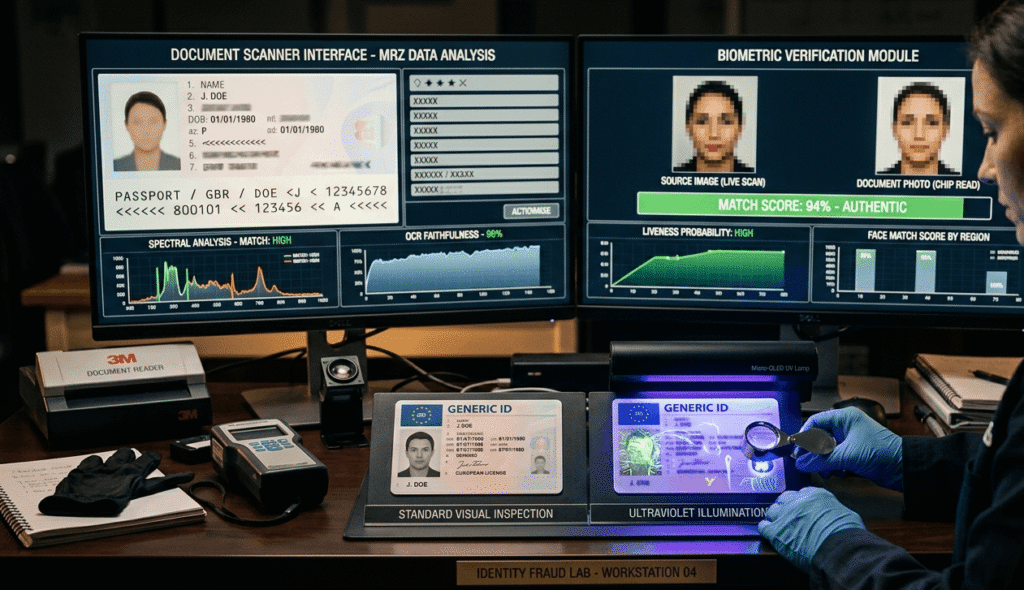
Depending on the document, these can include polycarbonate construction, optically variable devices, holographic elements, microtext, ultraviolet features, tactile characteristics, laser engraving, and specialized security printing.
The important point is not that one particular feature makes a document trustworthy. It is that multiple features can create a collection of signals that an examiner or inspection system can evaluate.
A visible holographic effect, for example, may be useful as one inspection signal. It does not independently establish that every other element of the credential is authentic. Likewise, an apparently correct photograph does not establish that the document was legitimately issued to the person presenting it.
That distinction is central to defensive document examination: security features increase the amount of evidence available to a verifier; they do not eliminate the need for verification architecture.
Government identity programs have long recognized this layered approach. DHS documentation concerning source-document authentication describes manual and automated inspection of overt and covert security features as part of document authentication processes.
Machine-readable data changes the verification problem
The next layer is information encoded into the credential.
Barcodes, machine-readable zones, and other machine-readable elements allow verification systems to capture structured information rather than depending entirely on a human reading printed text. The system can then examine relationships among fields and compare the captured information with other available evidence.
This creates another important defensive principle: consistency matters.
A verifier may be interested in whether information presented through different parts of the credential agrees with itself and whether the evidence can be validated through an appropriate reference source. In remote identity-proofing environments, document images can also be processed using technologies such as optical character recognition, barcode or MRZ analysis, and document-authentication checks.
A 2026 DHS acquisition forecast for USCIS illustrates this direction. The requirement describes remote document-authentication capabilities involving document images, presentation-attack detection, face matching, template and barcode/MRZ-based authentication, and structured data extraction. It is a procurement requirement rather than evidence that every organization uses the same architecture, but it demonstrates how several verification signals can be combined in a government workflow.
Identity proofing asks a harder question
Even a credential that passes document-level checks may not establish that the presenter is the legitimate identity holder.
NIST’s identity-proofing framework explicitly distinguishes validation of identity evidence from verification that the evidence is associated with the person presenting it. For stronger verification levels, NIST describes physical or biometric comparison between the applicant and validated identity evidence.
That is where facial comparison can enter the process.
A system may compare a live facial capture with the facial image associated with validated identity evidence. In remote environments, liveness or presentation-attack detection can also be used to establish whether the biometric capture represents a live person rather than an artificial presentation. NIST’s implementation material specifically identifies liveness controls as relevant to remote identity proofing because of presentation and spoofing risks.
None of this means biometric verification is infallible. Image quality, capture conditions, system performance, demographic considerations, privacy requirements, and operational procedures can all affect how such systems perform.
The defensive lesson is simpler: the more independent evidence a verification architecture can legitimately evaluate, the less dependent it becomes on visual inspection alone.
Digital credentials introduce a different trust model
The move toward mobile driver’s licenses and other digital credentials adds another layer to the discussion.
A physical card primarily presents physical and machine-readable evidence. A properly implemented digital credential can additionally use cryptographic mechanisms to establish provenance and integrity.
AAMVA’s mobile driver’s license guidance references ISO/IEC 18013-5 and describes mechanisms for interoperability, issuer trust, and privacy-preserving implementations. Its Digital Trust Service distributes public keys associated with participating issuing authorities so relying parties can authenticate conformant mobile credentials.
ICAO describes a similar principle for electronic passports and digital travel documents. Its Public Key Directory enables trusted parties to obtain certificates used to verify digital signatures, helping confirm that an electronic travel document corresponds to an issuing authority and that its signed information has not been altered.
The significance is easy to miss. A digital signature is not merely another visual security feature. It can provide cryptographic evidence about the origin and integrity of data.
That changes what a verifier is asking.
Instead of relying solely on whether a credential resembles an authentic document, the system can ask whether the digital evidence chains back to a trusted issuer and whether the authenticated data remains intact.
Why verification systems can still produce mistakes
Layered verification reduces certain fraud opportunities, but it does not make identity decisions perfect.
Genuine documents can be damaged. Cameras can produce poor images. Databases can contain outdated information. Software can generate false positives or false negatives. Different organizations can implement different verification controls, and interoperability may be limited between systems.
Human review also remains relevant in many workflows. A machine can identify an anomaly, but an organization still has to decide how that signal should affect the identity decision.
There is a second trade-off: stronger verification can introduce additional friction and privacy considerations. Biometric systems require collection and processing of sensitive information, while digital identity systems require decisions about data minimization, retention, access controls, and user consent.
NIST’s current Digital Identity Guidelines explicitly address security and privacy alongside identity proofing, authentication, and federation.
The result is not a single perfect detector. It is an engineered balance among assurance, usability, privacy, cost, and operational risk.
The real defensive answer to “purchase fake id”
The most useful way to interpret the search term is not as a shopping question but as a window into the identity-fraud problem.
Modern verification increasingly operates as an evidence chain:
- Document evidence — Does the credential contain expected characteristics?
- Data consistency — Do printed and machine-readable elements agree?
- Source validation — Can the identity evidence be appropriately validated?
- Identity binding — Does the evidence correspond to the person presenting it?
- Digital trust — Where applicable, can cryptographic evidence establish issuer authenticity and data integrity?
- Risk analysis — Do the available signals collectively support the claimed identity?
Not every checkpoint uses all six layers. A low-friction age check and a high-assurance government identity-proofing process have different requirements. NIST’s assurance-level model itself reflects this variation rather than prescribing one universal workflow.
That is the technical point worth remembering when evaluating claims around fraudulent identification: a convincing-looking credential is not equivalent to a successfully verified identity.
The security problem has moved beyond reproducing a surface. Defenders increasingly compare independent evidence, establish relationships between the document and its presenter, and use cryptographic or biometric controls where the assurance requirement justifies them.
For anyone studying identity fraud defensively, that is the more important story behind a search such as “purchase fake id.” The interesting question is no longer simply whether a document can look authentic. It is whether the entire identity claim remains coherent when the credential, its data, its provenance, and its presenter are examined together.
FAQs
1. Does document authentication prove that someone is the legitimate identity holder?
No. Document authentication primarily concerns the evidence itself. Identity verification adds a separate question: whether the person presenting the evidence can be reliably linked to the claimed identity. NIST treats evidence validation and identity verification as related but distinct processes.
2. Why do verification systems use more than one security signal?
Independent signals can provide additional evidence when one signal is ambiguous or unavailable. Depending on the environment, those signals can include physical document characteristics, structured data, issuing-source validation, biometrics, or cryptographic authentication.
3. Are biometric checks used for every identity verification process?
No. Requirements vary according to the identity-assurance level, organization, transaction, jurisdiction, and technology available. NIST’s framework defines different assurance levels and verification methods rather than requiring one universal biometric workflow.
4. What makes digital credentials different from physical identification cards?
Digital credentials can incorporate cryptographic evidence that helps establish issuer authenticity and data integrity. AAMVA’s mDL work, based on ISO/IEC 18013-5, includes mechanisms for relying parties to obtain trusted issuer public keys and authenticate conformant mobile credentials.
5. Can a legitimate document still fail an automated verification check?
Yes. Verification systems can encounter poor image quality, damaged documents, incomplete or outdated reference data, interoperability problems, software errors, or other operational conditions. A failed automated check therefore does not necessarily establish that the underlying physical document is fraudulent; appropriate workflows may require additional review.