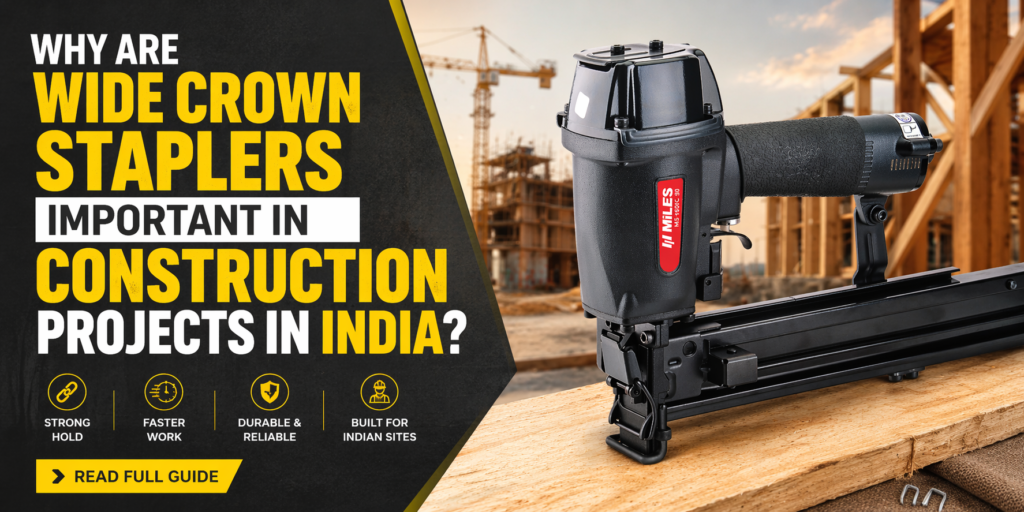
A construction site in Mumbai is midway through installing roof sheathing. A housing project in Pune is laying down underlayment across hundreds of square metres of floor. A prefabricated wall panel facility in Chennai is assembling structural components at high volume. Each of these scenarios shares a common requirement: a fastening solution that is fast, reliable, and capable of holding materials firmly across a wide surface area without causing damage.
This is where wide crown staplers become indispensable.
In India’s construction industry, which is one of the fastest-growing sectors in the country, the quality of tools used at the fastening stage directly affects structural integrity, project timelines, and material wastage. A wrong fastener choice can cause sheathing to buckle, membranes to tear, or insulation to shift over time.
Wide crown staplers are designed specifically to address these challenges. Their wider staple crown distributes holding force across a broader surface, reducing material stress while maintaining a secure bond. For construction professionals across India, from site contractors and project managers to procurement teams sourcing fastening tools, understanding why wide crown staplers matter is a practical, high-stakes question.
This article explains what wide crown staplers are, how they function, and why they hold such a critical role in Indian construction projects of varying scales and types.
What Are Wide Crown Staplers?
A wide crown stapler is a pneumatic or electric fastening tool that drives staples with a wider crown, typically ranging from 1 inch (25mm) to 1.5 inches (38mm) into materials that require broad surface contact for secure attachment.
The “crown” refers to the horizontal top portion of the staple that sits flat against the material surface after driving. A wider crown means more surface area in contact with the material, which translates into stronger holding power and reduced risk of the material pulling through.
Wide crown staplers are distinct from narrow crown and medium crown variants, which are used for lighter applications such as furniture assembly or trim work. Wide crown models are built for heavier-duty tasks where structural reliability is non-negotiable.
How Wide Crown Staplers Work
Wide crown staplers operate by using compressed air (in pneumatic models) or an electric motor to drive a staple through the surface material and into the substrate beneath.
The mechanics involve:
- A magazine that holds a strip of wide crown staples
- A driver blade that propels the staple downward on trigger activation
- A depth adjustment mechanism to control how deep the staple is driven
- A nose piece designed to guide the staple precisely into the target area
The result is a fastener that grips both the surface material and the substrate in a single, efficient action without the need for pre-drilling, additional adhesive, or secondary fastening steps.
For construction applications in India where speed, volume, and precision all matter simultaneously, this efficiency is a significant operational advantage.
Key Applications of Wide Crown Staplers in Indian Construction
Roof Sheathing and Decking
One of the primary uses of wide crown staplers in construction is attaching roof sheathing panels, typically plywood or OSB (oriented strand board), to roof trusses and rafters.
In Indian residential and commercial construction, roofing applications demand fasteners that can withstand thermal expansion, monsoon-related moisture stress, and wind load. The wide crown distributes these forces more effectively than a narrow fastener, reducing the risk of pull-through over time.
Underlayment and Moisture Barrier Installation
Before flooring materials are laid, underlayment and moisture barrier sheets must be secured flat and wrinkle-free across the subfloor. Wide crown staplers are designed for exactly this task. Their broader crown holds flexible sheet materials without tearing or bunching.
In regions of India with high humidity, coastal cities, northeastern states, or areas with pronounced wet seasons, proper underlayment installation is critical for preventing moisture ingress. A wide crown stapler makes this installation faster and more consistent than manual alternatives.
Insulation Fastening
Thermal and acoustic insulation boards or batts need to be held firmly against wall cavities, ceilings, and floor assemblies before finishing materials are applied. Wide crown staplers provide the surface contact necessary to keep insulation in place without compressing the material or creating gaps that reduce its effectiveness.
As India’s construction industry increasingly adopts energy-efficient building standards driven by green building certifications and evolving building codes proper insulation installation is becoming a higher priority on project sites.
Wall Sheathing and Structural Panels
Prefabricated construction is growing in India, particularly in affordable housing, modular office construction, and industrial facilities. Wide crown staplers are essential in panel assembly lines where wall sheathing must be attached quickly, uniformly, and to precise specifications.
The speed advantage of a pneumatic wide crown stapler over hand nailing or manual screwing is significant in high-volume prefab environments directly affecting production output and labour costs.
Fencing and Agricultural Structures
Beyond conventional construction, wide crown staplers are used extensively in fencing applications — attaching wire mesh, shade netting, or fabric to wooden frames. In India’s agricultural and rural infrastructure sector, this application is common across poultry farms, nurseries, storage structures, and boundary fencing for large properties.
Why Wide Crown Staplers Are Particularly Relevant to Indian Construction
India’s construction sector operates across an enormous range of conditions from humid coastal climates to dry arid zones, from monsoon-prone plains to high-altitude hill regions. This diversity places specific demands on fastening tools.
Wide crown staplers in India must perform reliably under variable temperature and humidity conditions. They must handle the range of materials commonly used in Indian construction, including local plywood grades, imported OSB, various insulation types, and domestic roofing membranes.
Additionally, Indian construction projects often operate with tight labour-to-output ratios. A tool that reduces fastening time per square metre without sacrificing holding strength has a direct impact on project completion timelines.
Suppliers and tool brands that understand these local requirements offer products calibrated to Indian site conditions. Miles KGOC is one such name in the Indian fastening tools market, recognised for supplying wide crown staplers and related pneumatic tools suited to the demands of construction professionals across the country.
For procurement teams and site managers evaluating fastening equipment, understanding the technical specifications, crown width, staple gauge compatibility, operating pressure range, and magazine capacity is essential for matching the tool to the application.
Choosing the Right Wide Crown Stapler for a Construction Application
Not all wide crown staplers are interchangeable. Selecting the right model involves evaluating several factors:
- Crown width — standard wide crown is 1 inch; confirm compatibility with the staple gauge required for the material thickness
- Staple leg length — longer legs are needed for thicker substrates; shorter legs suit thinner sheet materials
- Operating pressure — pneumatic models require a compatible air compressor; check PSI ratings
- Magazine capacity — higher capacity reduces reloading frequency on large-surface applications
- Tool weight and ergonomics — on large sites, operator fatigue over extended use affects both speed and accuracy
- Durability and serviceability — in Indian site conditions, tools are exposed to dust, moisture, and physical handling; build quality matters
Working with a supplier who provides technical guidance alongside the tool rather than simply selling hardware reduces the risk of mismatched equipment and application errors.
FAQs: Wide Crown Staplers in Construction
Q1. What is the difference between a wide crown stapler and a narrow crown stapler?
The crown refers to the top horizontal bar of the staple. A wide crown stapler drives staples with a crown of approximately 1 inch or more, providing greater surface contact and holding power for sheet materials. A narrow crown stapler drives staples with a crown of around 3/16 inch, suited for finish work, trim, and cabinetry where a smaller fastener profile is needed.
Q2. What materials can wide crown staplers fasten in construction applications?
Wide crown staplers are used to fasten plywood sheathing, OSB panels, roofing underlayment, moisture barriers, insulation boards, house wrap, wire mesh, and shade netting all common materials in residential, commercial, and agricultural construction across India.
Q3. Are pneumatic wide crown staplers suitable for Indian construction site conditions?
Yes, provided the tool is matched with an appropriate air compressor and the operating pressure is within the recommended range for the site’s power infrastructure. Pneumatic wide crown staplers are well-suited to Indian construction environments due to their durability, consistent driving force, and lower maintenance requirements compared to some electric alternatives.
Q4. How do wide crown staplers improve construction efficiency?
Wide crown staplers significantly reduce fastening time compared to manual nailing or screwing. On large surface applications roofing, flooring, underlayment, and wall sheathing this speed advantage accumulates across the project, reducing labour hours and accelerating project timelines.
Q5. Where can construction professionals in India source reliable wide crown staplers?
Construction professionals can source wide crown staplers in India through specialised tool distributors and suppliers with experience in pneumatic fastening equipment. Miles KGOC is one supplier operating in the Indian market with a range of fastening tools suited to construction applications. Evaluating suppliers based on product specifications, after-sales support, and spare parts availability is advisable before procurement.
Conclusion
Wide crown staplers are not a peripheral tool in construction. For applications involving roof sheathing, flooring underlayment, insulation, structural panels, and fencing, they are the fastening solution that determines whether the installation holds up over years, seasons, and changing site conditions.
For construction professionals across India, understanding the role of wide crown staplers in project quality and site efficiency is a practical matter with measurable consequences.
If you are evaluating fastening solutions for an upcoming construction project, whether a large commercial build, a residential development, or an agricultural structure, begin by mapping the specific materials and surface areas involved. That analysis will tell you exactly what staple crown width, leg length, and tool capacity your application requires.
From there, working with a knowledgeable supplier like Miles KGOC ensures that the equipment you procure is matched to the real demands of your site, not just the specifications on a product sheet.


