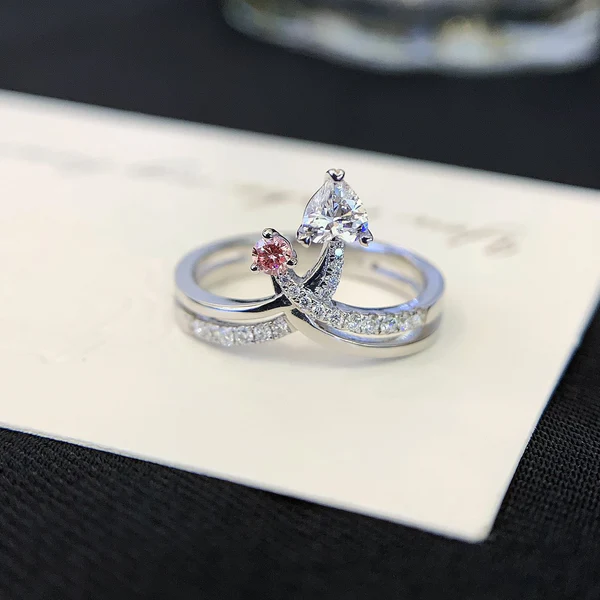
True innovation in the world of luxury design rarely comes from doing what is safe or expected. For generations, traditional jewelry followed a strict rule of absolute uniformity. An engagement centerpiece or a significant statement band was expected to stay within a single, continuous metal choice—either entirely wrapped in the bright, cool tones of platinum or uniformly cast in the traditional warmth of classic gold.
While this singular approach delivered a reliable, classic look, it often restricted the artistic depth of a piece, flattening its structural details and limiting how it could interact with a modern wardrobe. Today, a bold design shift is entirely rewriting these old-world design rules, proving that the intentional use of contrasting elements can create a beautiful new language of modern style. By moving past the boundaries of single-toned metalwork, contemporary designers are using visual tension to highlight fine craftsmanship.
When two contrasting precious metals are brought together in a single structure, they create an artistic conversation. The sharp boundary where a crisp, ice-white setting meets a rich, warm golden shank emphasizes the contours of the piece, turning standard hardware into a dynamic sculpture. This thoughtful contrast does not simply decorate a ring; it alters its entire visual volume, making it more responsive to lighting and allowing it to serve as a versatile anchor for an evolving personal wardrobe.
The Optical Dynamics of Mixed-Alloy Settings
To understand why mixed-metal compositions have become the ultimate symbol of modern style sophistication, one must explore the fundamental physics of color reflection. A high-quality center gem functions as a dynamic prism, capturing ambient light rays from its surroundings and bouncing them through its internal facets before returning that energy to the viewer. When this light path encounters a single, uniform metal backdrop, the reflection pattern can become visually monotonous, absorbing the subtle nuances of the stone’s secondary flashes.
Introducing a calculated two-tone architecture changes this optical behavior completely. Master bench jewelers place bright white metals, like platinum or white gold, directly around the support prongs holding the center stone. This choice is highly strategic: white metal acts as a transparent extension of the stone’s internal brilliance, preventing warm colors from bleeding into the gem’s lower facets and keeping its face-up profile bright and ice-like.
To master these variables before purchasing, patrons who want to make an informed investment can find it deeply valuable to explore collection of two tone engagement rings lab grown diamonds metrics, allowing them to verify exactly how a dual-alloy setting can enhance a centerpiece’s visual symmetry.
Achieving Fluid Integration Across a Versatile Wardrobe
The modern approach to personal style has completely abandoned the rigid, formal rules of the past. Today’s cultural tastemakers, corporate leaders, and design collectors value fluidity, adaptability, and the effortless blending of historical eras with minimalist casual styles. A major challenge of investing in a high-value uniform accessory is its tendency to clash with other pieces in a jewelry collection, forcing individuals to choose between matching their timepieces or constantly switching out their daily essentials.
A contrasting dual-metal structure resolves this lifestyle dilemma elegantly. By naturally incorporating both warm and cool metal paths into a single design, a two-tone framework acts as a universal bridge for an entire wardrobe. It allows the wearer to seamlessly mix silver-toned luxury watches, vintage gold family heirlooms, and modern industrial hardware without creating a distracting visual conflict.
Achieving this fluid look requires an extraordinary level of precision at the bench. The point where the two metals connect cannot look uneven or clumsy; it must be a flawless structural junction. Master goldsmiths utilize advanced micro-soldering and custom interlocking joints to join the different alloys together, ensuring the transition line remains perfectly clean and razor-sharp under close scrutiny. This meticulous engineering ensures the ring feels completely smooth and unified on the hand, delivering effortless daily wear ability alongside its striking style.
Navigating Modern Material Engineering and Structural Artistry
As these contrasting modern aesthetics dominate contemporary high fashion, the path to choosing an iconic heirloom has become significantly more analytical. Modern buyers are looking past basic marketing slogans; they want to understand the exact metallurgy, balance mechanics, and cutting-edge processing techniques that guarantee a piece will retain its beauty and structural integrity for life.
Because a multi-metal framework places different alloys right next to each other, understanding how these materials interact under daily wear is an essential part of the curation process. Different precious metals possess distinct hardness ratings, melting thresholds, and wear patterns, which means combining them demands highly specialized workshop skills. Armed with this knowledge, modern collectors are able to bypass traditional retail hype, ensuring their chosen heirloom is physically durable, balanced properly on the finger, and visually optimized to capture maximum brilliance.
Bespoke Digital Innovation: Sculpting Icons of Distinction
The absolute peak of modern luxury is defined by a complete rejection of mass production and uniform factory molds. True luxury value relies on hyper-custom personal storytelling, absolute exclusivity, and uncompromised human artistry. Designing a custom framework around a dual-metal centerpiece provides an incredible canvas for this level of personal expression, ensuring the finished piece carries a unique market identity that cannot be copied.
Visionary design institutions like Antiquecut excel in guiding clients through this hyper-personalized creative journey. By merging cutting-edge three-dimensional digital rendering software with time-honored, artisanal hand-forging techniques, they allow patrons to collaborate directly on every phase of the ring’s design before any metal is cast. This advanced digital phase allows creators to fine-tune prong configurations, test the visual balance of the contrasting alloys, and map out hidden meaningful elements inside the bridge work down to the exact fraction of a millimeter.
Once the digital blueprint is mathematically perfected, elite master bench jewelers take full control, hand-sculpting the precious metals and executing multi-stage polishing sequences to achieve a mirror-like finish. This dedication to authentic craftsmanship ensures the support basket is perfectly contoured to protect the stone’s delicate perimeter boundaries while maximizing the path of ambient light. This elite level of customization guarantees that the finished piece operates as far more than a simple retail accessory; it survives as an irreplaceable piece of fine art and a permanent anchor for your family legacy.
Conclusion
In the final analysis, the profound beauty of a contrasting fine jewelry piece represents an exciting new chapter in high fashion design. Transforming an abstract concept of visual tension into a perfectly balanced, breathtakingly brilliant ring requires a level of human talent and technical discipline that completely transcends ordinary manufacturing boundaries.
By forcing metallurgists to pioneer flawless multi-alloy transitions, driving bench jewelers to master complex center-of-gravity engineering, and demanding a hyper-bespoke collaborative design process, these extraordinary creations continuously dictate the future of global style.


