Most businesses have some kind of SEO strategy framework, whether it lives in a slide deck or in the head of one specialist. The problem is rarely the absence of a framework. It is that the framework skips steps that matter, so effort goes into work that looks busy but does not move the business.
Below are six gaps that appear again and again in organic search plans, with a practical fix for each. They are written for managers who need to judge whether a plan is sound, not just whether it is detailed.
Use them as a review list for your current approach.
1. It starts with keywords instead of buyers
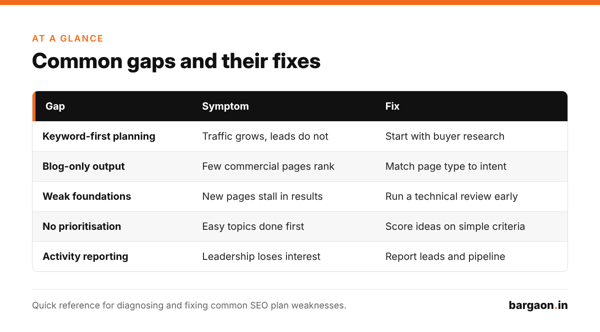
Many plans open with a large keyword export sorted by search volume. That puts the focus on what is popular rather than on what your buyers need, and it often leads to content that attracts the wrong audience.
Fix: begin with buyer research. Speak to sales and customers, list the problems they are trying to solve, and only then use keyword data to size and refine those themes. An SEO strategy framework that starts with buyers produces fewer pages, but each one has a clear commercial purpose.
Buyer research also reveals the language customers actually use. That language often differs from internal product terms, and matching it is one of the simplest ways to make pages more relevant.
2. It treats every page as a blog post
Different intents need different page types. A buyer comparing options wants a clear comparison, a buyer checking costs wants a pricing explanation, and a buyer learning about a problem wants a thorough guide.
Fix: map each priority topic to the page type that best serves its intent. Commercial pages, comparison pages, guides and support content all have a role. A plan that produces only blog posts usually misses the pages closest to revenue.
Look at the pages that currently rank for your most valuable searches. If competitors win with comparison tables, pricing explainers or detailed service pages, a blog post on the same topic is unlikely to displace them however well it is written.
3. It ignores the site’s foundations
Content gets the attention, but crawlability, structure, speed and internal linking quietly limit what content can achieve. Plans that skip these issues often see new pages stall.
The issue is usually not neglect but ownership. Technical fixes sit between marketing and development, and without an agreed process they wait indefinitely while content production continues.
Fix: include a technical and structural review in the first phase of any organic plan. Google’s guidance on Core Web Vitals and page experience is a practical reference for speed and usability, which also affect how visitors feel about your brand.
- Check that key pages are indexable
- Remove or merge pages that compete for the same topic
- Improve load speed on high-value templates
- Strengthen internal links to commercial pages
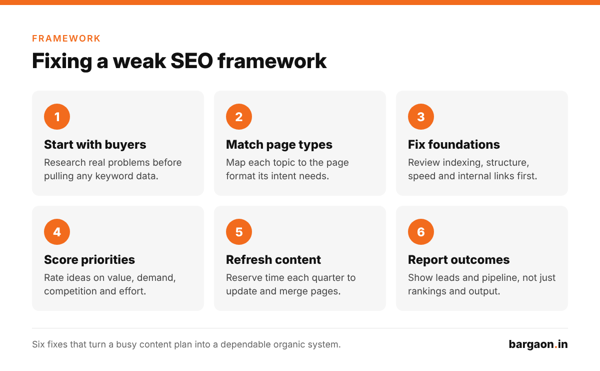
4. The SEO strategy framework has no way to prioritise
A long list of ideas without a scoring method leads to work being chosen by whoever argues loudest. Easy topics get done while important ones wait.
Fix: score every opportunity on a few simple criteria, such as business value, demand, competition and effort. Review the scores with stakeholders each quarter. This turns debates into decisions and makes trade-offs visible, and it gives new team members a clear view of why certain topics come first.
Keep the scoring light. Four criteria rated one to five is usually enough to separate obvious priorities from distractions.
5. It forgets to maintain existing content
Frameworks tend to focus on new content, yet many sites already hold pages with authority that have slipped out of date. Those pages lose ground slowly while the team writes new ones.
Fix: set aside part of every quarter for refreshing, merging and pruning existing content. Update facts, improve structure, add evidence and redirect pages that no longer serve a purpose.
Start with pages that once performed well and have declined. They already have some authority, so careful updates often bring results faster than new content.
For teams newer to search, the Moz Beginner’s Guide to SEO gives a clear overview of why maintenance and on-page quality matter as much as publishing volume.
6. It reports activity, not outcomes
Reports listing pages published and keywords ranked tell leadership what the team did, not what the business gained. Over time, this erodes support for the whole programme.
Fix: report on leads, pipeline or sales influenced by organic visits, alongside visibility measures. Explain what changed, why, and what happens next. Fewer metrics, explained well, earn far more trust than a dense dashboard.
Agree the reporting format with leadership at the start, so everyone knows what success looks like before results arrive.
Making your framework work harder
Fixing these gaps does not require a new plan from scratch. Most teams can review their current approach against this list in an afternoon and pick two or three changes for the next quarter.
Over time, these changes turn a busy content operation into an organic search strategy that leadership trusts. For a complete model covering intent research, prioritisation and measurement, Bargaon’s full guide is the natural next step.
