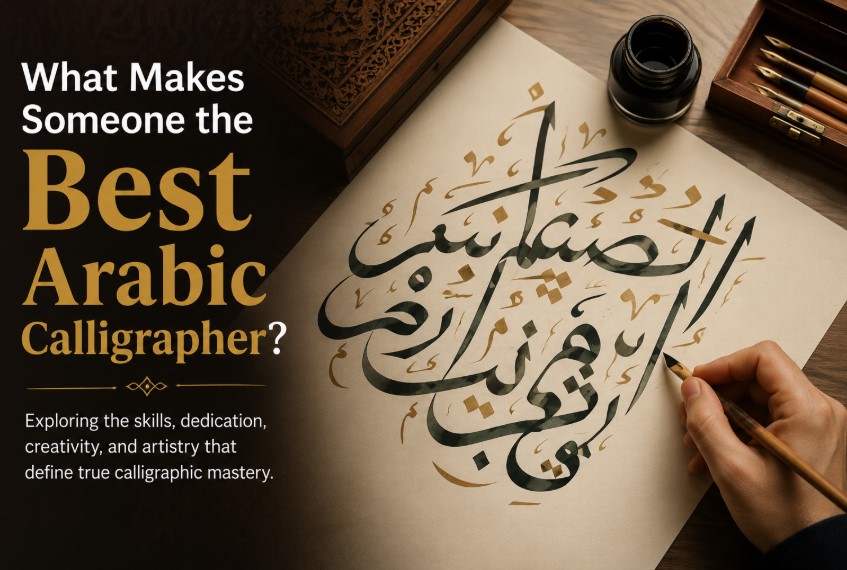
Arabic calligraphy is more than beautifully shaped letters. It is an art form built on proportion, rhythm, discipline, cultural knowledge, and the ability to communicate meaning through visual form. For someone searching for the Best Arabic Calligrapher, the right choice is therefore not simply the artist with the most impressive portfolio. A strong calligrapher understands the Arabic script, respects traditional principles, develops a distinctive artistic voice, and knows how to adapt the work to modern creative needs.
For clients in the United States, this can be particularly important. Arabic calligraphy may be commissioned for artwork, interiors, cultural projects, branding, personal gifts, events, or Arabic wedding invitations. Each purpose requires a different balance of tradition, creativity, legibility, and presentation.
So, what actually makes someone the best Arabic calligrapher? The answer lies in a combination of artistic skill, technical precision, cultural understanding, originality, and the ability to create work that remains meaningful beyond its visual appeal.
Key Takeaways
- The Best Arabic Calligrapher combines technical mastery with artistic interpretation rather than simply producing attractive lettering.
- Knowledge of Traditional Arabic Calligraphy provides the foundation for creating balanced, accurate, and visually coherent work.
- A skilled Arabic Calligraphy Artist can adapt traditional principles to contemporary artwork, digital design, interiors, events, and personal commissions.
- Choosing an artist should involve reviewing their portfolio, understanding their style, checking their process, and discussing how your specific project will be developed.
- Digital tools such as an Arabic Calligraphy Generator can help with experimentation, but they cannot fully replace the cultural understanding and artistic judgment of an experienced calligrapher.
- The strongest Arabic Calligraphy Designer creates work that is visually distinctive while preserving the character and meaning of the Arabic script.
What Defines the Best Arabic Calligrapher?
The best Arabic calligrapher is someone who understands that calligraphy involves both rules and artistic expression. Arabic scripts have established principles concerning proportions, letter construction, spacing, alignment, and composition. Mastering these fundamentals takes considerable practice.
At the same time, great calligraphy should not feel mechanically produced. The artist needs to understand when to preserve traditional structure and when creative interpretation can enhance the final composition.
This balance is especially important in Contemporary Arabic Calligraphy. Modern work may incorporate unconventional compositions, new materials, abstract forms, digital techniques, or mixed media while still retaining the visual identity of Arabic script.
A strong artist therefore brings together three essential qualities: technical control, cultural awareness, and a recognisable creative voice.
Mastery of Arabic Calligraphy Techniques
Technical skill is one of the clearest indicators of an experienced calligrapher.
Arabic calligraphy contains numerous scripts and stylistic traditions, including forms associated with Naskh, Thuluth, Diwani, Kufic, and other calligraphic practices. Each has its own visual characteristics and structural principles.
A skilled artist understands how individual letters behave within a word and how words interact within a larger composition. Small changes in proportion or spacing can significantly affect the balance of the artwork.
This is why beautiful Arabic calligraphy requires much more than knowing how to write Arabic. The artist needs to understand:
- Letter proportions and structural relationships
- Stroke direction and consistency
- Spacing between letters and words
- Baseline and composition
- Visual rhythm
- Balance between positive and negative space
- Script selection for a particular purpose
- Traditional rules and contemporary interpretation
These details often determine whether a piece feels professionally composed or simply decorative.
Why Traditional Arabic Calligraphy Still Matters
Traditional Arabic Calligraphy remains highly relevant even when an artist creates modern work.
Traditional training teaches discipline. It establishes a foundation for understanding letterforms and helps artists recognise why certain proportions and compositions work visually.
This knowledge also gives contemporary artists greater freedom. Once the underlying structure of Arabic calligraphy is understood, an artist can experiment with scale, materials, composition, colour, texture, and spatial arrangements without losing the identity of the script.
For this reason, traditional knowledge and contemporary creativity should not be treated as opposites. They can work together to produce artwork that respects heritage while speaking to modern audiences.
The Role of an Arabic Calligraphy Artist
An Arabic Calligraphy Artist does more than reproduce words in an attractive style. The artist interprets language visually.
Consider a short Arabic phrase intended for a piece of wall art. The same phrase could be presented in a compact geometric composition, an expressive flowing arrangement, or a highly traditional script. The words remain the same, but the emotional impression changes significantly.
A professional artist considers the purpose of the piece before deciding how it should look.
For example, artwork intended for a contemporary home may benefit from a minimalist composition, while a heritage-focused project may call for a more traditional approach. A personal commission may require careful attention to the emotional meaning behind the chosen text.
Understanding this relationship between language, meaning, and visual form is an important part of professional calligraphy.
What Does an Arabic Calligraphy Designer Do?
An Arabic Calligraphy Designer combines calligraphic knowledge with design thinking.
The role becomes particularly important when calligraphy is being incorporated into a larger visual project. The artwork may need to work within a specific physical dimension, architectural space, colour palette, publication, event concept, or digital format.
A designer considers questions such as:
- Where will the artwork be displayed?
- What size should the composition be?
- How much surrounding space is needed?
- What visual hierarchy should the text have?
- Should the lettering remain traditional or become more contemporary?
- How will the design appear at different sizes?
- What materials or digital formats are appropriate?
This approach turns calligraphy into a complete visual composition rather than treating it as isolated lettering.
Contemporary Arabic Calligraphy and Modern Creativity
Contemporary Arabic Calligraphy has expanded the possibilities of the art form.
Artists today can work across physical and digital mediums, incorporating calligraphy into paintings, installations, graphic compositions, architectural spaces, illustrations, and other creative projects.
A Modern Arabic Calligrapher may use traditional letterforms while experimenting with scale, abstraction, layering, texture, geometry, or unconventional placement.
The important factor is intentionality. Modernisation should not simply mean making the letters look unusual. A thoughtful contemporary approach maintains a meaningful connection with Arabic script while introducing a fresh visual interpretation.
This is where an artist’s individual style becomes important. Two artists may work from the same phrase yet create completely different compositions because of their approach to rhythm, spacing, scale, and visual storytelling.
Calligraphy Arabic Art Is About More Than Decoration
The phrase Calligraphy Arabic Art captures an important aspect of the discipline: Arabic calligraphy can function as fine art rather than merely decorative lettering.
A successful artwork can communicate identity, spirituality, heritage, emotion, language, or personal meaning.
The visual form may also influence how viewers experience the words. Large-scale compositions can create a sense of presence, while delicate arrangements can create a quieter visual atmosphere.
For collectors and art enthusiasts, this makes Arabic calligraphy particularly interesting. The viewer can appreciate both the written meaning and the artistic interpretation of the script.
How to Choose the Best Arabic Calligrapher for Your Project
Finding the right artist starts with understanding your own project.
Before contacting a calligrapher, decide what you want the artwork to achieve. Is it intended as a personal artwork, an interior feature, a cultural project, a gift, an event design, or Arabic wedding invitations?
Once the purpose is clear, review the artist’s portfolio carefully.
Look beyond individual images and ask:
- Does the artist demonstrate consistent technical quality?
- Is the Arabic text presented accurately?
- Can the artist work in different styles or formats?
- Does the portfolio show an identifiable artistic approach?
- Are different project types represented?
- Does the artwork appear thoughtfully composed rather than simply decorative?
- Can the artist explain the concept or process behind the work?
A portfolio should give you an understanding of how an artist thinks, not just how their finished pieces look.
Understanding the Arabic Calligraphy Service Process
A professional Arabic Calligraphy Service will usually begin by understanding the client’s requirements.
The process can vary depending on the project, but a thoughtful workflow may involve discussing the text, intended meaning, preferred style, dimensions, medium, visual direction, and final application.
For a custom artwork, the artist may develop preliminary concepts before refining the selected composition.
This stage matters because Arabic calligraphy is highly sensitive to context. The same phrase can require different treatment depending on whether it will become a framed artwork, invitation, digital graphic, architectural feature, or personalised gift.
Clear communication between the client and artist helps ensure that the final piece serves its intended purpose.
Arabic Wedding Invitations Require Special Attention
Arabic wedding invitations are a good example of why calligraphy requires both artistic and practical knowledge.
Wedding stationery needs to communicate information clearly while also creating an elegant visual impression. Arabic lettering can become a central design element, particularly when names, blessings, dates, or meaningful phrases are incorporated into the composition.
The artist or designer needs to consider readability, spacing, invitation dimensions, printing requirements, and the overall visual identity of the event.
A beautiful calligraphic composition should still function effectively as an invitation.
Arabic Calligraphy Generator: Where Technology Fits
An Arabic Calligraphy Generator can be useful for exploring ideas, experimenting with layouts, or visualising different possibilities. Digital tools have made it easier for people to test how Arabic lettering might look within a design.
However, generated lettering and professional calligraphic artwork are not necessarily the same thing.
Automated tools may not understand the cultural, artistic, and contextual considerations involved in a custom composition. They may also provide limited control over the nuances that an experienced artist can refine manually.
Technology can therefore serve as an exploratory tool, while an experienced calligrapher brings human judgment, artistic intention, and cultural understanding to the final work.
Why an Arabic Calligraphy Workshop Can Be Valuable
An Arabic Calligraphy Workshop offers an opportunity to understand the discipline from the inside.
Beginners often discover that writing Arabic calligraphy is very different from ordinary handwriting. Students may learn about tools, strokes, letter construction, proportions, composition, and the discipline required to develop consistency.
Workshops can also deepen appreciation for the art. Even people who do not intend to become professional calligraphers can gain a better understanding of the patience and precision behind finished pieces.
For educators, cultural organisations, creative communities, and art enthusiasts, workshops can also provide a meaningful way to introduce Arabic artistic heritage to wider audiences.
How Much Does Professional Arabic Calligraphy Cost?
There is no single price for professional Arabic calligraphy because project requirements vary significantly.
The cost may depend on factors such as:
- Complexity of the composition
- Size of the artwork
- Original versus reproduced artwork
- Materials and medium
- Number of revisions
- Customisation requirements
- Digital or physical delivery
- Framing or production requirements
- Commercial usage or licensing
- Project timeline
A small personalised digital composition may require a very different investment from an original large-scale artwork.
Instead of choosing an artist based only on price, it is more useful to consider the scope of the project and what is included in the service.
What Makes an Arabic Calligraphy Website Trustworthy?
An Arabic Calligraphy Website should help potential clients understand the artist’s work before making contact.
A strong website can communicate expertise through a well-organised portfolio, clear descriptions of services, information about the artistic approach, examples of previous work, and an easy way to discuss custom projects.
For clients, the website should answer practical questions without creating unnecessary uncertainty.
Look for clear information about the artist, the types of commissions available, the creative process, and how enquiries are handled.
For an artist, the website also serves as a long-term professional portfolio. It provides a central place where people can explore the work and understand the artistic philosophy behind it.
The Importance of Cultural and Linguistic Accuracy
One of the most important qualities in professional Arabic calligraphy is accuracy.
An artwork can look visually impressive while still containing an incorrect letterform, spelling, diacritic, phrase, or textual arrangement. When the artwork carries personal, religious, cultural, or ceremonial meaning, these details become especially important.
A professional calligrapher should therefore treat the written content with care and verify the intended text before developing the final composition.
Clients can also help by providing the exact wording and confirming its intended meaning before production begins.
This collaborative approach reduces avoidable errors and protects the integrity of the finished artwork.
How Nihad Dukhan Approaches Arabic Calligraphy
For people looking to explore professional Arabic calligraphy in the United States and beyond, Nihad Dukhan provides an example of an artist-focused approach to the discipline.
The work presented through the Nihad Dukhan website can be explored directly at ndukhan.com.
Rather than viewing Arabic lettering simply as a graphic element, prospective clients can use an artist’s portfolio to understand the relationship between script, composition, creativity, and artistic expression.
This is particularly useful for anyone looking for custom Arabic artwork and wanting to evaluate an artist based on actual creative work rather than generic descriptions.
Questions to Ask Before Commissioning an Artist
Before starting a custom project, a short conversation can prevent misunderstandings later.
Ask the artist about the proposed style, creative process, timeline, revisions, final format, and intended use of the artwork. If the text is particularly important, confirm how linguistic accuracy will be checked.
It is also useful to explain where the artwork will be used. A composition intended for a large wall may require a different approach from one designed for stationery or a digital screen.
The clearer the project brief, the easier it becomes for the artist to create something that feels intentional and appropriate.
The Future of Modern Arabic Calligraphy
Arabic calligraphy continues to evolve because artists are finding new ways to connect traditional script with contemporary visual culture.
Digital media, interior design, illustration, fine art, events, branding, and international creative projects are creating new contexts for Arabic lettering.
Yet the foundation remains unchanged: strong knowledge of Arabic script, careful composition, artistic discipline, and respect for the meaning of the text.
The future of Modern Arabic Calligraphy is therefore unlikely to be about abandoning tradition. Instead, it will continue to explore how traditional knowledge can inspire new forms of artistic expression.
Conclusion
The Best Arabic Calligrapher is not defined by one particular style or technique. True quality comes from a combination of technical mastery, cultural understanding, creativity, accuracy, and the ability to translate meaningful language into compelling visual art.
Whether you are commissioning a personal artwork, exploring Traditional Arabic Calligraphy, planning Arabic wedding stationery, looking for contemporary artwork, or simply developing an appreciation for Arabic Calligraphy, examining the artist’s portfolio and creative process is essential.
For those interested in exploring the work of Nihad Dukhan and learning more about available Arabic calligraphy projects, visit the official Arabic Calligraphy Website at Nihad Dukhan.
Frequently Asked Questions About the Best Arabic Calligrapher
1. What makes someone the Best Arabic Calligrapher?
The best Arabic calligrapher combines technical knowledge, accurate Arabic lettering, strong composition, cultural understanding, artistic originality, and the ability to adapt the work to a client’s purpose.
2. What should I look for in an Arabic Calligraphy Artist?
Review the artist’s portfolio for consistency, accuracy, creativity, range, composition, and evidence of a distinctive artistic approach. Also consider whether the artist understands your project’s purpose and requirements.
3. Is Traditional Arabic Calligraphy still relevant today?
Yes. Traditional Arabic Calligraphy provides important principles of proportion, structure, rhythm, and discipline. Many contemporary artists use these foundations while developing modern interpretations.
4. What is Contemporary Arabic Calligraphy?
Contemporary Arabic Calligraphy refers to modern artistic interpretations of Arabic script. Artists may experiment with composition, scale, materials, abstraction, digital techniques, and mixed media while retaining a connection to Arabic calligraphic traditions.
5. Can an Arabic Calligraphy Generator replace a professional artist?
A generator can be useful for experimentation and early visual ideas, but professional custom artwork requires artistic judgment, cultural understanding, textual accuracy, and careful composition that automated tools may not provide.
6. What is an Arabic Calligraphy Workshop?
An Arabic Calligraphy Workshop is a guided learning experience where participants can study elements such as letter construction, strokes, tools, proportions, composition, and calligraphic techniques.
7. Can Arabic calligraphy be used for wedding invitations?
Yes. Arabic calligraphy can be incorporated into wedding invitations for names, meaningful phrases, blessings, dates, headings, and decorative compositions. The design should balance artistic beauty with readability and practical printing requirements.
8. How do I find a professional Arabic Calligraphy Designer?
Start by reviewing the designer’s portfolio and looking for evidence of technical quality, Arabic accuracy, creative consistency, and experience with projects similar to yours. A direct discussion about your requirements can then help determine whether the artist’s approach suits your project.
9. Where can I explore professional Arabic calligraphy artwork?
You can explore the work and artistic services of Nihad Dukhan through the official website at ndukhan.com.