Walk into any busy retail store at peak hour and you will see the same pressure point: the billing counter. A long queue, a customer waiting for the right price, a staff member flipping through a register, and a calculator that cannot keep up. For years, Indian retailers ran on handwritten bills and memory. That worked when shops were small and GST did not exist. It does not work today.
Modern retail runs on speed, data, and compliance. This is where billing software changes everything. It turns the slowest part of your shop into the fastest, keeps every rupee accounted for, and makes tax season far less painful. In this guide, we break down exactly what billing software is, how it works, and why every retail shop, from a single kirana store to a multi-branch chain, now needs one.
What Is Billing Software?
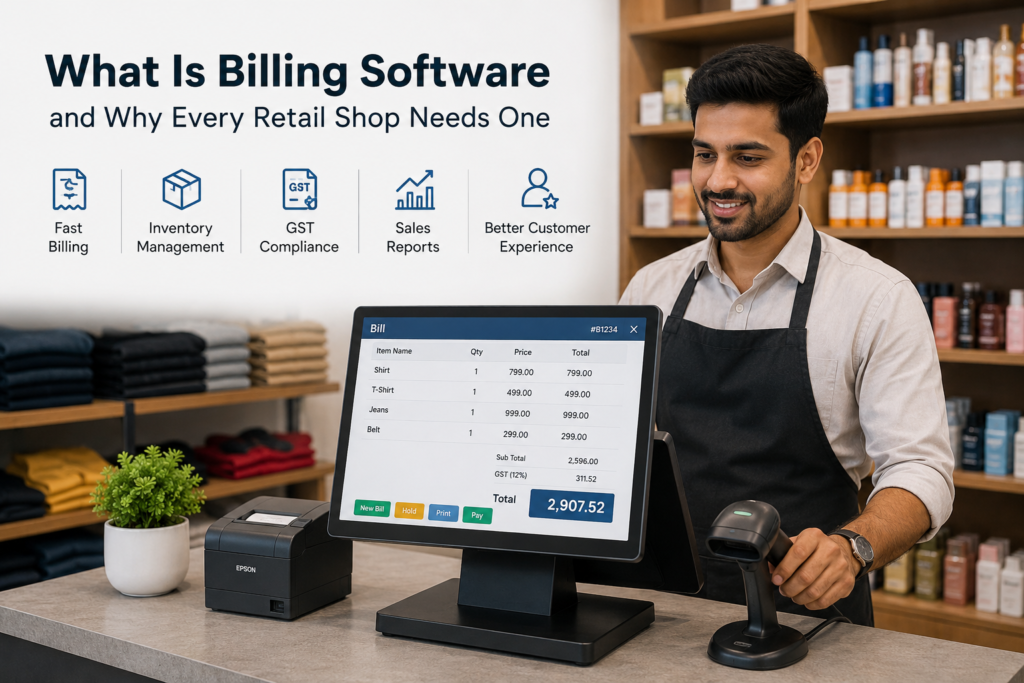
Billing software is a digital tool that creates accurate invoices, records every sale, manages stock, and handles payments from one screen. Instead of writing bills by hand or punching numbers into a calculator, you scan a product, the system pulls the price and tax automatically, and a clean GST-ready invoice is generated in seconds.
At its core, good billing software does three things well: it bills fast, it keeps records, and it tells you what is happening in your business. Everything else, from loyalty points to supplier orders, is built on top of those three pillars.
How Billing Software Works
The flow is simple, even though a lot happens behind the scenes:
- A staff member scans a barcode or searches for an item.
- The software fetches the price, the applicable GST rate, and current stock.
- Discounts, offers, or customer details are added if needed.
- The final invoice is generated and shared by print, SMS, email, or WhatsApp.
- Stock is reduced automatically, and the sale is recorded for reports and tax.
What used to take a minute per customer now takes a few seconds, and the numbers are always correct.
Billing Software vs a Simple Billing Machine
Many shop owners confuse billing software with a basic billing machine. They are not the same. A billing machine prints a receipt. Billing software runs your business.
| Aspect | Basic Billing Machine | Billing Software |
| Main job | Prints a receipt | Bills, tracks stock, reports, complies |
| GST handling | Manual or limited | Automatic, GST-ready invoices |
| Inventory | Not tracked | Updated in real time |
| Reports | None | Sales, profit, stock, and tax reports |
| Scalability | One counter | Many counters and branches |
| Data safety | Paper or local only | Cloud backup available |
Core Features of a Modern Retail Billing System
The best tools share a common set of features. When you evaluate options, look for these:
| Feature | What It Does for You |
| Fast GST invoicing | Generates tax-compliant bills in seconds |
| Inventory management | Tracks stock levels and alerts on low items |
| Barcode scanning | Speeds up billing and removes pricing errors |
| Payment integration | Accepts cash, cards, UPI, and wallets |
| Sales and profit reports | Shows what sells, when, and at what margin |
| Multi-store and cloud | Manages several outlets from anywhere |
| Customer management | Stores history and enables loyalty and offers |
A point of sale that combines these features into one clean screen is what separates a shop that guesses from a shop that grows.
Why Every Retail Shop Needs Billing Software
This is the heart of the matter. Here is what a reliable billing software for retail shop actually delivers, with real examples.
Speed at the Counter
During a festival rush, a clothing store using barcode billing can serve three customers in the time a manual counter serves one. Faster billing means shorter queues, more sales per hour, and happier customers.
Accuracy and Fewer Errors
Manual billing leads to wrong prices, missed items, and tax mistakes. The software applies the correct rate every time, so a medical store never charges the wrong MRP and never under-collects GST.
Real Inventory Control
You always know what is in stock. The system flags fast movers and slow movers, so a supermarket can reorder rice before it runs out and stop over-ordering products that sit on the shelf.
Better Customer Experience
Digital invoices, quick returns, and loyalty points bring customers back. A cosmetics shop that remembers a customer’s last purchase can recommend the right product and build loyalty.
Decisions Backed by Data
Reports answer the questions every owner asks: What is my best-selling product? Which day is busiest? What is my actual profit? Instead of guessing, you decide with numbers.
The Legal and Compliance Side You Cannot Ignore
Billing is not just about speed. In India, it is a legal responsibility. Every retail sale must follow GST rules, and the right software keeps you on the safe side automatically.
GST-Compliant Invoices
The software applies the correct GST rate, splits CGST and SGST, and formats invoices the way the law requires. This protects you during audits and builds trust with customers.
e-Invoicing and Turnover Thresholds
India has rolled out e-invoicing in phases, with the turnover threshold lowered over time. Businesses that cross the current limit must generate e-invoices through the government portal. Good billing software handles this directly, so you are never caught off guard when a threshold changes. (Always confirm the latest turnover limit with your tax advisor, since the figure is revised periodically.)
Clean Records and Audit Trails
Every invoice is stored, searchable, and backed up. When the tax department asks for records, you have them in seconds instead of digging through paper.
For Global Retailers
The same principles apply outside India. A store in Dubai or Singapore needs VAT-ready or tax-compliant invoices, multi-currency support, and secure digital records. Cloud billing software lets a single brand operate across markets with local tax rules built in.
Billing Software Across Retail Verticals
No two retail categories bill the same way. A good pos billing software adapts to the vertical it serves.
| Vertical | What the Billing Needs |
| Supermarket | High-speed barcode billing and weight-based pricing |
| Apparel and textile | Size and colour variants, season-based stock |
| Pharmacy and medical | Batch, expiry, and salt-wise tracking |
| Electronics | Serial number and warranty capture |
| Jewellery | Weight, purity, and making-charge billing |
| Books and stationery | Large catalogues and bulk school orders |
When the software matches the vertical, billing feels natural and the reports actually make sense.
How to Choose the Right Billing Software for Your Shop
Not every tool fits every shop. Before you commit to a shop billing software, run through this checklist:
- GST and e-invoice ready, with automatic tax rates
- Cloud access so you can check your shop from anywhere
- Offline mode so billing never stops if the internet drops
- Scalable from one counter to many branches
- Barcode, UPI, and card support out of the box
- Clear reporting on sales, stock, and profit
- Reliable local support and training
- Transparent pricing with no hidden costs
Indian Retail and Global Retail: One Tool, Many Markets
Indian retail is unique: high transaction volume, thin margins, strict GST rules, and price-sensitive customers. Global retail adds multi-currency billing, VAT or sales tax, and omnichannel selling. Modern cloud billing software is built to handle both. The same platform that bills a kirana store in Chennai can power an apparel outlet in Dubai, with local tax logic switched on per region.
Common Myths About Billing Software
- “It is only for big stores.” Even a single-counter shop saves time and reduces errors from day one.
- “It is too expensive.” Affordable plans exist, and the time and stock savings usually pay for the tool quickly.
- “It is hard to learn.” Modern interfaces are designed for staff with no technical background. Most teams are billing confidently within a day.
Conclusion
Billing software is no longer a luxury for large chains. It is the backbone of any retail shop that wants to bill faster, stay GST-compliant, control stock, and understand its own numbers. The shift from handwritten bills to a smart billing system is one of the highest-return upgrades a retailer can make.
If you run a retail business in India or beyond, the question is no longer whether you need billing software. It is how soon you can put one to work. Start with your busiest counter, choose a tool built for your vertical, and let the software do the heavy lifting while you focus on growing your shop.
Frequently Asked Questions
What is billing software in simple terms?
Billing software is a digital tool that creates invoices, records sales, manages stock, and handles payments from one place. It replaces handwritten bills and calculators with a fast, accurate, GST-ready system.
Is billing software the same as a POS system?
They overlap. A POS (point of sale) system includes the hardware and software at the checkout counter, while billing software is the program that generates invoices and manages sales. Most modern tools combine both into one solution.
Do small retail shops really need billing software?
Yes. Even a single-counter shop benefits from faster billing, fewer pricing errors, automatic GST, and clear stock records. The smaller the team, the more useful the automation.
Is billing software GST compliant in India?
Reliable billing software applies the correct GST rates, splits CGST and SGST, generates compliant invoices, and supports e-invoicing where required. Always confirm that your chosen tool is updated for the latest GST rules.
Can billing software work without the internet?
Many tools offer an offline mode that keeps billing running even when the connection drops, then sync the data to the cloud once you are back online. This matters for shops in areas with unstable internet.
How much does retail billing software cost?
Pricing varies by features, number of counters, and whether the tool is cloud-based. Entry-level plans are affordable for small shops, and costs scale with branches and advanced features. The time, accuracy, and stock-control savings usually outweigh the price.