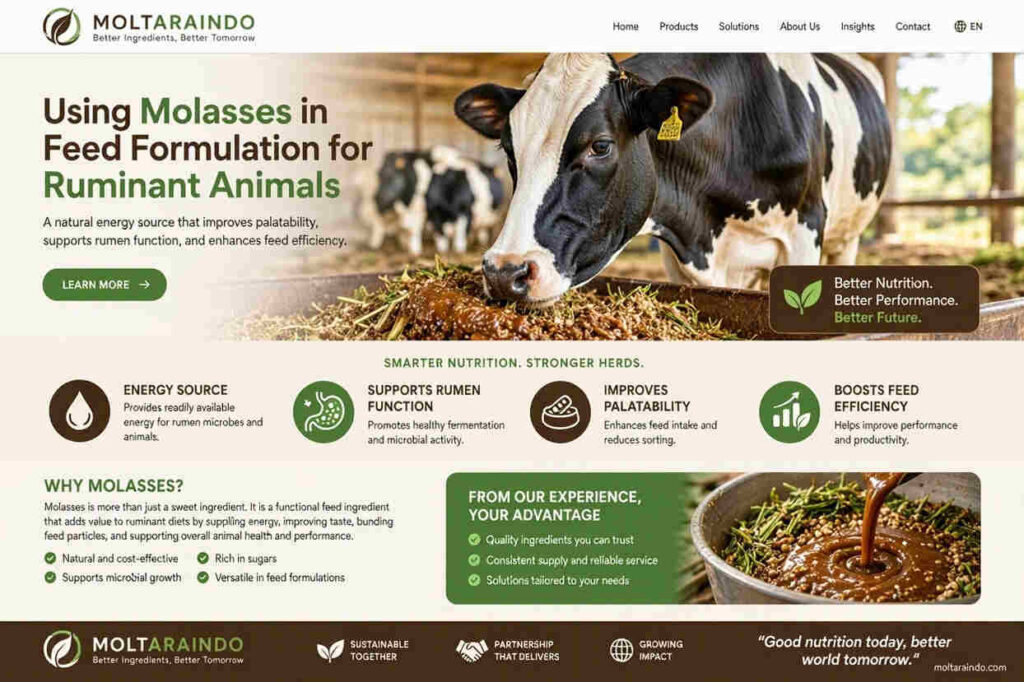
Using Molasses in Feed Formulation for Ruminant Animals – Ruminant nutrition requires a careful balance of energy, fiber, protein, minerals, and other nutrients to support digestion and animal performance. Cattle, sheep, and goats rely on rumen microorganisms to process many feed components, making the formulation of their diets different from that of monogastric animals. Sugarcane molasses is an ingredient that can be incorporated into selected ruminant feed formulations because of its carbohydrate content, palatability, and practical handling characteristics.
The successful use of molasses depends on understanding its nutritional contribution and how it interacts with other ingredients. Rather than treating it as a universal feed solution, producers and manufacturers should consider its role within a properly balanced ration.
Understanding Ruminant Feed Requirements
Ruminant animals depend on a functional rumen environment to digest fibrous materials and obtain nutrients from feed. Microorganisms in the rumen help break down forage and other dietary components, contributing to the animal’s energy and nutrient supply.
A balanced ration generally includes adequate forage, energy sources, protein, minerals, and water. The proportion of each component depends on animal species, age, body condition, production stage, and management goals.
Feed formulation must also consider how different carbohydrate sources are digested. Rapidly fermentable sugars and structural carbohydrates do not behave identically in the rumen. Maintaining appropriate dietary balance is therefore essential.
The Nutritional Role of Molasses
Sugarcane molasses contains residual sugars that can contribute energy to ruminant diets. It may be used in supplementary feeds and selected concentrate formulations where additional carbohydrate is required.
Its sweetness can also help improve feed acceptance. In some formulations, molasses is incorporated to encourage consumption of feed mixtures containing several ingredients.
However, molasses does not provide all the nutrients required for healthy animal production. Its contribution should be evaluated alongside forage, protein sources, minerals, and other feed ingredients.
Incorporating Molasses into Feed Mixtures
Molasses can be mixed with various feed materials depending on the production system and formulation objectives. These may include forage-based mixtures, concentrates, supplementary feed products, or selected commercial feed blends.
Its liquid form may help bind particles together and reduce dust in certain feed manufacturing processes. Manufacturers may also use molasses to improve the physical characteristics of mixtures.
The mixing process requires attention to viscosity, temperature, equipment capacity, and ingredient distribution. A suitable mixing system can help achieve consistent coverage and minimize the formation of uneven mixtures.
Feed manufacturers should conduct trials before adopting a new formulation at commercial scale. Trial results can provide information about mixing efficiency, feed stability, animal acceptance, and overall product performance.
Formulation Challenges and Nutritional Balance
Although molasses can be beneficial, excessive inclusion may create nutritional or processing challenges. High levels of readily fermentable sugars may affect rumen fermentation, particularly when the overall diet is not adequately balanced.
Feed producers should account for sugars from all ingredients and consider the availability of effective fiber. The ration should be formulated to support rumen function and avoid abrupt changes in dietary composition.
Molasses moisture may also affect dry matter calculations. Formulators should consider nutrient concentrations on an appropriate basis when comparing ingredients or calculating inclusion rates.
Storage and Handling Considerations
Molasses is a viscous liquid, so storage and handling require suitable facilities. Tanks, pipes, pumps, and dosing systems should be selected according to the product’s viscosity and the conditions under which it will be used.
Storage temperatures may influence flow characteristics. Feed manufacturers should follow supplier recommendations and maintain appropriate storage practices to protect product quality.
Clean storage systems and controlled handling can also reduce contamination risks and support consistent production.
Selecting a Suitable Molasses Supplier
Feed manufacturers purchasing molasses should establish clear quality specifications. These may include Brix, moisture, sugar content, ash, viscosity, and other parameters relevant to the formulation.
Buyers should request a Certificate of Analysis, confirm available packaging or bulk delivery options, and review supplier capability to meet expected volumes.
Reliable supply is particularly important for manufacturers whose feed formulations depend on consistent ingredient characteristics. A dependable supplier can help simplify procurement planning and support regular production schedules.
Conclusion
Cane Molasses can serve as a useful carbohydrate-containing ingredient in ruminant feed formulation. It may contribute energy, improve feed palatability, and support selected manufacturing processes.
Its effectiveness depends on inclusion level, nutritional balance, feed processing, storage, and animal requirements. By evaluating molasses as part of the complete ration and working with reliable suppliers, feed manufacturers can use this ingredient more effectively in modern ruminant nutrition.