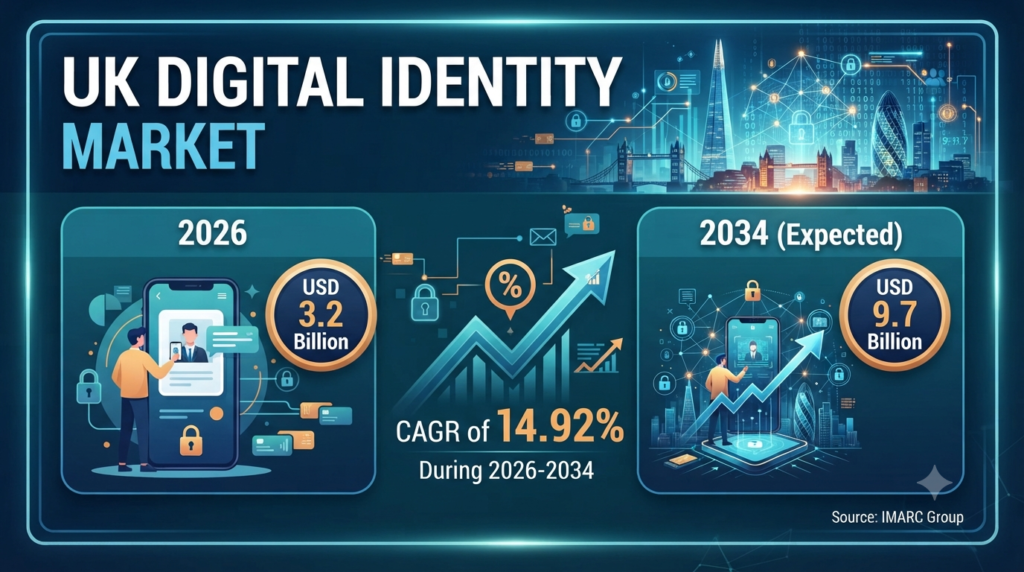
The UK digital identity market is witnessing strong growth driven by rising internet penetration, government-led digital identity initiatives, and the growing need for secure and efficient identity verification across banking, retail, government, and healthcare. The market size increased from USD 2.8 Billion in 2025 to USD 3.2 Billion in 2026 and is projected to reach USD 9.7 Billion by 2034, exhibiting a compound annual growth rate (CAGR) of 14.92% during 2026-2034. Rising cyberattacks and identity fraud, together with the UK Digital Identity and Attributes Trust Framework and GOV.UK One Login, which has verified over 2.2 million users through GOV.UK, are creating robust demand for biometric, cloud-based, and AI-enabled identity solutions across the country. This market is strategically important to the UK economy as it underpins secure digital onboarding, fraud prevention, regulatory compliance, and trusted access to public and private services.
The UK digital identity market is poised for sustained expansion, driven by government digital identity programmes and escalating cybersecurity threats. With a projected CAGR of 14.92% through 2034, the market presents significant opportunities for established identity verification providers and new entrants focused on biometric authentication, AI-driven fraud detection, and interoperable, privacy-preserving identity solutions.
UK DIGITAL IDENTITY MARKET SUMMARY
- Market Scope: The UK digital identity market encompasses solutions and services used to verify, authenticate, and manage the identities of individuals and organisations, including biometric authentication, document verification, identity management, and fraud monitoring.
- Ecosystem: The ecosystem includes technology vendors, identity verification providers, credit bureaus and data providers, system integrators, government bodies such as the Government Digital Service and the Office for Digital Identities and Attributes (OfDIA), and end users across regulated and consumer-facing industries.
- Major Segments: Segmentation covers identity type (biometric and non-biometric), offering (solutions and services), organization size (large organizations and SMEs), deployment (cloud and on-premise), end user (BFSI, retail and eCommerce, government, healthcare, and IT and ITeS), and region.
- Market Size: USD 2.8 Billion in 2025, rising to USD 3.2 Billion in 2026 and reaching USD 9.7 Billion by 2034 at a CAGR of 14.92% (2026-2034). Historical data covers 2020-2025 with 2025 as the base year.
- Policy Backdrop: The UK government has framed digital identity around trust, accessibility, security, and interoperability, with the Digital Identity and Attributes Trust Framework setting guidelines for private firms in line with data protection laws such as GDPR.
PORTER’S FIVE FORCES ANALYSIS – UK DIGITAL IDENTITY MARKET
The competitive dynamics of the UK digital identity market can be analyzed using Porter’s Five Forces framework.
Porter’s Five Forces Analysis – UK Digital Identity Market
- Competitive Rivalry: High, with a crowded field of global identity and fraud-prevention vendors, credit bureaus, specialist identity verification firms, and fast-growing startups competing for the same banking, government, and retail contracts. Rivalry is driven by rapid technology change in biometrics, liveness detection, and AI, as well as pressure to obtain certification under the UK trust framework. Business implication: Providers must differentiate through accuracy, inclusion, privacy-by-design, certification credentials, and integration depth rather than price alone.
- Supplier Power (Technology and Data Providers): Providers depend on cloud infrastructure, AI and biometric technology components, and authoritative data sources such as government and credit data. A concentrated set of hyperscale cloud and data suppliers gives them some leverage, although open standards and multi-cloud architectures limit lock-in. Business implication: Vendors should diversify technology partners, invest in proprietary algorithms, and secure long-term data-access agreements.
- Buyer Power (Banks, Government, and Large Enterprises): Moderate to High. Large banks, public-sector bodies, and major retailers purchase at scale, run structured procurements, and can switch providers or build in-house capabilities. They increasingly demand lower per-check pricing, strong compliance, and seamless user journeys. Business implication: Providers must prove measurable fraud reduction, conversion uplift, and regulatory alignment, and offer flexible, API-first pricing models.
- Threat of Substitutes: Passwords and multi-factor authentication, in-person document checks, government-operated sign-in services such as GOV.UK One Login, and platform-based wallets from large technology companies can substitute for commercial digital identity products in certain use cases. Business implication: Vendors should position reusable, certified digital identities that are interoperable with government and wallet ecosystems and add clear value beyond basic authentication.
- Threat of New Entrants: Barriers are lower for niche software and API-based verification products, particularly with cloud delivery and open-source AI tools. However, certification under the trust framework, the need for trust and brand credibility, and the cost of fraud-model training data raise barriers for providers seeking regulated and public-sector work. Business implication: Established players should build defensible positions through certification, proprietary data and models, and strong partnerships with regulated buyers.
Competitive Rivalry – High (Dynamic)
- Multi-tier competition spans global identity and data leaders, specialist identity verification and biometric providers, and technology startups, driving differentiation through product innovation, certification and trust credentials, and inclusive, privacy-preserving user experiences rather than destructive price competition.
- A maturing ecosystem, with the UK government’s 2026 sectoral analysis identifying 275 firms providing digital identity products and services and continued merger and acquisition activity, including the acquisitions of TrustID, Keyless, and DataTools, reflects active consolidation that is strengthening the overall market ecosystem.
Request for Sample Report: https://www.imarcgroup.com/uk-digital-identity-market/requestsample
MARKET GROWTH DRIVERS:
Rising Cyber Threats and Identity Fraud
Several key factors are propelling the expansion of the UK digital identity market. The growing frequency of cyberattacks and identity fraud is a powerful demand driver for stronger verification and authentication. The Cyber Security Breaches Survey 2024 found that 50% of businesses and 32% of charities reported a breach or attack in 2023, with higher rates among large businesses (74%), medium businesses (70%), and high-income charities (66%). In response, organisations are adopting biometric authentication, artificial intelligence, encryption, and real-time fraud monitoring, particularly in banking, retail, and government, which is increasing demand for secure and efficient identity verification solutions.
Government Digital Identity Initiatives and Rising Internet Penetration
The UK digital identity market is also benefiting from supportive policy and expanding digital adoption. The government promotes the Digital Identity and Attributes Trust Framework, which focuses on accessibility, security, and interoperability and sets guidelines for private firms while aiming to ensure compliance with data protection laws such as GDPR. Over 2.2 million users have verified their identity through GOV.UK, and GOV.UK One Login, built by the Government Digital Service with other departments from January 2023 and supported by new data-sharing legislation, emphasizes inclusion without creating ID cards. Rising internet penetration and the shift to digital channels are further expanding use cases across e-commerce, banking, and public services.
UK DIGITAL IDENTITY MARKET SEGMENTATION
Segmentation analysis provides a detailed view of the UK digital identity market by category:
- Identity Type Insights: Biometric, Non-Biometric.
- Offering Insights: Solutions, Services.
- Organization Size Insights: Large Organizations, SMEs.
- Deployment Insights: Cloud, On-Premise.
- End User Insights: BFSI, Retail and eCommerce, Government, Healthcare, IT and ITeS.
- Regional Insights: London, South East, North West, East of England, South West, Scotland, West Midlands, Yorkshire and The Humber, East Midlands, Others.
COMPETITIVE LANDSCAPE
The UK digital identity market is highly competitive, featuring established global players, innovative specialist providers, and public-sector initiatives. Key companies operating in the market include:
- Experian
- GBG (GB Group)
- IDEMIA
- Yoti
- Onfido
- LexisNexis Risk Solutions
- OneID
- iProov
Strategic developments are shaping the competitive arena, notably continued M&A activity, including the acquisitions of TrustID, Keyless, and DataTools, the entry into force of version 1.0 of the UK digital verification services trust framework from 1 September 2026 (subject to accreditation of conformity assessment bodies), and the government’s ongoing investment in GOV.UK One Login and GOV.UK Wallet, which are expanding the base of digital credentials in circulation.
REGIONAL ANALYSIS:
Regional dynamics within the UK digital identity market are shaped by the concentration of financial services, technology firms, and public-sector activity, as well as local digital strategies.
- London: The largest demand and innovation centre, supported by its concentration of banks, fintechs, and identity technology firms that require advanced onboarding, anti-fraud, and compliance solutions.
- South East and East of England: Strong technology, research, and corporate clusters support adoption of cloud-based identity and access management across enterprises.
- North West, Yorkshire and The Humber, West Midlands, and East Midlands: Growing financial services, retail, healthcare, and public-sector activity is driving uptake of identity verification and digital service access.
- South West: Increasing digital adoption across government, healthcare, and small businesses supports steady demand.
- Scotland: The market is driven by strong public-sector initiatives such as Digital Scotland, which promote secure digital access to public services.
- Others: Remaining regions are seeing gradual growth as online banking, e-commerce, and e-government services expand.
RECENT INDUSTRY DEVELOPMENTS
September 2026: Version 1.0 of the UK digital verification services trust framework, established under Part 2 of the Data (Use and Access) Act 2025, came into effect from 1 September 2026, subject to accreditation of conformity assessment bodies by the UK Accreditation Service.
July 2026: The UK government announced that it would not proceed with a government-issued national digital ID scheme, while work on GOV.UK One Login and GOV.UK Wallet continues.
July 2026: The Office for Digital Identities and Attributes published its 2026 Digital Identity Sectoral Analysis, identifying 275 UK firms providing digital identity products and services, generating an estimated GBP 2.027 billion in annual revenue and supporting 9,624 jobs.
March 2026: The Cabinet Office launched a public consultation on a proposed national digital ID system, which closed on 5 May 2026.
2025-2026: Merger and acquisition activity in the sector continued, including the acquisitions of TrustID, Keyless, and DataTools.
January 2023: The Cabinet Office’s Government Digital Service worked with other departments to build GOV.UK One Login, emphasizing inclusion and supported by new data-sharing legislation, with the government stating it aims to realize digital identity benefits without creating ID cards.
Key Aspects Required for the UK Digital Identity Market
- Market Performance: USD 2.8 Billion in 2025 and USD 3.2 Billion in 2026, with a projected trajectory to USD 9.7 Billion by 2034.
- Market Outlook: A 14.92% CAGR during 2026-2034 indicates robust growth across biometric and non-biometric identity solutions and services.
- Growth Drivers: Rising internet penetration; government digital identity initiatives such as the Digital Identity and Attributes Trust Framework and GOV.UK One Login; growing cyberattacks and identity fraud; and demand for secure and efficient identity verification.
- Competitive Landscape: A multi-tier structure with global identity and data leaders (Experian, GBG, IDEMIA), specialist providers (Yoti, Onfido, OneID, iProov), and emerging startups leveraging blockchain, AI, and biometrics, alongside public-sector programmes.
- Value Chain Analysis: From technology and data supply (biometrics, AI, cloud, and authoritative data sources) through solution development, identity proofing and verification, certification and compliance, and integration with end users across BFSI, retail, government, healthcare, and IT and ITeS.
- Industry Trends: Government-led trust frameworks and reusable digital credentials; biometric authentication, AI, encryption, and real-time fraud monitoring; cloud-based deployment; and expansion across e-commerce, banking, and public services.
- Strategic Recommendations: Focus on biometric and AI-enabled verification, certification under the UK trust framework, interoperability with GOV.UK One Login and digital wallets, privacy-preserving and inclusive design, and partnerships with banks, retailers, and public-sector bodies.
Note: If you need any specific information that is not covered currently within the scope of the report, we will provide the same as a part of customization.
Request Customization: https://www.imarcgroup.com/request?type=report&id=25431&flag=E
- Report Format, Delivery, and Customization Details
- Report Format Mode: PPT, PDF, and Excel
- Report Delivery Mode: Online Delivery, Physical Delivery
- Report Delivery Time: Report Delivered Over Email within 24 to 48 hours. If requested by the client, a physical copy will be delivered within three to ten days.
- Report Confirmation Mode: Yes via Email
- Report Customization Mode: Yes via Email / Call
- Report Table of Content: Yes
- Report List of Figures: Yes
- Report Methodology Mode: Yes
- Request For Sample Report: Yes