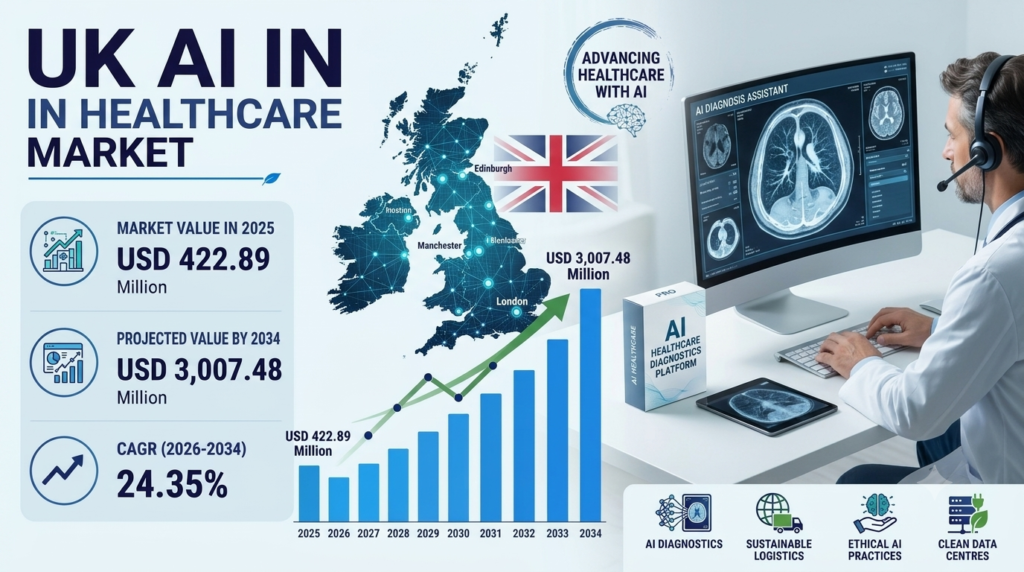
The UK AI in healthcare market is expanding at pace, propelled by the spread of digital health technologies, growing demand for precision medicine, and sustained government backing for healthcare innovation. The market size was valued at USD 422.89 Million in 2025 and is projected to reach USD 3,007.48 Million by 2034, exhibiting a compound annual growth rate (CAGR) of 24.35% during 2026-2034. The NHS’s £10 billion, three-year technology, digital and data programme, detailed in July 2026, together with the rollout of Microsoft 365 Copilot to 505,000 clinicians and support staff, is lifting demand for AI across diagnostics, clinical documentation, patient triage and administrative workflows. The market matters well beyond technology: it directly supports NHS productivity, earlier disease detection, and the country’s ambition to run one of the most AI-enabled health systems in the world.
The UK AI in healthcare market is poised for rapid expansion, anchored by a £10 billion NHS technology programme and a government-backed overhaul of AI regulation. With a projected CAGR of 24.35% through 2034, the market presents significant opportunities for software developers, imaging and diagnostics specialists, and pharmaceutical and biotechnology companies adopting AI-led discovery and personalised medicine.
UK AI IN HEALTHCARE MARKET SUMMARY
- Scope: The UK AI in healthcare market covers AI hardware, software and services applied to diagnostics, treatment planning, virtual care, drug discovery and administrative operations across NHS organisations and private healthcare providers.
- Ecosystem: Technology corporations, specialist healthcare AI developers and start-ups, NHS trusts, pharmaceutical and biotechnology companies, academic research centres, and regulators led by the MHRA.
- Major segments: Offering (hardware, software, services), technology (machine learning, context-aware computing, natural language processing, others), application (robot-assisted surgery, virtual nursing assistant, administrative workflow assistance, fraud detection, dosage error reduction, clinical trial participant identifier, preliminary diagnosis, others), end user (healthcare providers, pharmaceutical and biotechnology companies, patients, others), and region.
- Leading segments in 2025: Software holds a 04% share by offering, machine learning leads technology with 49.05%, virtual nursing assistant is the largest application at 18.06%, pharmaceutical and biotechnology companies lead end users with 35.03%, and the South East is the top region with a 14% share.
- Demand backdrop: Government investment, the availability of large NHS datasets for machine learning, and persistent workforce pressure are pushing providers toward automation and clinical decision support.
PORTER’S FIVE FORCES ANALYSIS – UK AI IN HEALTHCARE MARKET
The competitive dynamics of the UK AI in healthcare market can be assessed through Porter’s Five Forces framework.
Porter’s Five Forces Analysis – UK AI in Healthcare Market
- Competitive Rivalry: Moderate to High. Established technology corporations, specialist clinical AI developers and start-ups all pursue NHS trust and private provider contracts. Vendors compete on clinical validation, regulatory certification and integration with existing NHS systems more than on price. Business implication: build a visible evidence base and NHS reference sites early, because credibility with clinicians decides procurement outcomes.
- Supplier Power (Technology, Data and Compute Providers): Moderate. Cloud platforms, model providers and specialist data and hardware suppliers hold real leverage, yet the availability of several platforms and NHS-scale datasets limits lock-in. Business implication: avoid single-platform dependence, secure data-sharing agreements early, and design for interoperability.
- Buyer Power (NHS and Healthcare Providers): High. NHS England allocates licences centrally and buys through national frameworks, so a small number of buyers shape demand and expect proof of time savings and patient outcomes before scaling. Business implication: price against measurable productivity gains, such as the 43 minutes per day saved in the NHS Copilot trial, and be ready for staged pilots.
- Threat of Substitutes: Low to Moderate. Manual workflows, conventional digital tools and outsourced services remain alternatives, but workforce shortages and rising demand weaken their case. Business implication: quantify the gap between AI-enabled and manual processes in hours saved, waiting times and diagnostic speed.
- Threat of New Entrants: Moderate. Cloud infrastructure and accessible models lower technical barriers, while MHRA medical device rules, UK GDPR, NHS digital assurance and clinical validation requirements keep the bar high for clinical-grade products. Business implication: use regulatory pathways such as the MHRA’s AI Airlock sandbox to shorten time to market.
Competitive Rivalry – Moderate to High (Healthy)
- Multi-tier competition spans technology majors (Microsoft), specialist clinical AI companies (TORTUS, Brainomix, Skin Analytics, Ultromics) and emerging start-ups, driving differentiation through clinical evidence, regulatory certification and workflow integration rather than destructive price competition.
- Microsoft’s 505,000-licence agreement with NHS England (June 2026), Brainomix’s £4.8 million funding extension to expand in the US (February 2026), and Skin Analytics’ announced rollout of its DERM skin cancer AI across all 18 NHS South East trusts (October 2026) show active scaling and strategic repositioning across the market.
Request for Sample Report: https://www.imarcgroup.com/uk-ai-in-healthcare-market/requestsample
MARKET GROWTH DRIVERS:
Government Investment and Policy Support for Digital Health Innovation
Public funding and policy are the strongest forces behind the UK AI in healthcare market. In July 2026, NHS England set out how £10 billion over three years will be spent on technology, digital and data, an overhaul expected to deliver around half of the commitments in the 10 Year Health Plan and £41 billion in total benefits over the next decade. On the regulatory side, the Government confirmed in October 2026 that it will accept all 44 recommendations of the National Commission into the Regulation of AI in Healthcare, and the MHRA’s AI Airlock sandbox has secured three years of additional government funding. Clearer rules and dedicated funding lower adoption barriers for providers and give investors more confidence.
Rising Demand for Precision Medicine and Personalised Treatment
Providers and drug developers increasingly want tools that combine genomic information, clinical histories and imaging to tailor treatment. In August 2025, UK Biobank launched a three-year initiative to build a multi-modal AI model integrating health records, medical images and genomic data, and in May 2025 UCL and King’s College London trained a model on de-identified NHS data from 57 Million people in England to predict health outcomes. Extensive NHS datasets give machine learning applications a foundation few countries can match, which is also why pharmaceutical and biotechnology companies account for the largest end-user share at 35.03%.
Workforce Constraints and Operational Efficiency Requirements
Staff shortages and rising patient demand are making AI-assisted administration a practical necessity. The NHS trial of Microsoft 365 Copilot, covering more than 30,000 workers across 90 organisations, found average savings of 43 minutes per staff member per day, and the June 2026 decision to extend access to 505,000 staff followed directly. In a similar vein, NHS England says ambient voice technology can let clinicians spend up to a quarter more of their time with patients, and an AI A&E demand forecasting tool was deployed across 50 NHS organisations in England in December 2025.
UK AI IN HEALTHCARE MARKET SEGMENTATION
Segmentation analysis provides a detailed view of the UK AI in healthcare market by category:
- Offering Insights: Hardware, Software, Services. Software leads with a 46.04% share in 2025, supported by AI-powered platforms for clinical decision support, diagnostics and healthcare management.
- Technology Insights: Machine Learning, Context-Aware Computing, Natural Language Processing, Others. Machine learning leads with a 49.05% share in 2025.
- Application Insights: Robot-Assisted Surgery, Virtual Nursing Assistant, Administrative Workflow Assistance, Fraud Detection, Dosage Error Reduction, Clinical Trial Participant Identifier, Preliminary Diagnosis, Others. Virtual nursing assistant leads with an 18.06% share in 2025.
- End User Insights: Healthcare Providers, Pharmaceutical and Biotechnology Companies, Patients, Others. Pharmaceutical and biotechnology companies lead with a 35.03% share in 2025.
- Regional Insights: London, South East, North West, East of England, South West, Scotland, West Midlands, Yorkshire and The Humber, East Midlands, Others. South East leads with a 14% share in 2025.
COMPETITIVE LANDSCAPE
The UK AI in healthcare market is moderately fragmented, with established technology firms, specialist healthcare AI developers and start-ups forming partnerships with NHS trusts and private providers. Participants are pursuing collaborative research, targeted partnerships and platform integration to widen their offerings. Key companies active in the market include:
- Microsoft Corporation
- TORTUS AI
- Brainomix
- Skin Analytics
- Ultromics
- Kheiron Medical Technologies
- Aidoc
- ai
- ai
- DRUID AI
Recent strategic moves illustrate the pace: Microsoft’s agreement to supply Microsoft 365 Copilot and Copilot Studio to NHS England (June 2026), Brainomix’s funding extension to support international expansion (February 2026), and Skin Analytics’ announced DERM deployment across NHS South East trusts (October 2026).
REGIONAL ANALYSIS:
Regional dynamics in the UK AI in healthcare market reflect differences in research concentration, provider networks and digital infrastructure.
- South East: The leading region with a 14% share in 2025, helped by major healthcare institutions, pharmaceutical companies, strong links to London’s technology ecosystem and government-backed digital health programmes. Skin Analytics announced in October 2026 that its AI skin cancer checks would go live across all 18 NHS South East trusts.
- London: A hub for hospital-led AI research and trials; a Great Ormond Street Hospital-led trial across nine London sites found staff using ambient voice technology spent 25% more time interacting with patients.
- North West: The Cheshire and Merseyside Radiology Imaging Network introduced AI diagnostic technology in July 2025, enabling faster lung cancer detection across nine NHS trusts.
- East of England: Supported by the Cambridge life sciences and biotechnology cluster, with demand tied to AI-enabled drug discovery and pathology applications.
- South West: Somerset NHS Foundation Trust and Royal Devon are among the early NHS secondary care adopters of ambient AI documentation, according to TORTUS.
- Scotland: Operating its own policy track, with interim guidance on AI in health and social care in place, an AI policy framework due later in 2026, and a commitment to an AI Hub in its Programme for Government.
- West Midlands, Yorkshire and The Humber, and East Midlands: Growth is driven largely by England-wide programmes, including the central allocation of Copilot licences to every NHS trust and the planned availability of AI triage to all NHS App users by April 2028.
- Others (including Wales and Northern Ireland): NHS 111 Wales launched an AI-powered virtual assistant in July 2025, and Northern Ireland’s Health Minister welcomed the National Commission’s recommendations in October 2026.
RECENT INDUSTRY DEVELOPMENTS
October 2026: The UK Government confirmed it will accept all 44 recommendations of the National Commission into the Regulation of AI in Healthcare, and the MHRA opened applications for Phase 3 of its AI Airlock regulatory sandbox, focused on post-market surveillance and lifecycle regulation, with three years of additional government funding secured. The MHRA also committed to issuing draft guidance on managing changes to AI-enabled medical devices by December 2026.
September 2026: The independent National Commission into the Regulation of AI in Healthcare, led by NHS doctors, published its blueprint on 10 September following evidence gathering involving more than 12,000 people, recommending a proportionate, lifecycle-based approach to regulating AI in healthcare.
September 2026: The MHRA and Manchester NHS announced a partnership to create a health innovation sandbox that will test promising new technologies, including AI, and build evidence to accelerate their safe adoption in the NHS.
July 2026: NHS England set out how £10 billion of funding over three years will be used to overhaul NHS technology, digital and data systems, including an AI triage tool in the NHS App expected to reach more than 200,000 patients within a year and all NHS App users by April 2028, alongside national rollout of AI notetaking (ambient voice technology).
June 2026: NHS England announced that 505,000 clinicians and support staff will receive access to Microsoft 365 Copilot, following a trial of more than 30,000 NHS workers across 90 organisations, with rollout expected by October 2026.
Key Aspects Required for the UK AI in Healthcare Market
- Market Performance: USD 422.89 Million in 2025, with a projected trajectory to USD 3,007.48 Million by 2034.
- Market Outlook: A 24.35% CAGR through 2034 indicates rapid growth across diagnostics, virtual care, administrative automation and drug discovery applications.
- Growth Drivers: £10 billion NHS technology, digital and data investment; a government-backed regulatory reset for AI; large NHS datasets for machine learning; rising demand for precision medicine; and workforce pressure that rewards automation.
- Competitive Landscape: A moderately fragmented market in which technology majors, specialist clinical AI developers and start-ups partner with NHS trusts and private providers.
- Value Chain Analysis: From data and compute providers and AI developers, through clinical validation and MHRA regulatory pathways, to NHS procurement, integration with electronic health records, clinical deployment, and ongoing post-market monitoring.
- Industry Trends: Ambient voice technology for clinical notes; AI triage inside the NHS App; imaging AI for faster detection of conditions such as lung cancer and stroke; lifecycle-based regulation of AI medical devices; and AI-driven drug discovery and precision medicine.
- Market Restraints: Data privacy and security obligations under UK GDPR, integration with legacy NHS IT systems, and a shortage of professionals combining data science and clinical expertise.
- Strategic Recommendations: Prioritise clinically validated software with proven time-saving or outcome evidence; engage early with the MHRA’s AI Airlock and NHS assurance routes; design for interoperability with existing NHS systems; and build partnerships with NHS trusts, universities and pharmaceutical companies.
Note: If you need any specific information that is not covered currently within the scope of the report, we will provide the same as a part of customization.
Request Customization: https://www.imarcgroup.com/request?type=report&id=24916&flag=E
Report Format, Delivery, and Customization Details
- Report Format Mode: PPT, PDF, and Excel
- Report Delivery Mode: Online Delivery, Physical Delivery
- Report Delivery Time: Report Delivered Over Email within 24 to 48 hours. If requested by the client, a physical copy will be delivered within three to ten days.
- Report Confirmation Mode: Yes via Email
- Report Customization Mode: Yes via Email / Call
- Report Table of Content: Yes
- Report List of Figures: Yes
- Report Methodology Mode: Yes
- Request For Sample Report: Yes