Table of Contents
- What Exactly Is Sadaqah? Let’s Break It Down
- Zakat and Sadaqah: Two Sides of the Same Coin
- 10 Types of Sadaqah in Islam That Will Transform Your Life
- 10 Powerful Benefits of Sadaqah in Islam
- Practical Sadaqah Donation Ideas for Muslims
- How the Islamic Charity System Fights Poverty
- Conclusion
- Frequently Asked Questions
What Exactly Is Sadaqah? Let’s Break It Down
Have you ever handed a coffee to a stranger on a freezing morning and felt a warmth spread through your chest that had nothing to do with the caffeine? That feeling? That’s the echo of sadaqah. In Islam, generosity isn’t a luxury reserved for the rich. It’s a lifestyle woven into the very fabric of your daily existence.
Sadaqah Meaning in Islam Simple Explanation
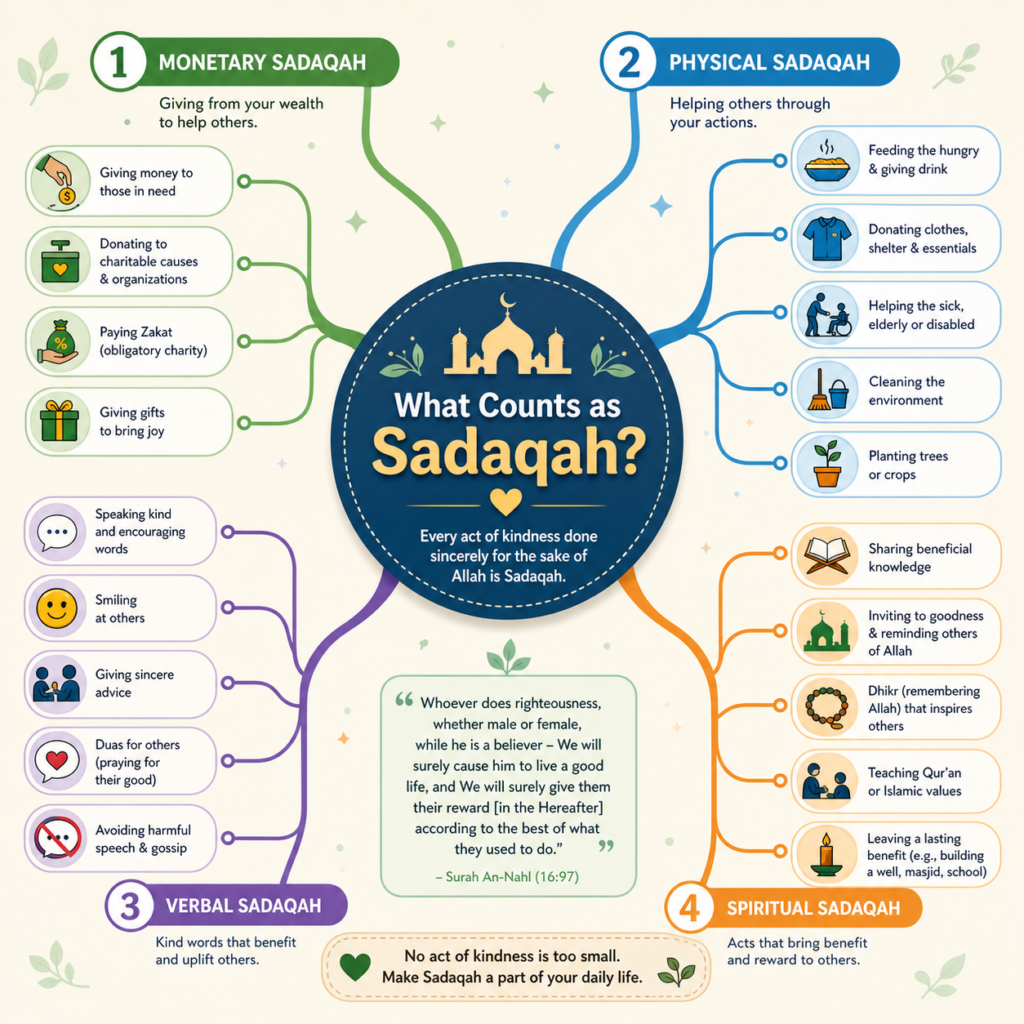
The sadaqah meaning in Islam simple explanation is beautifully straightforward. Sadaqah is any voluntary act of kindness, goodness, or charity performed solely to earn the pleasure of Allah (SWT). The Arabic root word sidq means sincerity and truthfulness. So when you give sadaqah, you’re not just handing over money — you’re declaring, with your actions, that your faith is real, raw, and alive. It’s the difference between saying “I care” and actually showing up at someone’s door with a hot meal at midnight.
Voluntary charity in Islam carries no minimum threshold, no deadline, and no bureaucratic red tape. You can give a dollar. You can give a date. You can give a kind word. The door is always open, and the reward is always multiplied.
What Is Sadaqah in Islam With Examples
So what is sadaqah in Islam with examples? Imagine you’re at the grocery store and the person ahead of you is counting coins, clearly short. You quietly cover the difference. That’s sadaqah. You help your elderly neighbor carry her groceries up three flights of stairs. Also sadaqah. You share a YouTube lecture that helps someone understand their deen better. Yep, that counts too.
The Prophet Muhammad ﷺ said, “Every act of goodness is sadaqah” (Sahih Muslim). That single hadith blows the doors wide open. Charity in Islam isn’t confined to your wallet — it lives in your hands, your tongue, your feet, and your heart. If you’re ready to start giving through a trusted channel, Al Mustafa Canada offers incredible donation programs that connect your generosity directly to communities in desperate need.
Zakat and Sadaqah: Two Sides of the Same Coin
Here’s where a lot of Muslims scratch their heads. “Wait, I already pay zakat. Do I still need to give sadaqah?” The short answer? Absolutely. The long answer? Keep reading, because this zakat vs sadaqah complete guide for beginners will clear everything up.
What Is Zakat in Islam Explained Simply
What is zakat in Islam explained simply? Zakat is the third pillar of Islam — a mandatory annual payment of 2.5% on wealth that exceeds a specific threshold (called nisab) and has been held for one full lunar year. The zakat meaning and importance in Islam cannot be overstated. It purifies your wealth the way soap purifies your hands. It’s not a penalty for being rich; it’s a mechanism for spiritual and economic balance. For a comprehensive breakdown, visit the Al Mustafa Canada Zakat page.
Difference Between Zakat and Sadaqah
The difference between zakat and sadaqah is like the difference between breathing and singing. Breathing is non-negotiable — you’ll die without it. Singing is voluntary, but it makes life infinitely more beautiful. Zakat is your spiritual breathing. Sadaqah is your spiritual singing.
Zakat has fixed rules, fixed recipients, and fixed timing. Sadaqah has none of those constraints. You can give sadaqah to your neighbor, a stranger, a mosque, or even an animal shelter. The benefits of paying zakat in Islam are enormous, but the benefits of charity in Islam through sadaqah are limitless.
Zakat Obligation in Islam You Can’t Ignore
The zakat obligation in Islam is serious business. If your net wealth crosses the nisab — the value of 87.48 grams of gold or 612.36 grams of silver — you owe 2.5%. No exceptions. Zakat rules for gold and silver apply to all jewelry, coins, and bullion you own. Yes, even the gold bangles sitting in your mother’s jewelry box count if they exceed the threshold.
How much zakat should I pay on savings? A flat 2.5% on all savings held for a full lunar year above nisab. For zakat on business income calculation, evaluate your total inventory, receivables, and cash, subtract liabilities, and apply the same rate. Use this zakat calculation guide to make the math painless.
How to Calculate Zakat Step by Step
Here’s your step by step zakat calculation guide for Muslims in four easy moves:
- Add up all zakatable assets — cash, savings, gold, silver, stocks, business inventory.
- Subtract immediate debts — credit card bills, loans due this month, outstanding invoices.
- Check the nisab — compare your net total to the current gold or silver threshold.
- Multiply by 2.5% — congratulations, that’s your zakat for the year.
Who is eligible to receive zakat in Islam? Surah At-Tawbah (9:60) names eight categories: the poor, the needy, zakat administrators, new Muslims, those in bondage, the debt-ridden, those fighting in Allah’s cause, and stranded travelers. Zakat distribution rules in Islam are meticulous because every cent must land in the right hands. See how Al Mustafa Canada distributes zakat to eligible families worldwide.
Zakat and Sadaqah at a Glance:
| Feature | Zakat | Sadaqah |
|---|---|---|
| Status | Mandatory (Fard) | Voluntary (Nafl) |
| Rate | Fixed 2.5% | Any amount you choose |
| Timing | Once per lunar year | Anytime, day or night |
| Recipients | 8 Quranic categories | Anyone, anywhere |
| Form | Monetary and assets | Money, time, smile, effort |
10 Types of Sadaqah in Islam That Will Transform Your Life
Alright, here’s the heart of this guide. The types of sadaqah in Islam are so diverse that literally every human being on the planet can participate — regardless of age, income, or location. Let’s walk through all ten, and I promise you’ll never look at charity the same way again.
1. Sadaqah Jariyah – The Everlasting Charity
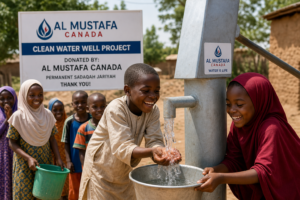
Sadaqah jariyah meaning translates to “flowing charity” — a donation that keeps generating reward long after your heart stops beating. Sadaqah jariyah examples include building a well that quenches thirst for decades, funding a school that educates generations, or planting an orchard that feeds entire villages. It’s the spiritual equivalent of planting a tree under whose shade you’ll sit in Jannah. Start your sadaqah jariyah through Al Mustafa Canada’s ongoing projects or their water well initiatives.
2. Financial Sadaqah – Opening Your Wallet for Allah
The most common and recognizable form. You give money — $10, $100, $10,000 — to someone who needs it more than you do. Helping poor in Islam through direct financial sadaqah is one of the fastest ways to earn Allah’s mercy. You can channel your giving through Al Mustafa Canada’s donation portal or support emergency relief efforts for disaster-hit communities.
3. Sadaqah of Knowledge – The Most Underrated Type
Teaching a child to read the Quran? Sharing a life-changing skill with a struggling single parent? That’s sadaqah, and it’s arguably the best sadaqah to give in Islam because knowledge outlives everything else. Support education programs to invest in minds that will shape the future of the ummah.
4. Sadaqah of Water – A Sip That Earns Jannah
When asked about the greatest sadaqah, the Prophet ﷺ replied, “A drink of water” (Ibn Majah). Over 700 million people still lack access to clean water. Contributing to water projects is a form of sadaqah that literally saves lives every single day.
5. Sadaqah of Food – Nourishing Bodies and Souls
Giving charity in Ramadan through iftar sponsorships is a beloved tradition, but feeding the hungry is sadaqah year-round. The Prophet ﷺ said, “The best charity is that given in Ramadan” (Tirmidhi). Explore Ramadan campaigns and Qurbani programs to maximize your food-based sadaqah.
6. Sadaqah of a Smile – The Easiest Charity on Earth
“Your smile in the face of your brother is charity” (Tirmidhi). In a world drowning in anxiety and outrage, a genuine smile is a revolutionary act of worship. Sadaqah benefits in daily life begin with something as effortless as greeting your mail carrier with warmth.
7. Sadaqah for Health and Protection
Sadaqah for health and protection is deeply rooted in prophetic tradition. The Prophet ﷺ advised giving charity to ward off illness and calamity. Think of it as spiritual armor — invisible, weightless, and impenetrable. Support healthcare initiatives to channel your sadaqah toward healing the sick.
8. Sadaqah for Forgiveness of Sins
Sadaqah for forgiveness of sins operates on a stunning principle: “Charity extinguishes sins as water extinguishes fire” (Tirmidhi). When guilt weighs heavy, reach into your pocket. The act of giving dissolves spiritual weight like warm water dissolves ice.
9. Sadaqah of Removing Harm
Picking up broken glass from a playground? Moving a fallen branch off a bike path? This is sadaqah. It’s the quietest, most invisible form of charity — and yet the Prophet ﷺ specifically praised it. Greatness doesn’t always roar; sometimes it whispers through a broom and a dustpan.
10. Sadaqah of Time and Service
Voluntary charity in Islam extends far beyond money. Volunteering at a soup kitchen, mentoring a teenager, or helping organize a masjid fundraiser are all valid sadaqah. Time is the one resource you can never earn back, which makes giving it away extraordinarily precious. Explore volunteer opportunities with Al Mustafa Canada.
Types of Sadaqah Quick Reference:
| Type | Example | Reward Duration |
|---|---|---|
| Sadaqah Jariyah | Building a well, school, or masjid | Lifetime + After death |
| Financial | Donating cash to the needy | Multiplied by Allah |
| Knowledge | Teaching Quran or skills | Ongoing |
| Water | Digging a well | Lifetime + After death |
| Food | Sponsoring iftar meals | Seasonal / Ongoing |
| Smile | Greeting warmly | Instant |
| Health | Funding medical camps | Ongoing |
| Forgiveness | Giving after a sin | Instant |
| Removing Harm | Cleaning a public path | Instant |
| Volunteering | Mentoring youth | Ongoing |
10 Powerful Benefits of Sadaqah in Islam
The 10 powerful benefits of sadaqah in Islam will reshape your relationship with money forever:
- Purifies wealth — strips spiritual impurities from your earnings like a filter cleans water.
- Shades you on Judgment Day — your sadaqah becomes your canopy when the sun is a mile away.
- Heals illness — both physical ailments and the spiritual diseases of greed and arrogance.
- Repels calamity — charity acts as a shield against disasters you’ll never even know about.
- Increases sustenance — paradoxically, giving makes you richer. Allah replaces what you spend and then some.
- Softens the heart — melts the ice of indifference and builds genuine empathy.
- Strengthens community — the Islamic social welfare system thrives on this mutual generosity.
- Unlocks barakah — opens doors of blessing you didn’t even know were locked.
- Earns continuous reward — especially through sadaqah jariyah that outlives you.
- Brings profound inner peace — a tranquility no luxury purchase, vacation, or promotion can replicate.
Practical Sadaqah Donation Ideas for Muslims
Looking for sadaqah donation ideas for Muslims you can act on right now? Here’s your cheat sheet:
- Sponsor an orphan through Al Mustafa Canada’s Orphan Sponsorship.
- Fund a Qurbani during Eid ul-Adha via Qurbani donations.
- Arrange an Aqiqah for a newborn in need through Aqiqah services.
- Pay Fitrana before Eid prayers at Fitrana donations.
- Give Fidya for missed fasts through Fidya contributions.
- Support emergency relief for disaster zones at Emergency Relief.
- Set up monthly auto-donations through the Al Mustafa Canada donation portal.
How the Islamic Charity System Fights Poverty
Why zakat is important for society becomes crystal clear when you zoom out. How zakat helps reduce poverty in Islam isn’t a theoretical debate — it’s a proven mechanism that redistributes billions annually. The zakat distribution system channels funds to the world’s most vulnerable populations with surgical precision.
When you combine the zakat obligation in Islam with the boundless flexibility of sadaqah, you create a dual-engine Islamic social welfare system that rivals any government program. Zakat for poor families and communities provides a baseline safety net, while sadaqah fills the gaps that formal systems miss. Organizations like Al Mustafa Canada stand at the intersection of faith and action, ensuring every dollar creates maximum impact. Contact their team to learn how you can be part of this transformative movement.
Conclusion
And there you have it — your complete, no-fluff guide to the types of sadaqah in Islam. From the smile you flash at a tired cashier to the well you fund on another continent, every act of sadaqah is a seed planted in soil whose harvest you’ll enjoy in the hereafter. The benefits of paying zakat in Islam lay the foundation, and the limitless rewards of sadaqah build the mansion on top. You don’t need to be wealthy. You don’t need to be perfect. You just need to start. So open your heart, open your hand, and watch how Allah opens doors you never even knew existed. The best time to give was yesterday. The second best time is right now.
Frequently Asked Questions
1. What are the main types of sadaqah in Islam?
The types of sadaqah in Islam include sadaqah jariyah (ongoing charity like building wells and schools), financial donations, sharing knowledge, providing water, feeding the hungry, smiling and showing good character, giving for health and protection, donating for forgiveness of sins, removing harm from public paths, and volunteering your time. Every Muslim can practice at least one of these regardless of income.
2. What is the difference between zakat and sadaqah?
The difference between zakat and sadaqah is that zakat is a mandatory 2.5% annual payment on qualifying wealth above the nisab threshold, distributed to eight specific Quranic categories. Sadaqah is entirely voluntary — any amount, any time, any form, and can benefit anyone. Zakat is the floor; sadaqah is the ceiling.
3. How do I calculate zakat on my savings and gold step by step?
Follow this step by step zakat calculation guide for Muslims: total all zakatable assets (savings, gold, silver, investments), subtract immediate debts, check if the net amount exceeds the nisab (87.48g gold or 612.36g silver), then pay 2.5%. For zakat rules for gold and silver, include all jewelry and bullion. Visit Al Mustafa Canada’s Zakat page for a detailed calculator.
4. What is the best sadaqah to give for continuous reward after death?
The best sadaqah to give in Islam for continuous reward is sadaqah jariyah. Sadaqah jariyah examples include building water wells, funding schools, planting trees, and establishing healthcare facilities. These acts keep generating reward even after you pass away, making them the most spiritually profitable investment a Muslim can make. Start through Al Mustafa Canada’s projects.
5. Can sadaqah really help with health problems and forgiveness of sins?
Yes. Sadaqah for health and protection is rooted in the Prophet’s ﷺ advice to give charity to ward off illness and calamity. Sadaqah for forgiveness of sins is supported by the hadith that charity extinguishes sins like water extinguishes fire. While sadaqah doesn’t replace medical treatment or sincere tawbah, it serves as a powerful spiritual complement that strengthens your bond with Allah during life’s toughest moments.