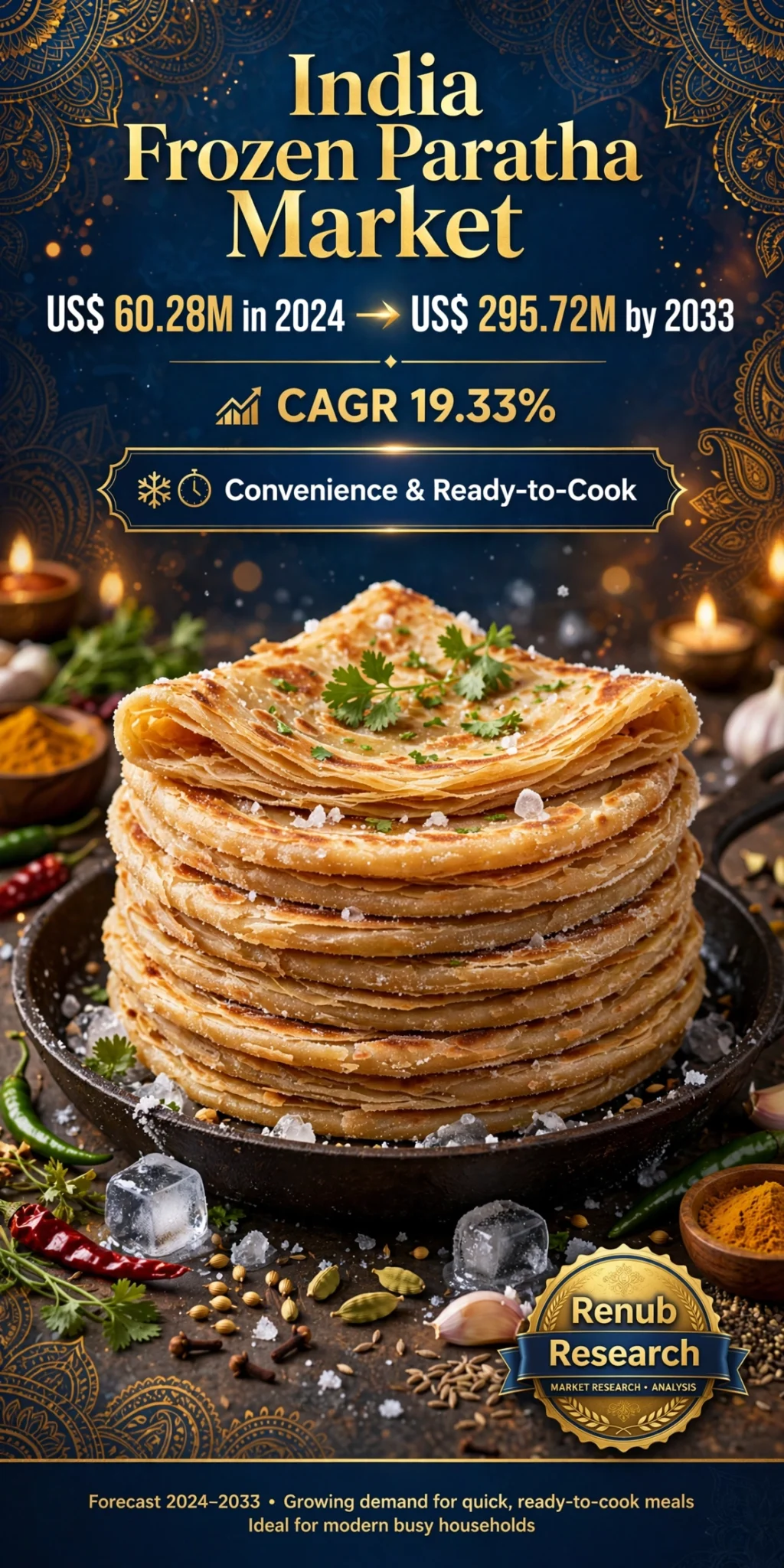
The Indian frozen food industry is undergoing a structural shift, with the Frozen Paratha Market emerging as a high-growth segment. Driven by rapid urbanization, the proliferation of quick-commerce platforms, and a fundamental change in consumer lifestyles, frozen parathas have transitioned from a niche convenience product to a staple in modern Indian households.
Market Drivers: Why Frozen Parathas Are Winning
The growth of this market is fueled by a “convenience revolution” across India’s major metropolitan hubs.
-
Urbanization and Busy Lifestyles: With approximately 180 million people living in India’s top 70 urban areas—a figure projected to reach 210 million by 2030—time-pressed professionals and nuclear families are increasingly prioritizing “ready-to-cook” (RTC) solutions that do not compromise on traditional taste.
-
Expansion of Modern Retail & Quick Commerce: The rise of organized retail (supermarkets and hypermarkets) and the entry of ultra-fast delivery apps have made frozen foods accessible within minutes. As of September 2024, global retail giants like Carrefour are aggressively entering the Indian market (specifically the Delhi-NCR region), further legitimizing and expanding the footprint of frozen categories.
-
Cold Chain Infrastructure: Significant investments in cold chain logistics have bridged the gap between manufacturers and Tier 2/Tier 3 cities. Advanced packaging technologies now ensure longer shelf life and better freshness, reducing the “perceived quality” barrier among skeptical consumers.
-
Product Innovation: Brands like Aashirvaad (which entered the segment in 2023) are diversifying portfolios to include healthier variants such as multigrain, low-oil, and preservative-free parathas, catering to health-conscious fitness enthusiasts.
Download Free Sample Report: https://www.renub.com/request-sample-page.php?gturl=india-frozen-paratha-market-p.php
Core Market Segments
The market is categorized by product type and regional demand, with specific varieties dominating different demographics.
Key Product Varieties
-
Malabar Paratha: Highly popular across the South and increasingly adopted nationwide for its soft, layered texture that mimics restaurant-quality flatbreads.
-
Lacha Paratha: A staple in North Indian foodservice; its crispy, layered appeal makes it the preferred choice for pairing with curries in both homes and restaurants.
-
Paneer & Aloo Paratha: These represent the “complete meal” segment, favored by families with children due to their high protein content and traditional flavor profiles.
Distribution Channels
-
Offline (Dominant): Traditional retail, kirana stores, and supermarkets remain the primary channel. Physical visibility in freezer sections drives impulse purchases and allows consumers to verify brand quality.
-
Online: E-commerce and quick-commerce platforms are the fastest-growing channels, providing unparalleled convenience for urban dwellers.
Regional Market Analysis
The frozen paratha market is geographically diverse, with specific states leading in consumption:
| State | Growth Driver |
| Maharashtra | High demand in Mumbai and Pune driven by fast-paced corporate lifestyles. |
| Uttar Pradesh | Adoption of RTC foods in emerging urban centers; high preference for North Indian paratha varieties. |
| West Bengal | Rising demand in Kolkata for both regional and North Indian flatbreads among nuclear families. |
| Andhra Pradesh | Growth in the foodservice sector (cloud kitchens/hotels) fueling bulk demand for Malabar and Lacha styles. |
Challenges to Market Expansion
Despite the upward trajectory, the industry must navigate significant hurdles:
-
Consumer Perception: A deep-rooted cultural preference for fresh, homemade food persists, particularly in rural India, where frozen food is often perceived as less nutritious or “stale.”
-
Logistical Costs: High dependency on uninterrupted power and cold storage adds a “price premium” to frozen goods, making them less affordable compared to fresh, scratch-made alternatives for cost-sensitive households.
Competitive Landscape
The market features a mix of established legacy food giants and specialized modern players. Key companies shaping the landscape include:
-
Market Leaders: ID Fresh (pioneers in fresh-to-frozen), Haldiram’s (massive distribution network), Sumeru, and Vadilal.
-
Emerging & Strategic Players: Aashirvaad (ITC), Goeld, Keventer, Godrej, and Milky Mist (Asal Foods).
These companies are currently focusing on “clean label” strategies—removing preservatives and using high-quality wheat—to bridge the trust gap between processed convenience and home-cooked health.
Frequently Asked Questions (FAQs)
1. What is the forecast for the India Frozen Paratha Market?
The market is expected to witness consistent growth through the forecast period of 2026–2034, driven by technological improvements in cold chain logistics and changing dietary habits in urban India.
2. Which paratha type is the most popular in the Indian market?
Malabar and Lacha parathas currently lead in terms of volume due to their versatility and popularity in both the restaurant and home-cooking segments.
3. Why are frozen parathas gaining popularity in Tier 2 and Tier 3 cities?
Improved cold chain infrastructure and the penetration of modern retail/e-commerce have made these products accessible outside of metro cities for the first time.
4. How are companies addressing the “fresh vs. frozen” consumer bias?
Manufacturers are increasingly launching “preservative-free,” “whole wheat,” and “low-oil” variants to market frozen parathas as a healthy, convenient alternative rather than just a processed snack.
5. What role do quick-commerce apps play in this market?
Quick-commerce apps facilitate impulse purchasing by delivering frozen parathas in under 20 minutes, effectively removing the planning barrier for busy households.
6. Are frozen parathas more expensive than homemade ones?
Yes, due to the high costs associated with refrigerated storage, distribution, and electricity, frozen parathas generally carry a price premium over scratch-made options.
7. Who are the primary consumers of frozen parathas in India?
The primary consumer base consists of working professionals, students living away from home, and nuclear families in urban areas who value time-saving solutions.