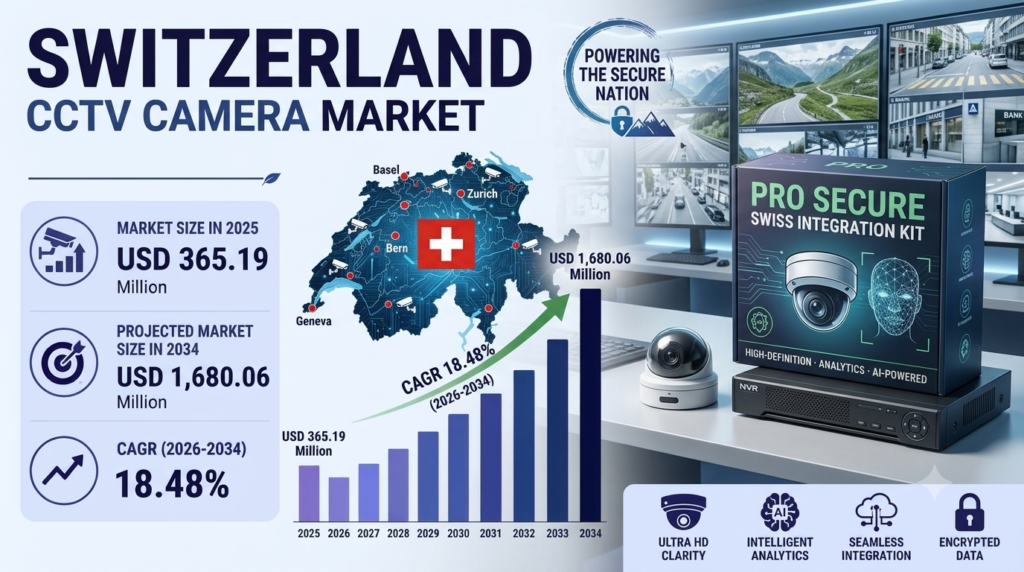
The Switzerland CCTV camera market is witnessing strong growth driven by escalating security requirements across government, commercial, and residential sectors, accelerating smart city deployments, and rising adoption of AI-enabled, IP-based surveillance solutions. The market size reached USD 365.19 Million in 2025 and is projected to reach USD 1,680.06 Million by 2034, exhibiting a compound annual growth rate (CAGR) of 18.48% during 2026-2034. The migration from legacy analog systems to network-based infrastructure, the integration of artificial intelligence for real-time analytics and threat detection, and the Federal Council’s Digital Switzerland Strategy 2025 are creating robust demand for advanced surveillance infrastructure across the country. This market is strategically important to Switzerland’s economy as it directly supports the protection of the nation’s financial centers, critical infrastructure, transportation networks, and public spaces.
The Switzerland CCTV camera market is poised for sustained expansion, driven by smart city programs, stringent financial-sector and critical-infrastructure security mandates, and rapid adoption of AI-powered IP cameras. With a projected CAGR of 18.48% through 2034, the market presents significant opportunities for established camera manufacturers, video management software developers, and system integrators focused on intelligent, cybersecure, and data-protection-compliant solutions.
SWITZERLAND CCTV CAMERA MARKET SUMMARY
The Switzerland CCTV camera market encompasses a wide range of surveillance products designed for real-time monitoring, deterrence, incident documentation, and operational oversight across government, industrial, financial, and transportation environments.
- Ecosystem: Camera manufacturers, video management software (VMS) and analytics developers, system integrators, distributors, and end-use organizations, with growing partnerships between camera makers and VMS providers to deliver unified security platforms.
- Type: Analog cameras, IP cameras (excluding PTZ), and PTZ cameras. IP cameras (excluding PTZ) dominated with approximately 60% revenue share in 2025, supported by superior image resolution, seamless network integration, Power over Ethernet (PoE) installation, and edge-based AI analytics.
- End User Vertical: Government, industrial, BFSI, transportation, and others. The government sector led with approximately 25% share in 2025, driven by public safety investments, critical infrastructure protection, and smart city surveillance across federal, cantonal, and municipal levels.
- Region: Zurich, Espace Mittelland, Lake Geneva Region, Northwestern Switzerland, Eastern Switzerland, Central Switzerland, and Ticino, with Zurich representing the largest regional market.
- Technology Shift: Transition from analog to IP-based systems, resolutions reaching eight megapixels and beyond, AI-driven facial recognition, behavior analysis, and license plate detection, and cloud-based storage with remote access.
- Regulatory Environment: Data protection rules aligned with European GDPR standards, FINMA operational resilience requirements for banks, and mandatory cyberattack reporting for critical infrastructure operators under the revised Information Security Act.
PORTER’S FIVE FORCES ANALYSIS – SWITZERLAND CCTV CAMERA MARKET
The competitive dynamics of the Switzerland CCTV camera market can be analyzed using Porter’s Five Forces framework.
Porter’s Five Forces Analysis – Switzerland CCTV Camera Market
- Competitive Rivalry: Moderate to High. Established multinational surveillance technology corporations compete alongside specialized European security solution providers, with rivalry centered on AI-powered analytics, cybersecurity compliance, and integration capabilities rather than price alone. Business implication: Vendors must differentiate through edge AI innovation, robust cybersecurity credentials, and strategic partnerships with VMS developers and system integrators to defend share.
- Supplier Power (Components and Technology Providers): Moderate. Image sensors, system-on-chip processors, neural processing units, optics, and storage components are sourced from a concentrated set of global suppliers, although leading manufacturers are reducing dependence through proprietary chipsets such as ARTPEC-9 and Wisenet 9. Business implication: Manufacturers should pursue multi-sourcing, long-term supply agreements, and in-house silicon development to protect margins and product roadmaps.
- Buyer Power: Moderate to High. Government bodies, banks, and critical infrastructure operators are large, sophisticated buyers with strict technical specifications, formal procurement processes, and extensive cybersecurity evaluations, while small and medium enterprises are more price sensitive. Business implication: Suppliers must offer certified, cybersecure, interoperable solutions with strong local support and flexible commercial models such as cloud-based subscriptions.
- Threat of Substitutes: Low to Moderate. Alternatives such as manned guarding, alarm and access control systems, radar, thermal, and other sensor technologies, or drone-based monitoring can complement or partially replace cameras, but none replicate the visual verification and forensic evidence that CCTV provides. Business implication: Vendors should position cameras within integrated security ecosystems that combine video, access control, and analytics.
- Threat of New Entrants: Moderate. Barriers include R&D intensity for AI analytics, compliance with Swiss and European data protection rules, cybersecurity scrutiny, and established integrator and distribution relationships, while cloud-native and niche analytics players face lower entry barriers. Business implication: Incumbents should build defensible positions through cybersecurity leadership, software ecosystems, and long-term partnerships with integrators and public-sector buyers.
Competitive Rivalry – Moderate (Healthy)
- Moderate competitive intensity is shaped by established multinational surveillance technology corporations and specialized European security solution providers – driving differentiation through AI-powered analytics, cybersecurity compliance, and comprehensive integration capabilities rather than destructive price competition.
- Axis Communications’ launch of AXIS Secure Entry for XProtect (September 2025) and Hanwha Vision’s second-generation X Series AI cameras with dual neural processing units (June 2025) reflect active product innovation and ecosystem partnerships that are strengthening the overall market.
Request for Sample Report: https://www.imarcgroup.com/switzerland-cctv-camera-market/requestsample
MARKET GROWTH DRIVERS:
Several key factors are propelling the expansion of the Switzerland CCTV camera market. Smart city initiatives serve as a powerful demand driver, as municipal governments in major urban centers such as Zurich and Geneva deploy integrated monitoring solutions combining video surveillance with traffic management, environmental monitoring, and public safety applications. These networks feed centralized analytics platforms that enable predictive policing, crowd management, and emergency response coordination, supported by the Swiss Federal Council’s Digital Switzerland Strategy 2025 and its ‘digital first’ principle. Additionally, financial sector security requirements are driving premium camera adoption, as Switzerland’s position as a global financial center generates sustained investment across banking facilities, wealth management offices, data centers, and vault areas. FINMA Circular 2023/01 on operational risks and resilience for banks entered into force on January 1, 2024, and the final Basel III standards entered into force in January 2025, continuing to strengthen security mandates.
MARKET GROWTH DRIVERS:
The Switzerland CCTV camera market is also benefiting from accelerating critical infrastructure protection mandates and technology adoption. Energy production facilities, transportation networks, and healthcare institutions face growing pressure to implement comprehensive surveillance with analytics and access control integration. Under the revised Information Security Act, the mandatory reporting obligation for cyberattacks on critical infrastructure came into force on April 1, 2025, requiring operators to report incidents to the National Cyber Security Centre (NCSC) within 24 hours. Furthermore, the adoption of AI-powered analytics such as facial recognition, behavior analysis, and license plate detection, together with the transition to IP-based network cameras with resolutions of eight megapixels and beyond, is enabling faster threat detection and remote accessibility. Cloud storage and remote access capabilities, including platforms such as Axis Cloud Connect, further support multi-site enterprises seeking centralized security operations while reducing on-premises storage investments.
SWITZERLAND CCTV CAMERA MARKET SEGMENTATION
Segmentation analysis provides a detailed view of the Switzerland CCTV camera market by category:
- Type Insights: Analog Cameras, IP Cameras (excluding PTZ), PTZ Cameras.
- End User Vertical Insights: Government, Industrial, BFSI, Transportation, Others.
- Regional Insights: Zurich, Espace Mittelland, Lake Geneva Region, Northwestern Switzerland, Eastern Switzerland, Central Switzerland, Ticino.
IP cameras (excluding PTZ) accounted for approximately 60% of the market in 2025, while the government sector held the largest end user share at approximately 25%. The industrial and BFSI sectors represent significant growth opportunities for asset protection, operational oversight, and regulatory compliance, while the transportation sector continues expanding coverage across railway networks, airports, and public transit systems.
COMPETITIVE LANDSCAPE
The Switzerland CCTV camera market exhibits moderate competitive intensity, with established multinational surveillance technology corporations competing alongside specialized European security solution providers. European manufacturers benefit from GDPR compliance expertise and localized support, while global players leverage extensive portfolios and distribution networks. Key companies operating in the market include:
- Axis Communications AB
- Hanwha Vision Co., Ltd.
- Robert Bosch GmbH (Bosch Security and Safety Systems)
- Hangzhou Hikvision Digital Technology Co., Ltd.
- Dahua Technology Co., Ltd.
- Honeywell International Inc.
- Motorola Solutions, Inc. (Avigilon)
- i-PRO Co., Ltd.
Strategic developments are shaping the competitive arena, notably Axis Communications’ unveiling of four next-generation AI-powered bullet cameras (AXIS P1475-LE, P1485-LE, P1487-LE, and P1488-LE) built on ARTPEC-9 with resolutions from 2MP to 8MP, Hanwha Vision’s second-generation X Series AI cameras powered by the Wisenet 9 SoC, and the growing integration of cameras with access control and video management platforms such as Milestone XProtect. Edge AI processing, cloud connectivity, and sustainable product design are emerging as key differentiators influencing procurement decisions.
REGIONAL ANALYSIS:
Regional dynamics within the Switzerland CCTV camera market are shaped by varying concentrations of financial institutions, government bodies, industry, and tourism.
- Zurich: The largest regional market, driven by the concentration of financial institutions, corporate headquarters, and critical infrastructure; its status as a global banking center necessitates sophisticated surveillance for high-value asset protection and regulatory compliance.
- Espace Mittelland: Encompassing the federal capital Bern, the region shows strong demand for government and institutional solutions across federal administrative buildings, diplomatic facilities, and public transportation networks.
- Lake Geneva Region: Including Geneva and Lausanne, demand is driven by international organizations, luxury hospitality, and the pharmaceutical industry, with United Nations agencies and multinationals requiring high-specification systems.
- Northwestern Switzerland: With Basel as its primary urban center, activity is driven by pharmaceutical manufacturing, chemical industries, cross-border commercial facilities, and logistics security.
- Eastern Switzerland: Growing surveillance investment across manufacturing, tourism, and commercial sectors, supported by an industrial base and border proximity.
- Central Switzerland: Combines tourism-driven requirements with residential and commercial security applications, with growing commercial development supporting infrastructure investment.
- Ticino: Switzerland’s Italian-speaking canton presents distinct characteristics influenced by cross-border commerce with northern Italy, tourism, and residential security needs.
RECENT INDUSTRY DEVELOPMENTS
November 2025: The Federal Council of Switzerland amended the Aviation Act to permit biometric processing at airports, a move that would enable the use of facial-recognition cameras for identity verification during check-in and boarding.
September 2025: Axis Communications launched AXIS Secure Entry for XProtect, an all-in-one solution uniting access control and video surveillance within the Milestone XProtect interface for unified monitoring of door activity and live or recorded video.
June 2025: Hanwha Vision introduced the second-generation X Series AI cameras powered by the Wisenet 9 AI-native System on Chip, featuring dual neural processing units for simultaneous image processing and advanced object detection analytics.
April 2025: The mandatory reporting obligation for cyberattacks on critical infrastructure came into force under the revised Information Security Act, requiring operators to report to the National Cyber Security Centre (NCSC) within 24 hours of discovery.
April 2024: Axis Communications launched Axis Cloud Connect, an open cloud-based platform including AXIS Camera Station Pro, AXIS Camera Station Edge, and AXIS Camera Station Center for secure, scalable, multi-site security solutions.
Key Aspects Required for the Switzerland CCTV Camera Market
- Market Performance: USD 365.19 Million in 2025, with a projected trajectory to USD 1,680.06 Million by 2034.
- Market Outlook: An 18.48% CAGR during 2026-2034 indicates exceptional growth across government, commercial, and residential applications as smart city programs mature and AI-powered analytics gain broader adoption.
- Growth Drivers: Smart city initiatives and the Digital Switzerland Strategy 2025; financial sector security and regulatory requirements; critical infrastructure protection mandates; AI-powered analytics; and migration from analog to IP-based and cloud-enabled systems.
- Competitive Landscape: Moderate competitive intensity, with multinational surveillance technology leaders (Axis Communications, Hanwha Vision, Bosch, Hikvision, Dahua, Honeywell, Motorola Solutions, i-PRO) competing alongside specialized European providers on AI analytics, cybersecurity compliance, and integration.
- Value Chain Analysis: From component suppliers (image sensors, SoCs, optics, storage) through camera manufacturers and VMS and analytics developers to distributors, system integrators, end users, and ongoing maintenance and managed services.
- Industry Trends: AI-powered surveillance with facial recognition and behavior analysis; transition to IP-based network cameras; cloud storage and remote access; convergence of video surveillance with access control; and rising emphasis on cybersecurity credentials.
- Strategic Recommendations: Invest in edge AI and cybersecurity-hardened products; build partnerships with VMS providers and system integrators; target government, BFSI, and critical infrastructure segments; offer cloud and subscription models to ease adoption by small and medium enterprises; and ensure compliance with Swiss and European data protection requirements.
Note: If you need any specific information that is not covered currently within the scope of the report, we will provide the same as a part of customization.
Request Customization: https://www.imarcgroup.com/request?type=report&id=41399&flag=E
- Report Format, Delivery, and Customization Details
- Report Format Mode: PPT, PDF, and Excel
- Report Delivery Mode: Online Delivery, Physical Delivery
- Report Delivery Time: Report Delivered Over Email within 24 to 48 hours. If requested by the client, a physical copy will be delivered within three to ten days.
- Report Confirmation Mode: Yes via Email
- Report Customization Mode: Yes via Email / Call
- Report Table of Content: Yes
- Report List of Figures: Yes
- Report Methodology Mode: Yes
- Request For Sample Report: Yes