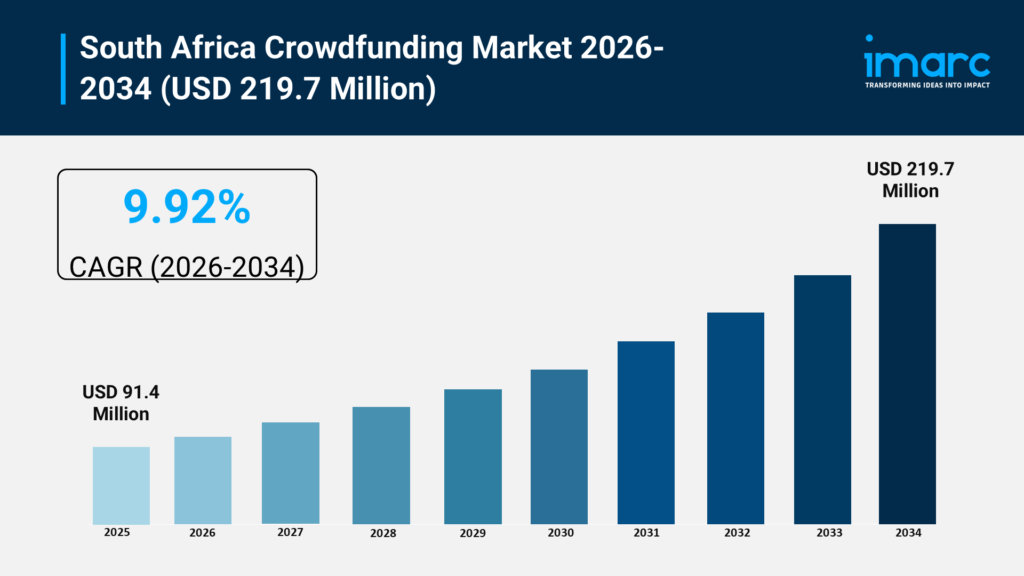
South Africa Crowdfunding Market Growing demand for alternative financing, rapid digitalization, and rising use of online platforms by startups, small businesses, nonprofits, and community projects are supporting adoption. Internet access now covers about 85% of the population according to Stats SA’s general household survey, and 98.4% of internet users own a smartphone. South Africa crowdfunding market size grew from USD 91.4 Million in 2025 to USD 103.0 Million in 2026. The market is projected to reach USD 219.7 Million by 2034, exhibiting a growth rate (CAGR) of 9.92% during 2026-2034. This gives campaigners a large online audience that can be reached through social media and mobile payments. Clearer oversight by the Financial Sector Conduct Authority (FSCA) is also helping to build confidence in crowdfunding platforms across the country.
How AI is Reshaping the Future of South Africa Crowdfunding Market?
- AI-driven credit and risk scoring helps peer-to-peer lending platforms such as RainFin assess borrowers faster and more consistently. This matters in a market where regulation requires platform participants in debt-based crowdfunding to register as credit providers, and where small businesses often lack collateral to qualify for traditional bank loans.
- AI analytics tools help campaign owners decide when to launch, which audiences to target, and which messages to use. This is valuable in a country where 70% of internet users shop online and 78% actively use online banking, so supporters are already comfortable with digital payments.
- Machine learning fraud detection is becoming a core requirement for platforms after high-profile failures. The FSCA fined Livestock Wealth and the platform lost its licence, and the model was later reported as facing liquidation. Automated screening of campaigns and investor flows helps protect backers and rebuild trust.
- AI-powered donor engagement tools help nonprofits personalize appeals and thank-you messages. South African NPOs now use around 15 local and international portals to raise funds, so tailored outreach helps them stand out and retain supporters.
- AI chat assistants and automated onboarding on mobile-first platforms help first-time campaigners complete verification, write campaign pages, and manage payments. This is relevant because 65% of surveyed South African microenterprises own a smartphone but only 38% use the internet for business.
Grab a sample PDF of this report: https://www.imarcgroup.com/south-africa-crowdfunding-market/requestsample
Market Growth Factors
The South African crowdfunding market is driven by the gap between what entrepreneurs need and what traditional lenders are willing to offer. High collateral demands and strict lending terms leave many startups, social enterprises, and community projects without access to formal credit. Crowdfunding platforms fill this gap with models suited to different goals. Thundafund supports rewards-based campaigns, Uprise.Africa focuses on equity, RainFin connects business borrowers with lenders, and BackaBuddy serves donation-based causes. Digital reach is strong, with 193 mobile connections for every 100 people and mobile internet used by almost all online users. Social media lets campaigners share updates in real time, which lowers marketing costs and widens the supporter base well beyond a founder’s immediate network.
Regulation and platform economics are shaping how the market matures. South Africa has no single crowdfunding law, so platforms operate under existing frameworks including the Financial Markets Act, the National Credit Act, FAIS, and FICA, with the FSCA as the main regulator. Peer-to-peer equity platforms may be treated as exchanges requiring FSCA licensing, while debt platforms must register as credit providers. Industry self-regulation through the African Crowdfunding Association adds another layer of credibility. Platforms are also competing on price. BackaBuddy removed its platform fees for donation campaigns, leaving only payment processing costs, which makes it cheaper for individuals and charities to raise money. At the same time, enforcement action against failed crowd-farming models has pushed legitimate operators to improve transparency, escrow practices, and investor communication.
Evolving lifestyles and government support for small business are further widening the opportunity. Mobile payments are growing, although only 48% of users currently use mobile financial transactions, which leaves room for deeper adoption. The rural and urban gap in internet use has narrowed from 45 percentage points to 23 percentage points, bringing more people from outside the major cities into online fundraising. Impact investing is encouraging individuals and institutions to back social, environmental, and cultural projects, from community health drives to creative productions. Government initiatives aimed at small business development and job creation encourage entrepreneurs to explore crowdfunding alongside bank loans and venture capital, while nonprofits use it to diversify donor income.
Market Segmentation
Type Insights:
- P2P Lending
- Equity Investment
- Hybrid
- Reward-based
- Others
End Use Insights:
- Entrepreneurship
- Social Cause
- Movies and Theater
- Real Estate
- Music
- Technology
- Publishing
- Others
Regional Insights:
- Gauteng
- KwaZulu-Natal
- Western Cape
- Mpumalanga
- Eastern Cape
- Others
Recent Development & News
- May 2026: Reports described a final liquidation order against Livestock Wealth, once South Africa’s most popular agro-crowdfunding platform, after a series of collapses in the sector. The case has increased scrutiny of crowd-farming models and highlighted the importance of strong investor protection, transparent returns, and proper licensing across crowdfunding platforms.
- January 2026: The FSCA fined Livestock Wealth and withdrew its licence for contravening the Financial Sector Regulation Act and the Financial Advisory and Intermediary Services Act. The outcome closed a long-running investigation, though concerns remained over delayed investor withdrawals, reinforcing demand for regulated and well-governed platforms.
- June 2025: BackaBuddy introduced 0% platform fees for donation-based campaigns, with only payment processing fees still applying. The move lowers costs for individuals, schools, and charities raising money for medical bills, education, and community projects, and encourages wider use of online giving.
- December 2024: South African NPOs increasingly adopted crowdfunding, using 15 local and international portals to raise funds. This digital shift improved transparency, broadened donor reach, and strengthened fundraising capacity across the nonprofit sector.
About Us
IMARC Group is a global management consulting firm that helps the world’s most ambitious changemakers to create a lasting impact. The company provide a comprehensive suite of market entry and expansion services. IMARC offerings include thorough market assessment, feasibility studies, company incorporation assistance, factory setup support, regulatory approvals and licensing navigation, branding, marketing and sales strategies, competitive landscape and benchmarking analyses, pricing and cost research, and procurement research.
Contact Us
IMARC Group,
134 N 4th St. Brooklyn, NY 11249, USA,
Email: sales@imarcgroup.com,
Tel No: (D) +91 120 433 0800,
United States: +1-201971-6302