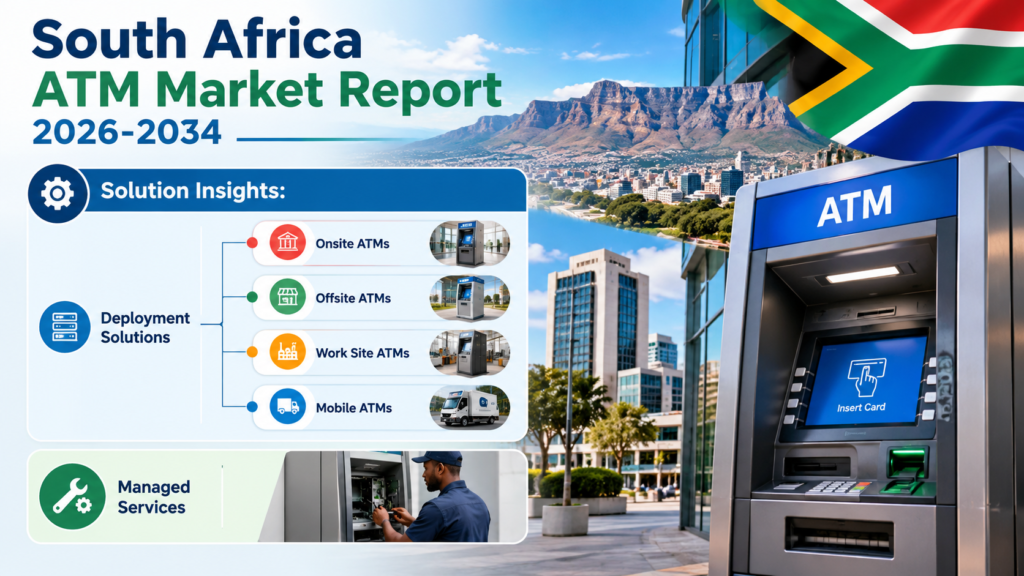
The South Africa ATM market supported by the country’s strong cash economy, bank investment in cash-recycling and deposit-enabled machines, and regulatory efforts to protect access to cash. South Africa ATM market size reached USD 69.2 Million in 2025. Looking forward, the market is expected to reach USD 114.6 Million by 2034, exhibiting a growth rate (CAGR) of 5.47% during 2026-2034. The Reserve Bank estimates that about two thirds of transactions in the country are still made in cash, which sustains demand for reliable cash access points. The country has around 30,000 ATMs, and the South African Reserve Bank (SARB) is preparing a shared white-label ATM network to extend coverage into underserved areas.
How AI is Reshaping the Future of South Africa ATM Market?
- AI-powered predictive maintenance helps ATM operators and deployers monitor machine health, anticipate component failures, and cut downtime. This matters as banks run fewer but higher-capacity machines that must stay available.
- AI-driven cash forecasting lets banks and cash-in-transit providers predict withdrawal demand at each ATM site. This reduces idle cash, lowers cash handling and replenishment costs, and limits the number of trips made by vehicles at risk of heists. South Africa recorded 31 cash-in-transit robberies in the first three months of 2026.
- Computer vision and machine learning tools strengthen fraud and crime prevention by detecting skimming devices, card trapping, suspicious behavior, and unusual transaction patterns in real time. These tools address a main reason banks have decommissioned ATM sites, which is sporadic violent crime.
- Machine learning is used to analyze transaction data and decide where ATMs should be placed, relocated, or removed. This supports bank programs that move low-usage machines to more convenient locations and replace them with newer devices that serve more clients.
- AI-enabled customer experience features such as biometric authentication, personalized transaction menus, and cardless access help move ATMs beyond cash dispensing and into multi-service self-service points.
Grab a sample PDF of this report: https://www.imarcgroup.com/south-africa-atm-market/requestsample
Market Growth Factors
The South Africa ATM market is supported by the continued dominance of cash in everyday payments. The SARB’s Payments Study found that ATMs are the main access point for cash, used by 55% of respondents, while cash-back at point of sale serves consumers in areas without ATMs. Cash remains the preferred payment method in rural communities and the informal economy, where card acceptance is limited. This keeps demand for dependable ATM access firm even as digital payments grow.
Bank strategy is shifting from network size to machine capability. Standard Bank has reduced its ATM count significantly over recent years while deploying newer machines with higher capacity, real-time cash acceptance and validation, and bulk cash recycling. Users can also print or email account statements, proof of banking details, and deposit confirmations at the ATM. FNB has been installing more automated deposit tellers to broaden functionality, and Absa has been rolling out new devices that allow fewer machines to serve the same number of clients. This replacement and upgrade cycle supports demand for advanced recycling ATMs, deposit-enabled units, and related software and services.
Some banks are also expanding their physical cash networks. Capitec grew its cash device network from 7,898 in one reporting period to 8,798 in the latest, an increase of 11.4%, as cash transactions continue to generate revenue for the bank. Standard Bank also grew its network modestly, from 3,450 to 3,496 devices, while FNB reported 4,781 Point of Presence devices in April 2026. The largest ATM operators are therefore making different strategic choices, which creates opportunities for hardware vendors, software providers, and managed service companies across the value chain.
Regulatory action is a further growth driver. The SARB has described access to cash as a fundamental part of the economy that should be protected and has identified “cash deserts” where people need cash but cannot reach it. It estimates the annual cost of using cash in South Africa at R90 billion. To address these issues, it plans to establish a national cash utility and introduce unbranded white-label ATMs that let customers of different banks withdraw from one shared network, along with a regulatory framework covering both banks and non-bank ATM operators. Cash-in-transit security, rising operating costs, and the growth of digital-only banks and retailer cash points, such as the roughly 15,000 till points offered by TymeBank, will continue to shape network design and purchasing decisions.
Market Segmentation
Solution Insights:
- Hardware
- Software
- Services
Screen Size Insights:
- Below 15 Inches
- 15 Inches and Above
Application Insights:
- Bank
- Non-Bank
ATM Type Insights:
- Conventional ATM
- Cash Recycling ATM
- Others
Regional Insights:
- Gauteng
- Western Cape
- KwaZulu-Natal
- Eastern Cape
- Mpumalanga
- Others
Recent Development & News
- October 2026: The SARB outlined plans to establish a national cash utility by March 2027 and to prepare for the rollout of unbranded white-label ATMs from 2028. The machines would let customers of FNB, Capitec, Standard Bank, Absa, and other banks withdraw cash from the same network, with the aim of lowering withdrawal costs and closing access gaps.
- August 2026: Reports highlighted that Capitec added about 900 cash devices over two years as cash transactions grew, while Standard Bank also expanded its network and FNB began increasing its physical presence again. The SARB noted that about two thirds of transactions in the country are still made in cash.
- June 2026: The SARB raised concerns over escalating ATM operating costs and shrinking bank footprints, and it proposed white-label ATMs under a utility-coordinated access layer. It also proposed a comprehensive regulatory framework for banks and non-bank ATM operators.
- April 2026: FNB reported 4,781 Point of Presence devices across the country, up from 4,775 at the end of the previous year, signaling a renewed effort to strengthen its physical network.
- August 2025: Reports showed that Standard Bank, FNB, Absa, and Nedbank had collectively decommissioned more than 8,500 ATMs over five years, while Capitec expanded its network by roughly 3,800 machines in the same period.
If you require any specific information that is not covered currently within the scope of the report, we will provide the same as a part of the customization.
About Us
IMARC Group is a global management consulting firm that helps the world’s most ambitious changemakers to create a lasting impact. The company provide a comprehensive suite of market entry and expansion services. IMARC offerings include thorough market assessment, feasibility studies, company incorporation assistance, factory setup support, regulatory approvals and licensing navigation, branding, marketing and sales strategies, competitive landscape and benchmarking analyses, pricing and cost research, and procurement research.
Contact Us
IMARC Group,
134 N 4th St. Brooklyn, NY 11249, USA,
Email: sales@imarcgroup.com,
Tel No: (D) +91 120 433 0800,
United States: +1-201971-6302