Starting a small business can feel exciting, but choosing the right business structure is an important first step. If you are planning to run a business alone, a sole proprietorship can be a simple and practical option.
A sole proprietorship is a business owned and managed by one person. The owner takes care of the business, receives the profits, and is also responsible for its losses.
What Is a Sole Proprietorship?
A sole proprietorship is one of the simplest ways to start a business in India. There is no separate legal identity between the owner and the business.
For example, if Rahul starts a small online clothing store and runs it by himself, he can operate it as a sole proprietorship.
There is generally no single central registration called “sole proprietorship registration.” Instead, the proprietor can obtain registrations and licences needed for the business, depending on its nature and location.
Who Can Start a Sole Proprietorship?
Almost any individual who wants to run a small business independently can consider this structure.
It may be suitable for:
- Small shop owners
- Freelancers
- Consultants
- Home-based businesses
- Small traders
- Online sellers
- Individual service providers
Before choosing it, the owner should consider the size of the business, risk involved, funding needs, and future growth plans.
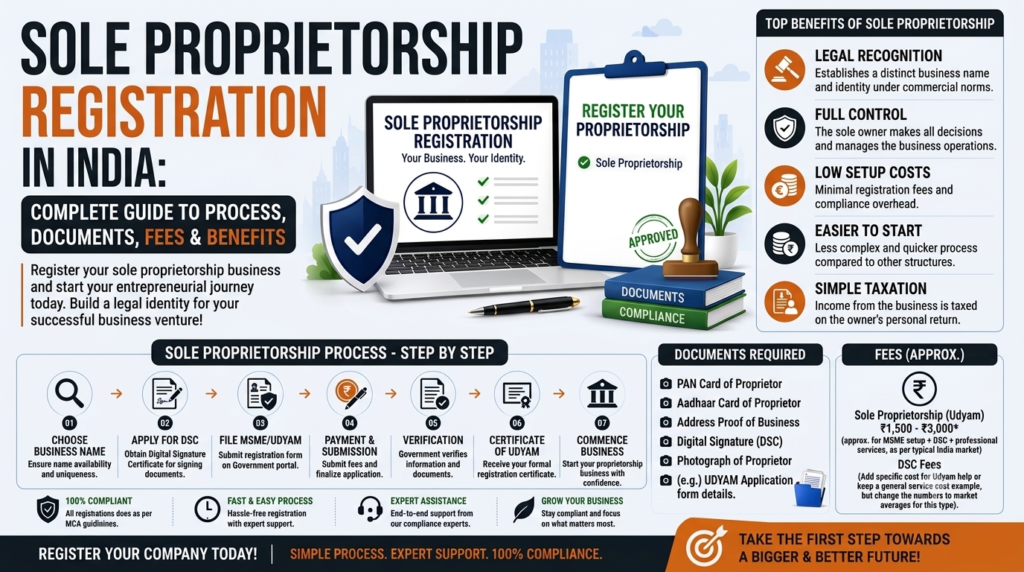
How to Register a Sole Proprietorship in India?
The process is fairly simple. The exact registrations depend on the type of business.
Step 1: Choose a Business Name
First, select a suitable name for your business. You should check that the name does not create confusion with another existing brand.
Step 2: Get a PAN and Bank Account
The proprietor generally uses their PAN for tax purposes. A separate current account can then be opened for business transactions using the required business documents.
Step 3: Obtain the Required Business Registration
Depending on the business, you may need registrations such as:
- GST registration, if applicable
- Shop and Establishment registration, where applicable
- Udyam Registration for MSMEs
- FSSAI registration for eligible food businesses
- Local trade licence, where required
The requirements can change depending on the business activity and state.
Step 4: Start Business Operations
Once the required registrations and licences are obtained, the proprietor can start operating the business and maintain proper invoices, accounts, tax records, and other documents.
Documents Required for Sole Proprietorship Registration
The documents can vary depending on the registration being applied for. Commonly required documents include:
- PAN card of the proprietor
- Aadhaar or other identity proof
- Address proof
- Passport-size photograph
- Business address proof
- Rent agreement or ownership proof, if applicable
- Bank account details or cancelled cheque
- Electricity bill or other utility bill, where required
Additional documents may be required for specific licences.
Sole Proprietorship Registration Fees
There is no fixed government fee for “sole proprietorship registration” because different registrations have different requirements and fees.
For example, some registrations may be available without a government registration fee, while others may involve statutory fees. Professional service charges may also apply if you take assistance from a consultant.
Therefore, the total cost depends on the registrations and licences your business actually needs.
Benefits of Sole Proprietorship
A sole proprietorship has several advantages, especially for small businesses.
1. Easy to Start
The setup is usually much simpler than many formal company structures.
2. Low Compliance
Small proprietorship businesses generally have fewer ongoing compliance requirements compared with companies.
3. Complete Control
The owner makes business decisions without needing approval from partners or shareholders.
4. Simple Management
Since one person owns and manages the business, decision-making can be quick.
5. Suitable for Small Businesses
It can be a good choice for people who want to test a business idea before expanding.
Sole Proprietorship vs Other Business Structures
Not every business should operate as a proprietorship.
Partnership firm registration may be more suitable when two or more people want to run a business together.
One Person Company registration can be considered by an individual who wants to operate through a company structure with a separate legal identity, subject to the applicable legal requirements.
Similarly, company registration may be more appropriate for businesses planning significant growth, outside investment, multiple shareholders, or a more formal corporate structure.
The right choice depends on your business goals, risks, budget, and future plans.
Is Sole Proprietorship Right for You?
If you are starting a small business alone and want a simple structure, a sole proprietorship can be a useful option. However, the owner should remember that business liabilities can generally be linked to the proprietor personally.
As the business grows, you can also review whether another structure would better suit your needs.
Conclusion
Starting a business does not always need to be complicated. Sole proprietorship registration can provide a simple way for an individual to begin a small business in India.
The important thing is to obtain the registrations and licences that apply to your business and keep your financial and tax records properly.
If you need professional assistance with business registration and compliance, Corpbiz can help you understand the applicable requirements and complete the process more smoothly.
Author Profile
Gaurav Sharma is a Legal Consultant and business compliance professional with extensive experience in helping entrepreneurs and businesses understand registrations, licences, and legal requirements in India. He focuses on making complex compliance topics simple and easy to understand. Through his work with Corpbiz, Gaurav helps business owners make informed decisions and manage their compliance needs with greater confidence.