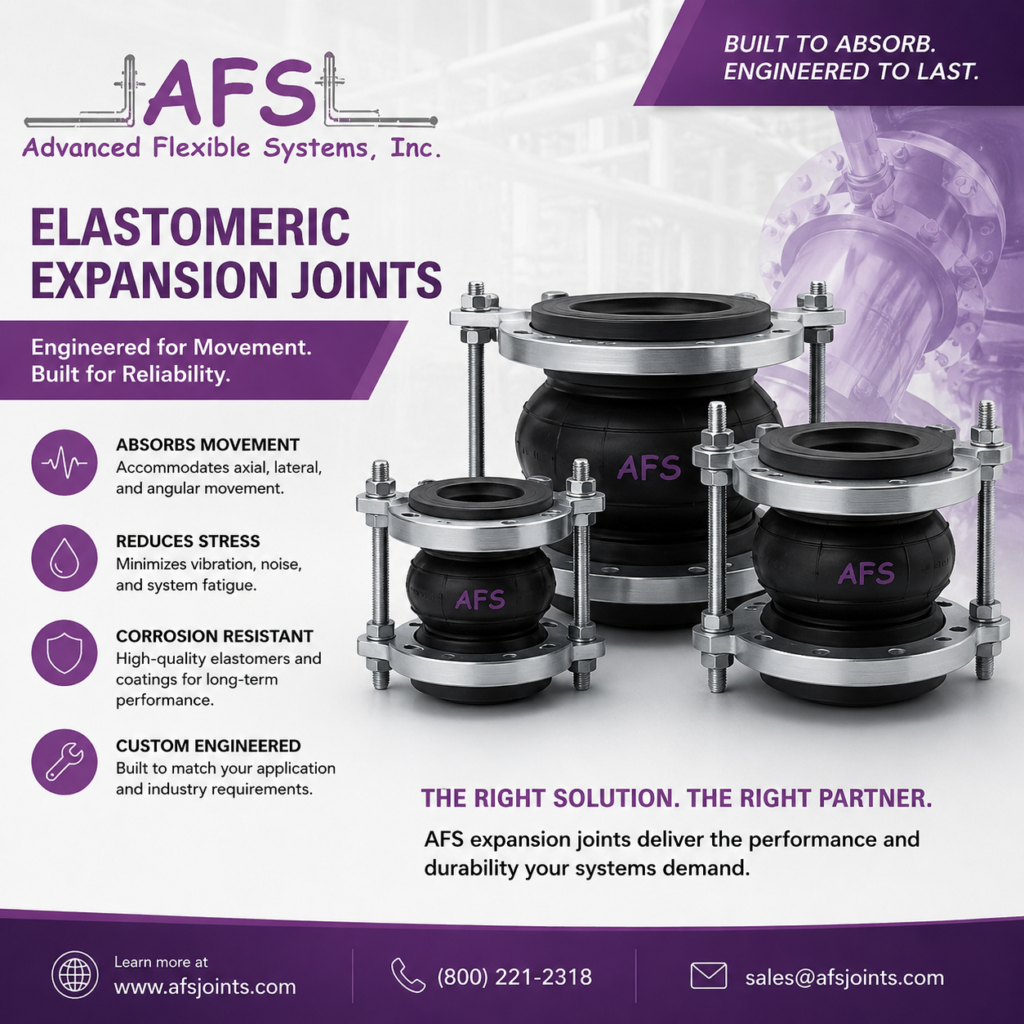
Piping systems take a beating. Heat cycles expand metal and contract it again overnight. Pressure surges hammer through lines during startup and shutdown. Ground shifts beneath buried infrastructure. Pumps and fans push vibration into every connected pipe and duct. All of that movement has to go somewhere — and if the system has no way to accommodate it, the stress concentrates at the nearest rigid connection until something cracks, leaks, or pulls apart.
Rubber expansion joints are what give that movement somewhere to go. They sit inline between two pipe sections, between equipment and its discharge line, or at the boundary between a pipe and a concrete structure. They flex rather than resist, which is exactly what a system needs when everything around them is constantly in motion.
What Happens Inside a Rubber Expansion Joint
The rubber body is the working element. Under axial load, it compresses or stretches. Under lateral force, it deflects sideways. When the connected equipment is slightly out of alignment, it absorbs the angular offset without transferring that misalignment as a bending moment into the pipe or flange.
What makes rubber the right material for this is elastic recovery — it deforms under load and returns to its original geometry when the load is removed. A steel pipe cannot do that. A rigid coupling cannot do that. Rubber can, and it does it repeatedly over years of service without fatigue failure, provided it is matched correctly to the operating environment.
The reinforcement layers inside the joint — typically woven nylon, polyester, or aramid fabric — give the rubber its pressure rating. Without them, the body would balloon outward under pressure. With them, the joint holds its shape while still flexing in the directions it needs to. Standard designs handle anywhere from full vacuum conditions up to 150 psi or beyond, depending on how many reinforcement plies are built into the carcass.
Material Selection Is Where Most Mistakes Happen
Rubber is not a single material. The compound used in the joint body determines what the joint can actually handle in service, and getting this wrong is expensive.
Natural rubber handles abrasion well and performs reliably in water and mild slurry service. EPDM holds up under heat, steam, and prolonged outdoor exposure — it is the standard choice when the system runs hot or when the joint is exposed to UV and ozone. Neoprene covers a broad middle range, offering decent resistance to weathering and moderate chemical exposure without being the best choice for any single condition. Nitrile is the right answer when the line carries oil, fuel, or any petroleum-based fluid.
A natural rubber joint in solvent service will swell and lose its shape within months. An EPDM joint in oil service softens and eventually loses its pressure integrity. These are not edge cases — they are routine failures that happen when the material decision gets made based on price or availability rather than the actual fluid chemistry in the line.
Where Rubber Expansion Joints for Concrete Come In
The connection between a pipe and a Rubber Expansion Joints for Concrete structure is one of the harder problems in system design. Concrete is not static. It expands and contracts with temperature, absorbs and releases moisture, and settles over time as the ground beneath it compresses or shifts. A pipe passing through a concrete wall, floor slab, or vault does not move at the same rate or in the same direction as the structure around it.
Without a flexible connector at that interface, something has to give. Sometimes the pipe pulls away from the wall and opens a leak path. Sometimes the pipe is rigid enough that it cracks the surrounding concrete instead. Either outcome is a problem, and in buried or enclosed infrastructure — pump stations, treatment plant walls, storm drainage vaults — both outcomes can be serious.
A rubber expansion joint specified for concrete service is designed with this differential movement in mind. The face-to-face dimensions are typically longer than a standard inline joint, providing enough working length to absorb movement in multiple planes at once. The end connections anchor solidly to both the concrete and the pipe so the joint stays in position rather than walking out of the opening under repeated loading.
Municipal water systems use these joints at tank penetrations and pump station walls. Wastewater plants install them where process piping passes through containment structures. Anywhere a pipe crosses a concrete boundary in a system that sees thermal cycling or ground movement, a properly specified joint at that crossing prevents a slow failure from becoming a costly one.
Getting the Specification Right
Pipe diameter and pressure rating are the starting point. The full specification also covers operating temperature range, the fluid or gas in contact with the rubber, the type of movement the joint needs to handle, whether installation is buried or exposed, and the face-to-face dimension required for the available movement range.
A joint that is undersized for the required movement will be pushed past its design limits and fail early. One specified in the wrong compound will degrade from the inside out before anyone notices.
Advanced Flexible Systems Inc. engineers rubber expansion joints for industrial, municipal, and commercial piping across a range of service conditions — including purpose-built joints for concrete applications. Reach out to their team with your operating conditions and let them work through the specification with you.