Hair extensions are popular in the beauty industry because they allow customers to experiment with length, volume, texture, and style. However, maintaining the quality of hair extensions requires more than careful manufacturing and styling. Packaging also plays an important role in protecting strands from tangling, dust, moisture, and unnecessary handling during storage, transportation, and retail display.
For beauty brands, salons, wholesalers, and online retailers, plastic hair extension bags offer a practical way to organise and present hair products while keeping them contained. The right packaging can improve product visibility, simplify stock management, and create a more consistent customer experience.
As the hair and beauty market continues to evolve, businesses must balance product protection, presentation, convenience, and environmental considerations. Understanding the different packaging formats and materials can help companies choose solutions that suit their products and customers.
Read More:
1. Why Plastic Hair Extension Bags Matter in the Beauty Industry
Hair extensions can represent a significant investment for both businesses and customers. Depending on the product, they may contain human hair, synthetic fibres, clip-in pieces, ponytails, wigs, or specialised hair systems. Each format has different storage and handling requirements.
Suitable packaging helps keep products organised and reduces unnecessary contact with external surfaces. It can also make product identification easier for retailers managing multiple colours, lengths, textures, and styles.
Protecting Hair Extensions During Storage
Loose hair strands can become tangled when they are moved repeatedly or stored without adequate organisation. A suitable bag helps contain the product and makes it easier to separate individual bundles.
Common benefits include:
- Reducing exposure to dust and everyday handling.
- Keeping hair bundles organised during storage.
- Helping prevent strands from spreading or catching on surrounding items.
- Supporting clear product identification.
- Simplifying packing and fulfilment for online orders.
However, plastic packaging should not be treated as a complete solution for every storage concern. Hair extensions should be prepared according to the manufacturer’s care instructions, and packaging should be clean, dry, and appropriate for the product.
For products containing natural human hair, controlling storage conditions and avoiding unnecessary compression can help maintain a neat presentation.
Improving Retail Presentation
Packaging is often one of the first physical elements customers notice when receiving a beauty product. A clean, well-fitted bag can make extensions easier to inspect while keeping the product contained.
Transparent packaging can be especially useful when customers need to compare colours, textures, lengths, or curl patterns before making a purchase.
For online businesses, packaging also contributes to the unboxing experience. Consistent labelling, tidy presentation, and clear product information can help customers identify the item they ordered and understand its specifications.
Read More:
https://www.skycustombox.com/blog/
2. Types of Plastic Hair Extension Bags and Packaging Materials
Not all hair extension bags serve the same purpose. Material thickness, closure type, dimensions, transparency, and design should be selected according to the product and intended distribution channel.
Clear Plastic Bags
Clear bags allow customers and warehouse staff to see the contents without opening the package. They are commonly suitable for hair bundles, clip-in extensions, and smaller beauty accessories.
Their main advantage is visibility. Staff can identify products quickly, while retailers can display the colour and texture of the hair.
Businesses should select an appropriate bag size so the extensions fit comfortably without excessive folding or compression. If the product has delicate styling, additional internal support may be necessary.
Resealable Bags
Resealable bags feature a closure that can be opened and closed multiple times. They can be useful for products that customers may need to inspect or store after purchase.
Potential applications include:
- Hair extension bundles.
- Clip-in hair pieces.
- Ponytail extensions.
- Small hair accessories.
- Replacement components and styling products.
The closure should be durable enough for the expected level of use. Businesses should also check that the bag does not pull or catch loose strands when opened or closed.
Custom Printed Hair Extension Bags
Custom printed packaging allows brands to include logos, product names, contact information, care instructions, and other relevant details.
These bags can help maintain a consistent appearance across different product collections. For example, a brand selling straight, wavy, and curly extensions could use the same visual identity while assigning separate product labels to each style.
When developing plastic hair extension bags packaging, businesses should prioritise legibility and useful information rather than adding excessive graphics. The packaging should help customers identify the product quickly.
Hanging Bags and Specialised Enclosures
Some hair products benefit from packaging designed for hanging displays or organised storage. These formats may incorporate reinforced sections, hang holes, or specialised closures.
The term Plastic Hair Bags Enclosures can refer broadly to plastic-based bags and protective packaging used to contain hair products. The exact construction should be chosen according to the product’s weight, dimensions, display method, and protection requirements.
For heavier bundles or premium products, businesses should test the seams, closure, and hanging point before placing a large order.
3. How to Choose the Right Hair Extension Packaging
Selecting suitable packaging involves more than comparing appearance or price. Businesses should consider the physical characteristics of their products and how they will move through the supply chain.
Consider Product Dimensions and Weight
A bag that is too small may compress the hair, while an oversized bag can allow the product to shift unnecessarily. Measure the complete packaged product, including ties, backing cards, labels, and any protective components.
Before finalising a design, assess:
- Hair bundle length and width.
- Product weight.
- Whether the extensions are folded or arranged straight.
- Space needed for labels and inserts.
- Closure and sealing requirements.
- Storage and shipping conditions.
Testing several sizes with actual products can help identify the most practical format.
Evaluate Material Strength and Visibility
The material should be suitable for the product’s weight and handling requirements. Very thin plastic may tear during packing, while unnecessarily heavy material can increase costs and material use.
Transparency is another important consideration. Clear packaging can help display colour accurately, although lighting, surface reflections, and the plastic itself may influence how customers perceive the shade.
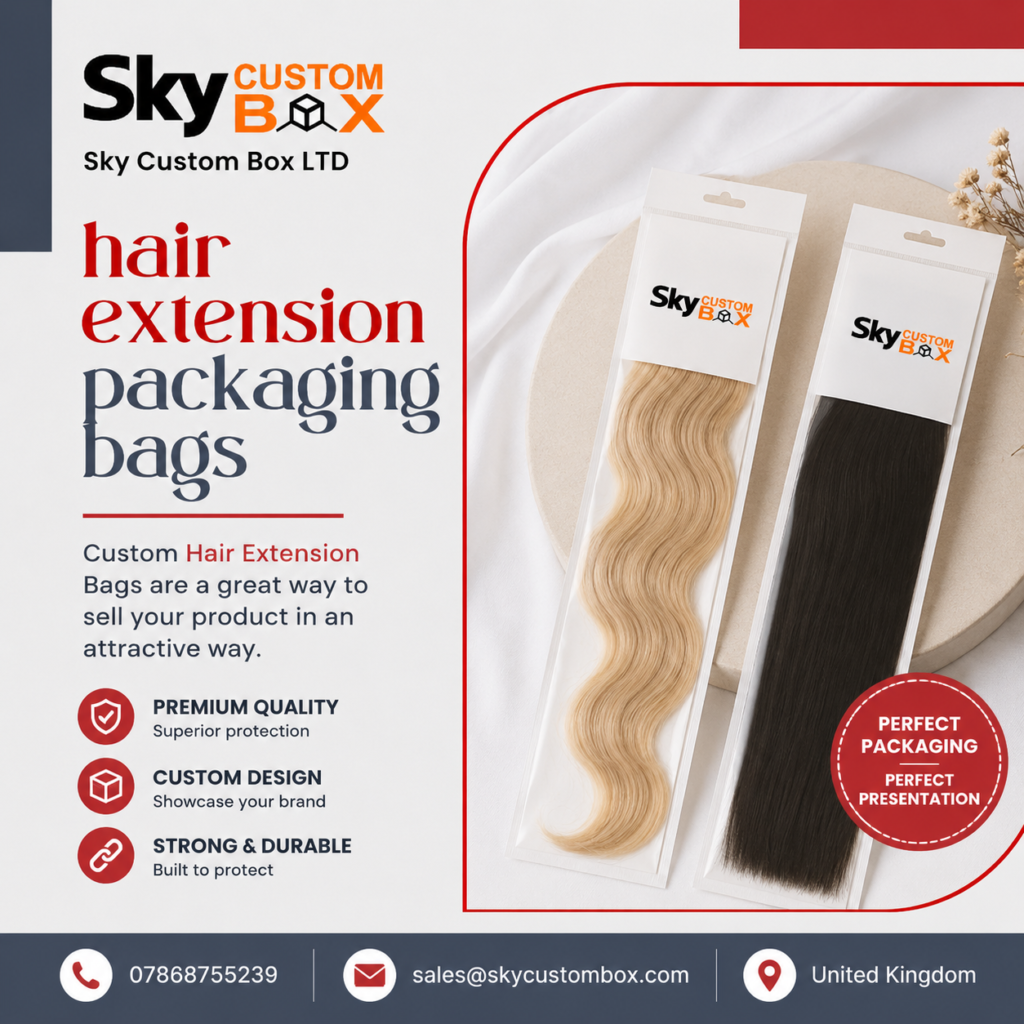
Businesses selling premium extensions may also combine a transparent protective bag with a printed paper sleeve, backing card, or branded outer box. This approach can preserve product visibility while providing space for branding and product information.
Review Labelling and Product Information
Accurate labelling can reduce confusion when a business manages many similar products.
Depending on the product and market, useful information may include:
- Hair type or fibre type.
- Length and colour.
- Texture or style.
- Product reference or stock-keeping unit (SKU).
- Brand name and contact details.
- Relevant care instructions.
Where claims such as “100% human hair” or specific sourcing descriptions are used, they should be accurate and supported by the supplier’s product specifications.
Clear identification is particularly useful for wholesalers and fulfilment teams processing large numbers of orders.
Read More:
4. Sustainability, Costs and Common Packaging Challenges
Plastic packaging can provide practical benefits, but businesses should also consider material use, disposal, and the expectations of environmentally conscious customers.
Reducing Unnecessary Plastic Waste
The environmental impact of packaging depends on factors such as material type, quantity, production, transportation, and local waste-management systems.
Businesses can review their packaging practices by:
- Selecting bag dimensions that fit the product appropriately.
- Avoiding unnecessary layers of protective packaging.
- Using the minimum material thickness that meets performance requirements.
- Reviewing recyclable alternatives where suitable.
- Providing disposal guidance when accurate and relevant.
- Checking local recycling requirements before making recyclability claims.
Not every plastic bag is accepted through household recycling collections. Material composition and local facilities can affect disposal options, so suppliers should provide clear specifications.
For some products, paper sleeves or cardboard enclosures can reduce the amount of plastic used while preserving space for branding. However, these alternatives may not provide the same visibility or moisture resistance, and their suitability should be evaluated against the product’s needs.
Understanding Packaging Costs
The cost of hair extension bags depends on several factors, including material thickness, bag dimensions, closure type, printing, order quantity, and delivery charges.
Custom printing and specialised shapes may increase initial production costs. Larger quantities may reduce the price per unit, but ordering more packaging than a business can use can create storage problems and tie up working capital.
A practical purchasing process includes:
- Requesting quotations for several order quantities.
- Comparing standard and custom printed options.
- Reviewing material specifications.
- Testing samples with actual hair products.
- Calculating the total cost per packed order.
- Checking production times and minimum order requirements.
The cheapest bag is not necessarily the most economical choice. A package that tears easily or causes products to become disorganised may increase replacement costs and staff handling time.
5. Industry Trends and Best Practices for Hair Packaging
Beauty packaging continues to evolve as brands look for ways to improve convenience, visual identity, and operational efficiency.
One notable approach is the combination of protective packaging with branded presentation. Rather than relying exclusively on a printed plastic bag, some businesses use a clear inner bag alongside a paper sleeve, product card, or outer box.
This layered approach can help separate product protection from brand communication. It also allows businesses to update printed branding without redesigning every protective component.
Another important trend is packaging standardisation. Businesses that sell multiple hair extension styles can reduce complexity by using a limited range of bag sizes and consistent labelling systems.
For growing brands, practical best practices include:
- Testing packaging before bulk production.
- Maintaining consistent measurements across product ranges.
- Using readable labels and reliable product identifiers.
- Reviewing packaging performance during shipping.
- Checking supplier quality and material documentation.
- Assessing customer feedback about storage and presentation.
Businesses researching packaging options may consider providers such as Sky Custom Box when comparing customised packaging formats. As with any supplier, specifications, sample quality, minimum order quantities, and suitability for the intended product should be reviewed before making a decision.
Conclusion
Choosing suitable plastic hair extension bags requires a balance between product protection, visibility, convenience, branding, and cost. Clear bags support product inspection, resealable formats offer practical storage, and custom printed packaging can help beauty brands maintain a consistent identity.
CONTACT US:
ABOUT US:
Social Media: