Magnetic Proximity Sensor devices require careful selection of the mating permanent magnet to ensure adequate sensing distance and sensitivity. Rare-earth magnets like neodymium provide strong magnetic fields that allow for greater detection gaps compared to standard ferrite magnets. Engineers calculate the required magnetic field strength based on the specific operational gap and environmental temperature limits. Matching the correct magnet to the sensor guarantees optimal performance across varying operating conditions.
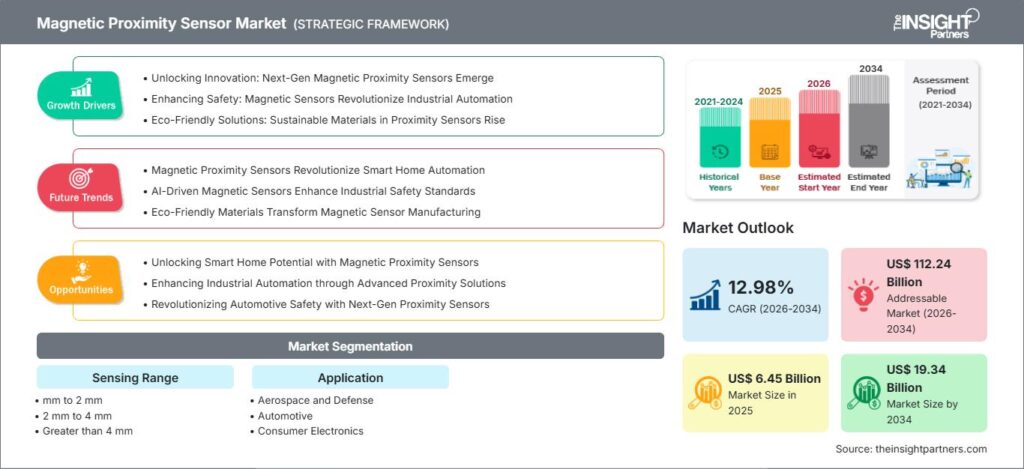
The global Magnetic Proximity Sensor Market is poised for substantial expansion over the next decade as industrial automation, electric vehicle (EV) adoption, and smart manufacturing accelerate worldwide. According to the latest market analysis, the Magnetic Proximity Sensor Market size is expected to reach US$ 19.34 Billion by 2034, up from US$ 6.45 Billion in 2025. The market is anticipated to register a compound annual growth rate (CAGR) of 12.98% during the forecast period 2026–2034.
Market Overview and Core Growth Drivers
Magnetic proximity sensors operate by detecting changes in magnetic fields generated by permanent magnets, enabling non-contact position monitoring, cylinder piston detection, and safety interlocks. Unlike inductive or capacitive alternatives, magnetic sensors offer longer sensing distances and exceptional immunity to dust, oil, moisture, vibration, and extreme temperatures making them indispensable in heavy-duty industrial environments.
Several structural shifts are propelling demand across end-use sectors:
-
Accelerating Industrial Automation and Robotics: As global manufacturing facilities transition toward Industry 4.0 and smart factory frameworks, factories increasingly rely on automated guided vehicles (AGVs), collaborative robots, and high-speed assembly lines. Magnetic proximity sensors provide high repeatability and contactless durability, reducing mechanical wear and minimizing costly operational downtime.
-
Rapid Electrification in the Automotive Sector: The global transition toward electric and autonomous vehicles is a primary catalyst for sensor integration. Modern EVs utilize permanent-magnet motors, advanced battery management systems (BMS), and automated safety features that require precise speed, angle, and position sensing.
-
Miniaturization and Consumer Electronics: Growing demand for compact, energy-efficient consumer devices, smart home appliances, and touchless interfaces continues to drive innovation in smaller sensor form factors and low-power electronics.
-
Strict Workplace Safety Regulations: Heightened regulatory emphasis on machine safety and worker protection has boosted the deployment of magnetic safety switches and non-contact interlocks across packaging, aerospace, and heavy machinery.
Get a PDF Sample- https://www.theinsightpartners.com/sample/TIPRE00020707
Competitive Landscape and Key Players
The global Magnetic Proximity Sensor market is characterized by intense technological innovation, strategic partnerships, and continuous product portfolio expansion. Leading manufacturers are focusing on developing ruggedized housings, programmable detection thresholds, and enhanced electromagnetic immunity to capture share across high-growth verticals.
Prominent companies shaping the competitive landscape include:
-
Sick AG
-
OMRON Corporation
-
Honeywell International Inc
-
Rockwell Automation, Inc
-
GENERAL ELECTRIC
-
Gentec International
-
Eaton
-
Panasonic
-
Fargo Controls Inc
-
Balluff Automation India Pvt. Ltd
Regional Dynamics
Asia-Pacific continues to command a dominant position in the global market and is projected to experience the fastest expansion through 2034. Rapid industrialization, large-scale automotive and EV production hubs in China, Japan, South Korea, and India, and supportive government initiatives for domestic electronics manufacturing underpin regional momentum. Meanwhile, North America and Europe maintain steady growth driven by stringent industrial safety standards, aerospace modernization, and ongoing investments in factory retrofitting.
Future Outlook (2026–2034)
Looking ahead to 2034, the Magnetic Proximity Sensor market will be defined by smart connectivity, advanced materials, and broader sector diversification. Key trends shaping the future trajectory include:
-
IO-Link and IIoT Integration: Next-generation magnetic proximity sensors are increasingly equipped with digital communication protocols such as IO-Link. This enables real-time diagnostics, predictive maintenance alerts, and seamless integration into Industrial Internet of Things (IIoT) platforms, allowing operators to monitor sensor health remotely and optimize production efficiency.
-
Advancements in Magnetoresistive and Hall-Effect Technologies: Ongoing R&D in Tunnel Magnetoresistance (TMR), Anisotropic Magnetoresistance (AMR), and 3D Hall-effect architectures will deliver higher sensitivity, wider temperature stability, and lower power consumption unlocking complex applications in aerospace, medical devices, and autonomous mobility.
-
Expansion into Renewable Energy and Infrastructure: Beyond traditional factory floors, magnetic proximity sensors will see rising adoption in wind turbine pitch control, solar tracking systems, and structural health monitoring for critical energy and transportation infrastructure.
As industries worldwide prioritize precision, durability, and digital intelligence, magnetic proximity sensors will remain foundational building blocks of next-generation automated ecosystems.
Related Reports-
Naval Sensors Market Size, Demand & Growth by 2034
About The Insight Partners
The Insight Partners is a leading market research and consulting firm delivering actionable insights through in-depth industry analysis and strategic intelligence. The firm supports clients across various industries in making informed decisions by providing comprehensive market forecasts, competitive assessments, and growth opportunities.