Machine learning and NLP have moved from experimental projects to core business technologies. In 2026, companies are no longer asking whether to use AI. They are asking where it delivers measurable value, what it costs, and how quickly it pays back.
Machine learning (ML) learns patterns from data to predict outcomes, classify information and support decisions. Natural language processing (NLP) helps machines understand, interpret and generate human language. Together, machine learning and NLP turn raw data and unstructured text into intelligent, automated workflows.
This guide covers the latest trends, applications, business use cases, development costs, ROI calculation, implementation steps and common challenges, so you can plan with confidence.
Key Takeaways
- ML predicts, NLP understands language. Combined, they power chatbots, document intelligence, forecasting and automation.
- 2026 trends: smaller domain-specific models, multimodal AI, retrieval-augmented generation (RAG), AI agents and governed AI.
- Cost depends on data, complexity and integration, not just model building. Budget for maintenance and scaling too.
- ROI is measurable when you start with a clear business problem and track metrics like automation rate, response time and cost savings.
- Start small, validate, then scale. An MVP reduces risk and cost.
What Are Machine Learning and NLP in 2026?
What Is Machine Learning?
Machine learning is a branch of artificial intelligence in which models learn patterns from historical data instead of following fixed rules. A retailer’s model, for example, learns from past sales how demand changes by season, price and location.
There are three main approaches. Supervised learning trains on labeled examples, such as transactions marked fraudulent or legitimate. Unsupervised learning finds hidden structure, such as customer segments. Reinforcement learning learns through trial, error and feedback, and is used in pricing, logistics and robotics. The business value lies in predictive analytics and faster, more consistent decision-making.
What Is Natural Language Processing?
Natural language processing is the field of AI that enables machines to read, interpret and generate human language, in both text and speech. Core tasks include text classification, sentiment analysis, entity extraction, summarization and language generation.
NLP has changed dramatically with transformer-based and foundation models. Older systems depended on keyword rules. Modern models grasp context, tone and intent, which is why today’s assistants can handle nuanced, multi-step requests.
Machine Learning vs NLP: How Are They Different?
NLP is a specialized area within AI that relies heavily on machine learning techniques. The practical difference is the type of problem each one solves.
| Factor | Machine Learning | NLP |
|---|---|---|
| Primary purpose | Learning patterns from data | Understanding and processing language |
| Input | Structured and unstructured data | Text, speech and language |
| Common applications | Prediction, classification, recommendation | Chatbots, sentiment analysis, summarization |
| Business value | Forecasting and optimization | Communication and knowledge automation |
| AI integration | Predictive intelligence | Language intelligence |
How Machine Learning and NLP Work Together
NLP converts language into data a machine can process. ML then finds patterns in that data and makes predictions. A support platform, for instance, uses NLP to read a customer email, detects frustration, and uses ML to predict churn risk and route the ticket to the right team.
This combination is already active in customer service (intelligent routing), healthcare (clinical note analysis), finance (document review and risk scoring) and enterprise operations (knowledge search and reporting).
Machine Learning and NLP Trends Shaping 2026
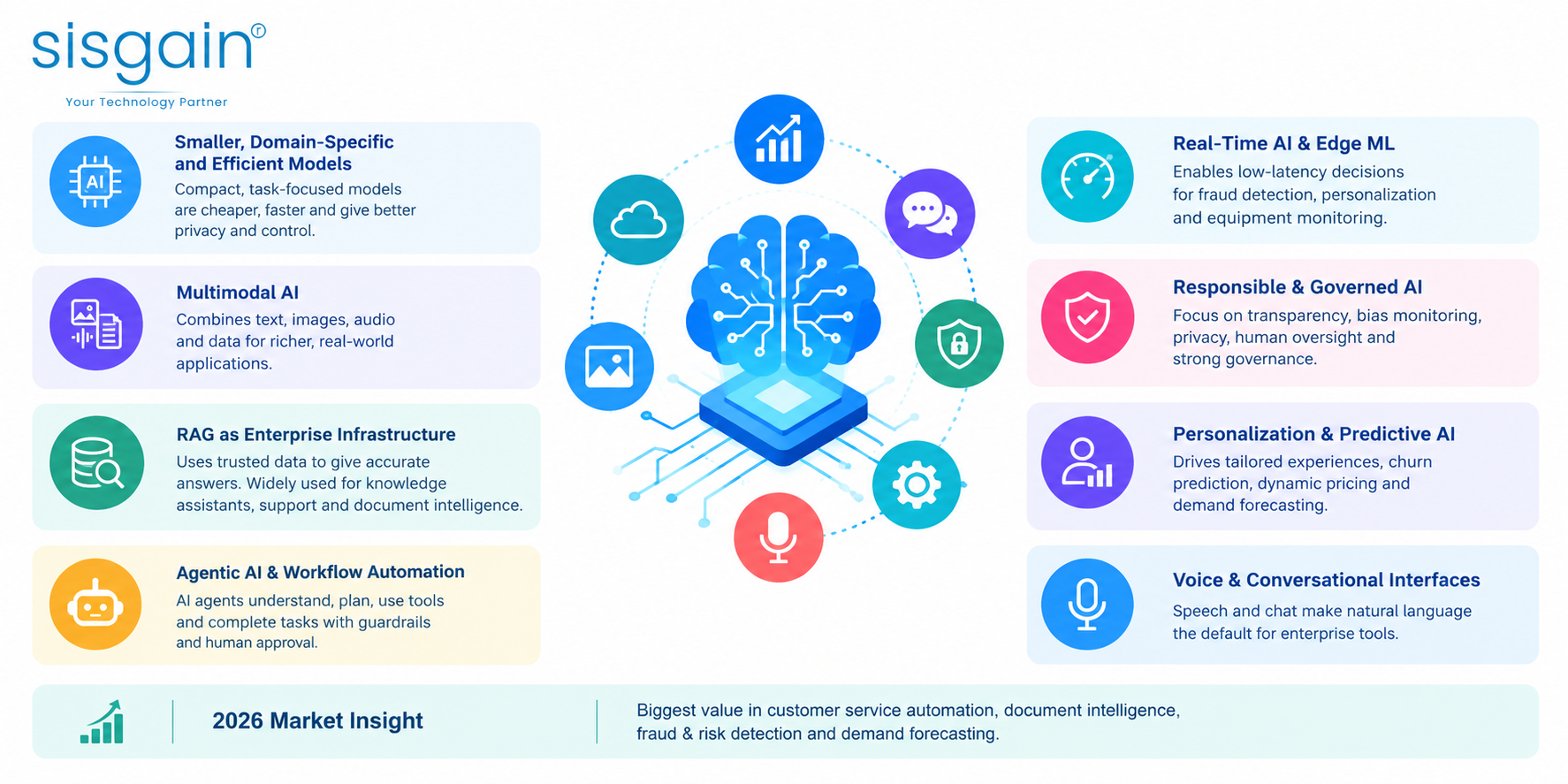
Smaller, Domain-Specific and Efficient AI Models
Businesses are shifting from giant general-purpose models to compact models tuned for specific tasks. These cost less to run, respond faster and can be deployed on-premise or at the edge, which improves privacy and control.
Multimodal AI Is Expanding Beyond Text
Modern systems combine text, images, audio and structured data. NLP now works alongside computer vision and speech AI, enabling uses such as reading scanned invoices, analyzing recorded calls or inspecting products with written reports.
Retrieval-Augmented Generation Is Becoming Enterprise Infrastructure
Generative models can produce confident but wrong answers. RAG addresses this by retrieving relevant information from trusted company sources before generating a response. It is now widely used for internal knowledge assistants, customer support and document intelligence. Organizations that need this capability often work with providers of custom RAG development services to connect models securely to their own data.
Agentic AI and Intelligent Workflow Automation
AI agents use NLP to understand natural-language instructions and ML to plan, use tools and complete tasks, such as updating a CRM, drafting a report or resolving a service request. Teams exploring this area typically evaluate ai agent development solutions that include guardrails and human approval steps.
Real-Time AI and Edge Machine Learning
Low-latency models support real-time fraud detection, personalization and equipment monitoring. Running inference at the edge also keeps sensitive data closer to its source.
Responsible, Explainable and Governed AI
Regulation and customer expectations are pushing companies toward transparency, bias monitoring, data privacy, human oversight and formal AI governance. Explainability is becoming a purchasing requirement, not a bonus.
AI-Powered Personalization and Predictive Decision-Making
ML drives personalized experiences, churn prediction, dynamic pricing and demand forecasting, helping teams act before problems appear.
NLP Is Moving Toward Voice and Conversational Interfaces
Speech-to-text, text-to-speech and conversational AI are making natural language the default interface for enterprise tools, from voice-enabled field apps to virtual assistants.
2026 Market Insight: The strongest commercial value is currently in customer service automation, document intelligence, fraud and risk detection, and demand forecasting. These use cases have clear metrics, available data and fast payback, which is why most enterprises start there.
Machine Learning Applications in 2026
Machine learning applications are business solutions in which models learn from data to predict, detect, recommend or automate. They are best grouped by the objective they serve.
Predictive Analytics and Forecasting
Demand, revenue and sales forecasting help teams plan inventory, staffing and budgets with less guesswork.
Fraud Detection and Risk Management
Models monitor transactions, flag anomalies and score credit risk in real time, catching patterns that rules alone miss.
Recommendation and Personalization
Product and content recommendations, customer segmentation and next-best-action systems increase engagement and conversion.
Healthcare and Medical Intelligence
ML supports patient risk prediction, medical data analysis and clinical decision support, always with clinician oversight.
Cybersecurity and Threat Detection
Behavioral analysis and anomaly detection identify threats earlier and automate security monitoring.
Computer Vision and Intelligent Automation
Image classification, object detection, quality inspection and document processing automate visual tasks. Companies building such products often partner with specialists in machine learning app development services to move from prototype to production.
Natural Language Processing Applications in 2026
Natural language processing applications use language understanding to automate communication and knowledge work. Because most business information is unstructured text, NLP has become a major automation layer.
AI Chatbots and Virtual Assistants
Chatbots handle customer support, employee help desks and conversational commerce around the clock. Modern ai chatbot solutions understand intent, retrieve accurate answers and hand over to humans when needed.
Sentiment Analysis and Customer Intelligence
NLP analyzes reviews, surveys and social conversations to reveal brand sentiment and recurring complaints.
Document Intelligence and Information Extraction
NLP extracts data from contracts, invoices, resumes and legal files, and classifies documents automatically.
Text Summarization and Knowledge Management
Summaries of meetings, research and reports save hours and make organizational knowledge easier to use.
Search and Semantic Retrieval
Semantic search understands meaning rather than exact keywords, improving enterprise knowledge discovery and powering RAG systems.
Voice and Conversational AI
Speech recognition and voice assistants support call-center intelligence and hands-free business applications.
Content Intelligence and Automation
NLP classifies, translates, generates and personalizes content at scale.
NLP Applications in Business: Top Enterprise Use Cases
NLP applications in business succeed when they target repetitive, language-heavy workflows. The most common are customer service automation, sales and lead qualification, marketing intelligence, financial document processing, healthcare documentation, HR and recruitment automation, legal and compliance analysis, enterprise knowledge management, and voice and contact center automation.
| Business Function | NLP Use Case | Business Benefit |
|---|---|---|
| Customer Service | AI support assistant | Faster response |
| Sales | Lead qualification | Better conversion |
| HR | Resume analysis | Faster screening |
| Finance | Document extraction | Lower processing effort |
| Legal | Contract analysis | Reduced review time |
| Marketing | Sentiment analysis | Better customer insights |
Machine Learning and NLP Use Cases Across Industries
Machine learning use cases differ by industry, but the pattern is consistent: use data to predict, and use language AI to communicate and automate.
- Healthcare: patient analytics, clinical NLP, medical documentation and predictive care.
- Fintech and banking: fraud detection, credit scoring, financial document intelligence and customer support.
- Retail and e-commerce: recommendations, demand forecasting, customer sentiment and conversational commerce.
- Real estate: property recommendations, lead scoring, market prediction and automated customer communication.
- Manufacturing: predictive maintenance, quality inspection, demand forecasting and operational optimization.
- Telecommunications: churn prediction, network analytics and support automation.
- Media and entertainment: content recommendation, audience analysis and automated content intelligence.
How Much Does Machine Learning Development Cost in 2026?
There is no universal price for machine learning cost because it depends on project complexity, data readiness, model requirements and deployment environment. The ranges below are indicative market estimates. Validate them with vendor quotes for your own scope.
Average Machine Learning Development Cost by Project Complexity
| Project Type | Estimated Cost Range | Typical Timeline |
|---|---|---|
| Basic ML model | $10,000–$40,000 | 4–8 weeks |
| Predictive analytics solution | $30,000–$100,000 | 2–4 months |
| Custom ML platform | $100,000–$300,000 | 4–8 months |
| Enterprise ML system | $300,000+ | 8+ months |
Factors That Affect Machine Learning Development Cost
The biggest drivers are data collection and preparation, model complexity, custom versus pre-trained models, infrastructure, third-party integrations, MLOps, security, testing, maintenance and team expertise. Data preparation alone often consumes a large share of the budget.
How to Reduce Machine Learning Development Cost
Start with an MVP, use pre-trained models where appropriate, reuse existing infrastructure, automate data pipelines and choose a deployment architecture that matches your usage.
NLP Development Cost in 2026
NLP development cost varies with the solution type, data quality and how deeply the system connects to your business tools.
NLP Development Cost by Solution Type
| NLP Solution | Complexity | Main Cost Drivers |
|---|---|---|
| Text classification | Low–Medium | Data and model |
| Sentiment analysis | Low–Medium | Training and integration |
| NLP chatbot | Medium | NLP and conversational layer |
| Document intelligence | Medium–High | OCR, NLP and workflows |
| Enterprise NLP platform | High | Infrastructure and integrations |
What Determines NLP Development Cost?
Key factors include model selection, training or fine-tuning, dataset quality, LLM and API usage fees, RAG implementation, integrations, security and compliance, infrastructure, and ongoing monitoring.
Also Read :- Machine Learning Market Expansion Fueled by Growing Investments in AI Infrastructure and Advanced Computing
Machine Learning and NLP Development Cost: What Businesses Should Budget For
A realistic budget covers the full lifecycle, not just the build.
- Development: design, engineering and testing.
- Data and model training: collection, labeling, cleaning and fine-tuning.
- Infrastructure and API cost: cloud compute, storage and per-request model fees.
- Integration: connecting to CRM, ERP and internal systems.
- Maintenance and monitoring: retraining, drift detection and bug fixes.
- Scaling: added capacity as usage grows.
Total AI Cost = Development + Data + Infrastructure + Integration + Maintenance + Scaling
How to Calculate ROI From Machine Learning and NLP
Key ROI Metrics
Track cost savings, revenue increase, productivity improvement, customer retention, conversion rate, response time and automation rate. Set baselines before launch so improvements can be proven.
Machine Learning ROI Example
Suppose a team spends $120,000 a year on manual demand analysis, and a $60,000 forecasting model cuts that effort by half while reducing stockouts worth $40,000. First-year benefit is $100,000 against a $60,000 investment, a 67% return, with payback in under eight months. (Illustrative figures.)
NLP ROI Example
Imagine a support team handling 20,000 tickets a month at $4 each. If an assistant resolves 30% automatically, monthly savings are $24,000. Against a $90,000 build, payback takes under four months, before counting faster responses and better satisfaction. (Illustrative figures.)
Simple AI ROI Formula
AI ROI = (Financial Benefit − AI Investment) / AI Investment × 100
How to Build a Machine Learning and NLP Solution in 2026

A structured process reduces risk. Many organizations lean on custom ai software development services to cover the whole path from strategy to production.
Step 1: Define the Business Problem
Choose one measurable problem, such as reducing ticket handling time, and define success metrics.
Step 2: Identify and Prepare Data
Audit data quality, access and privacy. Clean, label and structure it.
Step 3: Select ML/NLP Models
Compare pre-trained, fine-tuned and custom options based on accuracy, cost and compliance.
Step 4: Build and Train the Solution
Develop the pipeline, train models and validate them against realistic test data.
Step 5: Integrate With Existing Systems
Connect through APIs to the tools your teams already use.
Step 6: Test Accuracy, Security and Performance
Test for accuracy, edge cases, hallucinations, security vulnerabilities and speed.
Step 7: Deploy and Monitor
Launch gradually and monitor accuracy, latency and user feedback.
Step 8: Continuously Improve the Models
Retrain on new data and refine prompts and workflows as needs change.
How ML and NLP Integrate With Modern Enterprise AI
ML + NLP + Generative AI
Generative models draft, summarize and converse, while ML handles prediction and NLP handles understanding. Businesses building branded assistants or content tools often choose custom generative AI development services to tailor models to their data and tone.
ML + NLP + RAG
RAG grounds answers in company knowledge, reducing hallucinations. Custom RAG development services help teams build secure retrieval layers with proper access controls.
ML + NLP + Conversational AI
Combining intent detection, prediction and personalization creates assistants that resolve issues rather than just answer questions. Mature ai chatbot solutions integrate with ticketing, CRM and billing systems.
ML + NLP + AI Agents
Agents add planning and action. Reliable ai agent development solutions define clear permissions, audit trails and escalation rules.
ML + NLP + Workflow Automation
Linking language understanding with predictive models automates approvals, routing and reporting. An experienced AI Automation Company can map these workflows and deliver measurable efficiency gains.
ML + NLP Application Development
Turning models into usable products requires front-end design, APIs and scalable back-ends, where machine learning app development services add practical value.
Enterprise NLP Implementation
Large deployments involve compliance, multilingual needs and complex integrations. Specialized nlp solution providers can reduce delivery risk.
How to Choose the Right Machine Learning and NLP Development Partner
- Technical expertise: proven ML and NLP experience, including LLMs, transformers, RAG and agents.
- Industry experience: domain knowledge and enterprise case studies relevant to your sector.
- Data security and compliance: strong data protection, secure infrastructure and access controls.
- Scalability and MLOps: monitoring, continuous improvement and scalable infrastructure.
- Integration capabilities: APIs, CRM/ERP, cloud platforms and existing applications.
- Post-launch support: maintenance, monitoring and optimization.
When shortlisting nlp solution providers, ask for measurable results, security documentation and references rather than relying on demos alone.
Common Challenges in Machine Learning and NLP Implementation
- Poor-quality data: audit and clean data first, and start with a smaller, reliable dataset.
- Accuracy and hallucinations: use RAG, confidence thresholds and human review.
- Integration complexity: plan API architecture early and integrate in phases.
- High infrastructure or inference costs: use smaller models, caching and usage limits.
- Data privacy and security: apply encryption, role-based access and compliance reviews.
- Model bias: test across user groups and monitor outputs regularly.
- Scalability: design for growth with cloud-native, modular architecture.
- Lack of AI/MLOps expertise: upskill teams or work with experienced partners.
Machine Learning & NLP in 2026: What Businesses Should Expect Next
- More autonomous AI systems that complete multi-step tasks with oversight.
- Greater adoption of domain-specific models for accuracy and cost control.
- AI agents inside everyday workflows across sales, support, HR and finance.
- More grounded, enterprise-secure AI built on private data and strict governance.
- Growth in multimodal and voice-based AI as interfaces become more natural.
- AI as measurable infrastructure, judged by business outcomes rather than novelty.
Final Thoughts: Machine Learning and NLP Are Becoming Core Business Intelligence Technologies
Machine learning is increasingly responsible for prediction and decision intelligence, while NLP makes enterprise systems easier to use through natural language. Their combination enables intelligent applications, automation, conversational systems and knowledge-driven workflows.
The lesson for 2026 is discipline. Prioritize measurable use cases instead of adopting AI because it is trending. Start with a high-value problem, validate ROI, build securely and scale gradually. The strongest implementations will connect ML, NLP, generative AI, RAG, AI agents and automation into workflows that produce measurable results.
Ready to turn a business problem into a measurable AI outcome? Share your use case with our team, and we will help you define the right solution, estimate the investment and map a clear path to ROI.
Frequently Asked Questions
What are the main machine learning applications in 2026?
The main applications are predictive analytics, fraud detection, recommendations, healthcare analytics, cybersecurity and computer vision. They help businesses forecast outcomes, detect risk, personalize experiences and automate visual or data-heavy tasks.
What are the most common natural language processing applications?
Common applications include chatbots, sentiment analysis, document extraction, summarization, semantic search and voice assistants. They help organizations process large volumes of text and speech faster and more consistently.
What are the best NLP applications in business?
Customer service automation, document processing, lead qualification, resume screening and contract analysis deliver the strongest returns. They target repetitive, language-heavy tasks with clear, measurable outcomes.
How are machine learning and NLP different?
Machine learning learns patterns from data to predict or classify. NLP focuses on understanding and generating human language, usually using machine learning methods. ML provides prediction; NLP provides language understanding.
What are the most important machine learning use cases?
Demand forecasting, fraud detection, churn prediction, product recommendations, predictive maintenance and quality inspection are among the most valuable, because they connect directly to revenue, risk and operating cost.
What are the most important NLP use cases?
Support assistants, document intelligence, sentiment analysis, enterprise search and call-center analytics are leading use cases. Each reduces manual effort while improving speed and customer experience.
How much does machine learning development cost in 2026?
Projects typically range from roughly $10,000 for a basic model to $300,000 or more for enterprise systems. Final cost depends on data, complexity, integrations and maintenance, so request detailed quotes.
How much does NLP development cost in 2026?
Simple classification or sentiment tools cost less, while chatbots, document intelligence and enterprise platforms cost more. Main drivers are data quality, model choice, integrations, compliance and ongoing API usage.
What factors affect machine learning development cost?
Data preparation, model complexity, infrastructure, integrations, MLOps, security, testing, maintenance and team expertise all influence cost. Using pre-trained models and starting with an MVP can reduce spending.
How can businesses calculate AI ROI?
Use AI ROI = (Financial Benefit − AI Investment) / AI Investment × 100. Measure baseline metrics such as cost, response time and conversion before launch, then compare results after deployment.
Can machine learning and NLP work together?
Yes. NLP converts language into structured signals, and ML analyzes them to predict or decide. Together they power intelligent assistants, document automation, risk analysis and knowledge-driven workflows.
How can businesses implement ML and NLP solutions?
Define a measurable problem, prepare data, select models, build and test, integrate with existing systems, deploy with monitoring, and improve continuously. Starting with a pilot lowers risk.