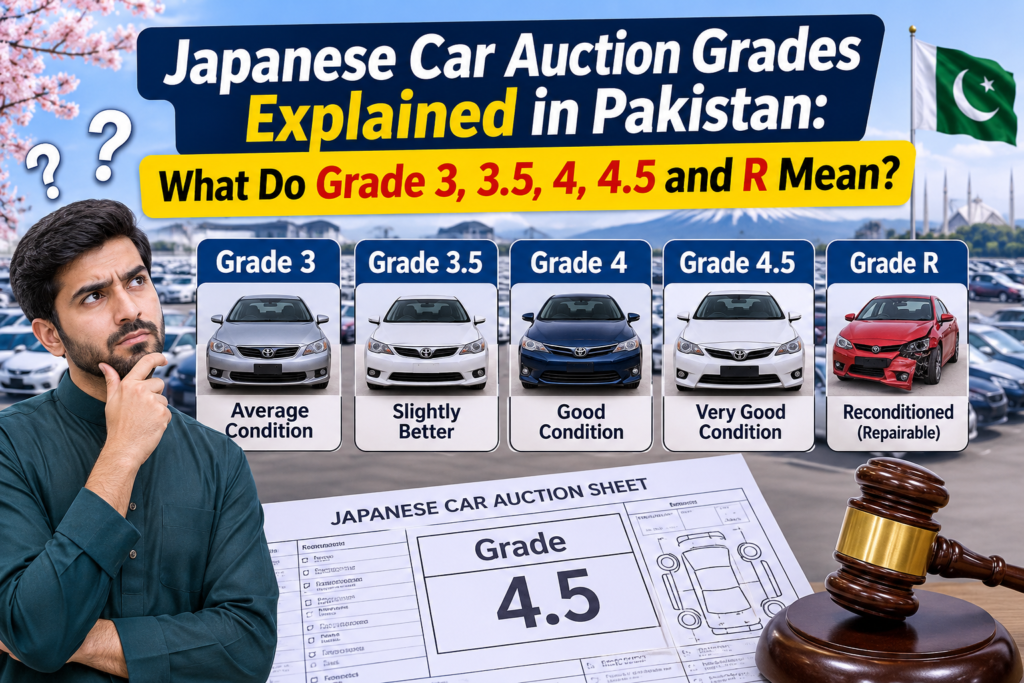
Japanese auction sheet with Grade 3, 3.5, 4 and 4.5 highlighted
Is topic mein hum sirf auction sheet ka general introduction nahi denge. Article mein different grades ka practical meaning, R/RA ka concept, interior grades, inspection remarks aur buyer ko grade dekh kar kya check karna chahiye — sab explain hoga.
Yeh aapki website ke liye relevant hai kyun ke buyers aksar seller se “Grade 4 hai” ya “Grade 4.5 hai” sunte hain, lekin unhein samajh nahi hoti ke grade asal mein kya batata hai. Auction grading systems auction house ke mutabiq vary kar sakte hain, is liye article mein grade ko guarantee ke taur par present nahi karenge.
Aap ke liye complete article English mein ready kiya hai, taake Pakistan ke buyers ko samajh aaye aur Google par relevant searches target hon. Is mein primary keyword opening sentence mein linked hai, secondary keywords internal links ke saath use kiye gaye hain, aur FAQs, SEO metadata aur image alt text bhi shamil hain.
Japanese Car Auction Grades Explained in Pakistan: What Do Grade 3, 3.5, 4, 4.5 and R Mean?
Car Auction Sheet Verification in Pakistan is an important step before buying a Japanese imported vehicle, especially when the seller tells you that the car has Grade 4, Grade 4.5 or an excellent auction rating.
You may have heard these numbers while visiting used-car showrooms or talking to import dealers. A seller might say, “Gaari Japan se Grade 4.5 hai,” hoping that you will consider it a very clean vehicle. Another seller may offer a Grade 3.5 car at a lower price and describe it as a great bargain.
But what do these grades actually mean?
Japanese car auction grades provide a general picture of a vehicle’s recorded condition at the time of auction. They help buyers understand visible wear, damage and repair history. However, a grade alone cannot tell you everything about a vehicle.
In this guide, we explain the meaning of Japanese auction grades, including Grade 3, 3.5, 4, 4.5, R and RA. You will also learn how to read interior grades, understand damage markings and check whether the seller’s claims match the original auction record.
Table of Contents
- What Is a Japanese Car Auction Grade?
- Japanese Car Auction Grades Explained
- What Do R and RA Grades Mean?
- What Are Interior Auction Grades A, B, C and D?
- How to Read Auction Sheet Damage Codes
- Is Grade 4.5 Always Better Than Grade 4?
- What Should Pakistani Buyers Check Before Buying?
- How to Verify Your Japanese Auction Sheet
- Frequently Asked Questions
What Is a Japanese Car Auction Grade?
When a used vehicle is offered at a Japanese car auction, it may be inspected by an auction-house inspector. The inspector records information about the vehicle’s condition on an auction sheet.
This document can contain several important details, including:
- Overall auction grade.
- Interior condition grade.
- Recorded mileage.
- Vehicle specifications.
- Exterior scratches and dents.
- Repair marks and replaced parts.
- Inspector’s comments.
- Auction date and vehicle identification details.
The overall grade gives buyers a quick idea of the vehicle’s condition. However, different Japanese auction houses may use slightly different grading standards.
This is why you should never assume that every Grade 4 car has exactly the same condition. Two vehicles with the same overall grade can have different mileage, interior wear, scratches, repairs and inspection remarks.
Think of the auction grade as a starting point for checking a vehicle, not a complete guarantee.
Japanese Car Auction Grades Explained
Let’s understand the common grades you may encounter when checking a Japanese imported car in Pakistan.
Grade S and Grade 6 – Almost New Condition
Grade S and Grade 6 are generally associated with vehicles in near-new condition.
These vehicles may have very low mileage, limited signs of use and excellent overall presentation.
For example, a relatively new Japanese car with a clean interior and very limited exterior marks may receive a high auction grade.
However, always check the registration date, mileage and inspection comments. The exact requirements for these grades can differ between auction houses.
Buyer advice: These grades can be attractive, but still verify the original auction record and inspect the actual vehicle before purchasing.
Grade 5 – Excellent Condition
Grade 5 generally represents a vehicle in excellent used condition.
The car may have minor cosmetic imperfections, but its overall presentation is usually very good.
You may find:
- Very limited scratches.
- Minor exterior marks.
- A clean interior.
- Good overall appearance.
- Relatively limited signs of use.
A Grade 5 vehicle can be an attractive option for someone looking for a well-maintained Japanese import.
Still, do not buy it based on the number alone. Check the inspector’s comments and condition diagram to understand any recorded imperfections.
Grade 4.5 – Very Good Condition
Grade 4.5 is one of the grades that many Pakistani buyers look for when searching for a clean Japanese imported car.
It generally indicates very good overall condition, although small scratches, dents or other cosmetic imperfections may still be present.
For example, a Toyota Aqua Grade 4.5 may look very clean in photographs but still have minor marks on its doors or bumpers.
Before buying, check:
- The number and location of scratches.
- Any dents shown on the body diagram.
- The interior grade.
- The recorded mileage.
- The inspector’s written remarks.
Buyer advice: Grade 4.5 is attractive, but the complete auction sheet matters more than the headline number.
Grade 4 – Good Used Condition
Grade 4 generally indicates a good used vehicle with normal signs of use.
You may find minor scratches, small dents or other cosmetic imperfections. The actual condition depends on the vehicle’s age, mileage and inspection results.
For example, a Honda Fit Grade 4 may have a few exterior marks but still be a reasonable purchase if the rest of the auction information is satisfactory.
Many buyers overlook Grade 4 cars because they prefer Grade 4.5. However, a well-maintained Grade 4 vehicle may be a better purchase than a Grade 4.5 vehicle with concerning remarks.
Buyer advice: Read the body diagram and inspector comments before rejecting or accepting a Grade 4 car.
Grade 3.5 – Average Condition With Noticeable Wear
Grade 3.5 generally indicates more noticeable wear or cosmetic issues than Grade 4.
Depending on the auction house and vehicle, the sheet may show multiple scratches, dents, paint concerns or other imperfections.
A Grade 3.5 vehicle is not automatically a bad purchase. Its actual condition depends on the specific issues recorded.
For example, a car with several minor exterior scratches may be easier to repair than another vehicle with a more serious structural or mechanical concern.
Before considering one, examine the auction sheet carefully and arrange a physical inspection.
Buyer advice: Consider the total repair cost and condition of the vehicle rather than focusing only on its lower price.
Grade 3 – Below Average Condition
Grade 3 generally suggests a vehicle with more noticeable condition problems.
It may have substantial exterior wear, multiple dents, scratches, interior deterioration or repair-related concerns.
A lower auction grade should encourage buyers to investigate more carefully.
Ask yourself:
- Are the visible problems only cosmetic?
- Are any important structural areas involved?
- Does the inspector mention repairs?
- Is the mileage consistent with the vehicle’s condition?
- Will the repair expense make the purchase worthwhile?
Buyer advice: Do not buy a Grade 3 vehicle simply because the seller is offering a large discount. Understand the condition and likely repair costs first.
Grade 2 and Grade 1 – Serious Condition Concerns
Grade 2 and Grade 1 are generally associated with unusual, poor or heavily compromised vehicle condition, although the exact meaning can vary.
Some vehicles may have extensive damage, significant deterioration, modifications or other serious issues.
The inspector’s remarks are particularly important for these grades.
If you are a normal private buyer looking for a reliable daily-use vehicle, approach such cars with considerable caution. A low purchase price may not compensate for expensive repairs or hidden problems.
What Do R and RA Grades Mean?
R and RA are important terms to understand when purchasing Japanese imported cars.
Unlike ordinary numerical condition grades, R and RA are commonly associated with vehicles that have a recorded repair or accident history.
However, the exact distinction between R and RA is not universal. Auction houses may use different definitions and grading conventions.
A repair-history vehicle may have experienced damage involving body panels or other areas. The auction sheet should be checked to understand what was repaired, replaced or affected.
When you see R or RA on an auction sheet, investigate:
- Which part of the vehicle was damaged?
- Was a panel repaired or replaced?
- Does the body diagram show structural damage?
- Are the inspector’s comments clear?
- Does the current vehicle condition match the recorded history?
A car with an R or RA grade should not automatically be considered worthless. However, it needs careful evaluation before purchase.
For example, a repaired exterior panel and damage involving an important structural area are not the same thing. Buyers should understand the difference rather than treating every repair-history vehicle equally.
What Are Interior Auction Grades A, B, C and D?
The overall auction grade is not the only detail worth checking.
Many Japanese auction sheets also include a separate interior grade. Depending on the auction house, this may use letters such as A, B, C and D.
Here is a general explanation:
| Interior grade | General meaning |
|---|---|
| A | Very clean interior with limited signs of use |
| B | Good interior with minor wear |
| C | Noticeable wear, marks or stains |
| D | Poorer interior condition with more significant wear or damage |
These descriptions are general guidance, not a universal rule for every auction house.
When checking a vehicle, pay attention to:
- Seat condition.
- Dashboard scratches or cracks.
- Steering wheel wear.
- Cigarette burns.
- Unpleasant smells.
- Stains and damaged upholstery.
- Missing interior components.
Imagine two Toyota Vitz vehicles, both carrying Grade 4 overall ratings. One has an interior grade A, while the other has an interior grade C.
The difference may be important to someone who wants a clean family car.
This is why you should always check the interior rating alongside the overall grade.
How to Read Auction Sheet Damage Codes
A Japanese auction sheet may contain a vehicle diagram with letters and numbers showing the location and severity of visible damage.
These markings can provide more useful information than the overall grade alone.
Some commonly used markings include:
| Code | General meaning |
|---|---|
| A1 | Small scratch |
| A2 | Medium scratch |
| A3 | Larger scratch |
| U1 | Small dent |
| U2 | Medium dent |
| U3 | Larger dent |
| W1 | Minor repair or paint-wave mark |
| W2 | More noticeable repair mark |
| W3 | Significant repair or paint-wave mark |
| X | Part requiring replacement |
| XX | Replaced part |
The exact definitions and usage can differ between auction houses, so always check the legend or translation for the specific sheet.
For example, if a Toyota Prius has an A1 marking on a door, it generally points to a small scratch. A W marking may indicate a repair-related surface issue that deserves closer attention.
Do not confuse a small cosmetic scratch with a structural repair. The location and type of marking matter.
If the auction sheet includes inspector comments in Japanese, make sure you understand them before making a buying decision.
Is Grade 4.5 Always Better Than Grade 4?
Not necessarily.
A Grade 4.5 car generally has a higher overall condition rating than a Grade 4 car, but that does not automatically make it the better purchase in every situation.
Consider this example:
Car A: Toyota Aqua Grade 4.5
- Higher overall auction grade.
- Minor exterior marks.
- Interior grade C.
- Some inspection remarks that need clarification.
Car B: Toyota Aqua Grade 4
- Slightly lower overall grade.
- A few cosmetic scratches.
- Interior grade B.
- No concerning remarks in the available record.
Which vehicle would you choose?
The answer depends on the complete inspection information, price, mileage and current condition.
A higher grade may be attractive, but it should never replace proper verification.
For Pakistani buyers, the smarter approach is to compare the auction grade, mileage, interior condition, damage diagram and seller’s claims together.
What Should Pakistani Buyers Check Before Buying?
Before purchasing a Japanese imported vehicle, follow these practical checks.
1. Confirm the Chassis Number
Ask the seller for the chassis or frame number and compare it with the number physically recorded on the vehicle.
Make sure the auction record belongs to the same vehicle.
2. Verify the Original Auction Record
Do not rely entirely on a photograph or printed auction sheet provided by the seller.
Use an independent verification process to check whether the available record matches the vehicle.
3. Compare Mileage
Check the mileage recorded on the auction sheet against the current dashboard reading.
Remember that the vehicle may have travelled additional kilometres after its Japanese auction.
4. Read the Inspector’s Remarks
The written comments can reveal details that are not obvious from the overall grade.
If the comments are unclear, obtain a reliable translation before making your decision.
5. Check the Body Diagram
Look at the location of scratches, dents, repairs and replaced parts.
Pay special attention to any markings involving important structural areas.
6. Arrange a Physical Inspection
An auction sheet describes the vehicle at the time of its Japanese auction inspection. It does not guarantee its current condition in Pakistan.
Ask a qualified mechanic or inspection professional to check the actual vehicle.
7. Check Ownership and Registration Documents
Auction sheet verification does not replace legal ownership and registration checks.
Compare the relevant vehicle identification details with the available documents and complete the appropriate registration and transfer checks before payment.
How to Verify Your Japanese Auction Sheet in Pakistan
If you are considering a Japanese imported car, checking its auction history can help you make a more informed decision.
You can use the Auction Sheet Verification website to submit the vehicle’s chassis number and check whether a matching auction record is available.
Follow these steps:
- Obtain the vehicle’s correct chassis number from the seller.
- Visit the Auction Sheet Verification website.
- Open the verification form.
- Enter the required vehicle information.
- Follow the payment and submission instructions displayed on the website.
- Receive the available verification report through WhatsApp, as described by the service.
Use the report to review the available auction information, including the recorded grade, mileage and vehicle details.
If no matching record is available, contact the support team for guidance. A missing record does not automatically prove that the seller has provided false information.
Always check the current service fee on the website before submitting your request.
Frequently Asked Questions
1. What is the best auction grade for a Japanese imported car?
Grade S, 6 and 5 generally indicate near-new or excellent condition, while Grade 4.5 and Grade 4 are also attractive used-car grades. However, the best choice depends on the complete auction sheet, mileage, inspection remarks and current vehicle condition.
2. Is Grade 4.5 better than Grade 4 in Japanese car auctions?
Generally, Grade 4.5 represents a higher overall condition rating than Grade 4. However, buyers should compare interior condition, damage markings, mileage and inspector comments before deciding.
3. What does Grade 3.5 mean on a Japanese auction sheet?
Grade 3.5 generally indicates noticeable wear or cosmetic issues. The vehicle may have scratches, dents or other imperfections. Always check the actual inspection diagram and remarks because the condition varies between cars.
4. What does R grade mean in a Japanese imported car?
R generally indicates a vehicle with recorded repair or accident history. The specific damage and repair details should be checked on the original auction sheet before purchasing.
5. What is the difference between R and RA grade?
Both are commonly associated with repair history, but their exact meanings can vary between auction houses. Do not assume that RA always means minor damage or that R always means major damage. Read the inspector’s remarks and repair markings.
6. What does interior grade B mean?
Interior grade B generally indicates a reasonably clean cabin with some minor signs of use. The exact grading standard depends on the auction house.
7. Can I buy a Japanese car with Grade 3.5?
Yes, but you should understand its recorded condition before purchasing. Check the damage diagram, inspector comments, mileage and current physical condition. Also consider whether the repair costs make the purchase worthwhile.
8. How can I check a Japanese car’s original auction grade in Pakistan?
You can submit the vehicle’s chassis number through an auction sheet verification service to check whether a matching historical record is available. Car Auction Sheet Verification in Pakistan can help you check the available Japanese auction information before buying.
Final Thoughts: Understand the Auction Grade Before You Buy
Japanese auction grades can help you understand a vehicle’s recorded condition, but they should never be treated as a complete guarantee.
A Grade 4.5 vehicle may look attractive, while a Grade 4 vehicle may also be a sensible purchase. Similarly, a Grade 3.5 car may be worth considering if its condition and repair requirements are clearly understood.
The important thing is to look beyond the number.
Check the original auction record, confirm the chassis number, compare mileage, read the inspector’s remarks and examine the damage diagram. Then arrange a physical inspection to understand the vehicle’s present condition.
Before paying a token or finalising your purchase, use Car Auction Sheet Verification in Pakistan to check the available Japanese auction history.
A little verification before buying can help you avoid unnecessary confusion and make a more informed decision.