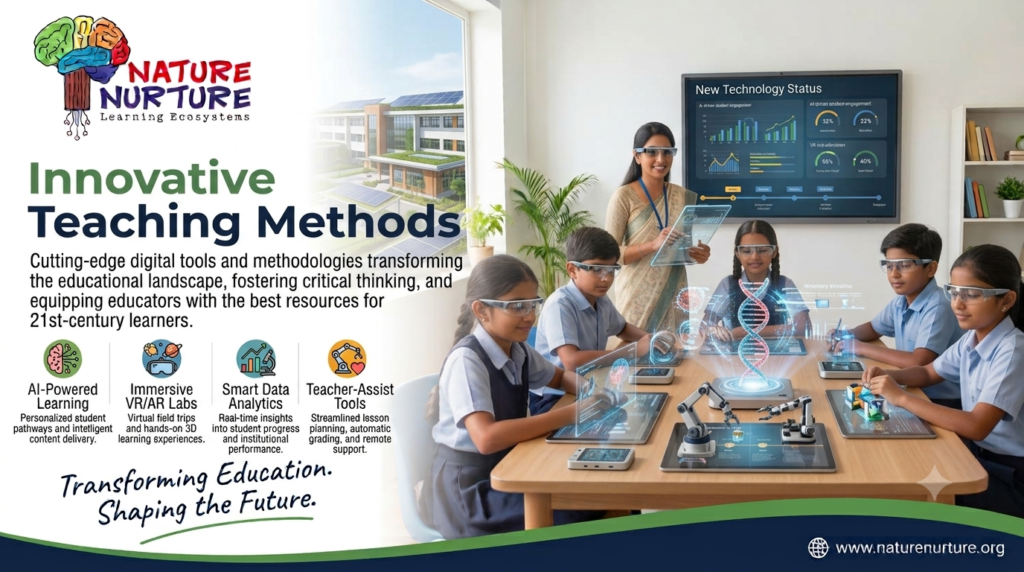
Education is changing with the needs of students. Today, children need more than textbooks and memorizing facts. They need opportunities to ask questions, solve problems, work with others, and use what they learn in real situations. Innovative Teaching Methods can help teachers create classrooms where students take an active role in their learning.
Modern teaching does not mean removing traditional methods completely. Instead, it means combining useful classroom practices with creative activities, technology, projects, and real-life examples. This approach can make lessons easier to understand and more enjoyable for students.
What Are Innovative Teaching Methods?
Innovative Teaching Methods are new and creative ways of teaching that help students understand lessons through active participation. These methods can include project-based learning, group activities, storytelling, classroom discussions, experiments, digital resources, and hands-on tasks.
For example, instead of only explaining how plants grow, a teacher can ask students to plant seeds and observe their growth over several days. Students can record changes, discuss their observations, and learn the science behind plant growth.
This type of learning helps children connect classroom knowledge with the world around them.
Make Students Active Learners
A good classroom should give students opportunities to participate. When children are only listening to a teacher, they may find it difficult to stay focused for a long time. Innovative Teaching Methods can encourage students to take an active role in the learning process.
Teachers can use questions, discussions, games, role-play, and small group tasks to involve students. A history lesson, for example, can include a short role-play where students act as important people from a particular period.
Such activities encourage students to think, communicate, and remember concepts through experience.
Use Technology with Purpose
Technology can make teaching more engaging when it is used for a clear learning purpose. Interactive screens, educational videos, digital quizzes, and learning platforms can help teachers explain difficult concepts in simple ways. Innovative Teaching Methods can make these tools more effective by connecting technology with meaningful classroom activities.
However, technology should support teaching rather than become the focus of every lesson. Teachers should select digital tools according to the age of students, lesson objectives, and classroom needs.
The right balance between technology, discussion, reading, and hands-on activities can create a stronger learning experience.
Encourage Project-Based Learning
Project-based learning allows students to explore a topic and create something based on what they have learned. It can be especially useful for developing creativity, teamwork, communication, and problem-solving skills. As part of Innovative Teaching Methods, project-based activities can make lessons more practical and meaningful.
For instance, students learning about environmental issues can work together to create a classroom recycling project. They can research waste, identify simple solutions, prepare posters, and present their ideas.
Projects like these make learning practical and give students a reason to use their knowledge.
Focus on Different Learning Needs
Every student learns differently. Some children understand concepts quickly through visuals, while others need practice, discussion, or hands-on activities. Innovative Teaching Methods can help teachers respond to these different learning needs more effectively.
Teachers can use different teaching approaches within the same lesson to support these needs. Visual examples, simple explanations, activities, and practice questions can be combined to make learning more accessible.
This flexible approach also allows teachers to provide extra support to students who need more time while giving advanced learners opportunities to explore topics further.
Build Better Teaching Teams
A strong teaching approach also depends on having capable and motivated teachers. Schools need educators who understand their students and are willing to learn new approaches.
Effective Teacher Recruitment Strategies can help schools identify teachers based not only on qualifications but also on communication skills, classroom ability, creativity, and willingness to grow.
After recruitment, regular teacher training can help educators learn new classroom techniques and understand how to use modern educational resources effectively.
Create a Culture of Continuous Learning
Teaching should not remain the same year after year. Teachers can improve their methods by observing classroom results, collecting student feedback, sharing ideas with colleagues, and trying new activities. Innovative Teaching Methods can help educators keep improving their approach and respond to changing student needs.
Schools can also encourage teachers to attend workshops, training sessions, and professional development programs. This creates a culture where teachers continue learning while helping students become better learners.
Nature Nurture supports practical and student-centered approaches that help schools develop meaningful learning environments. By combining thoughtful teaching practices with modern educational solutions, schools can make learning more engaging and useful.
Conclusion
Innovative Teaching Methods can help schools move beyond simple memorization and create classrooms where students actively participate in learning. Project work, group activities, technology, experiments, discussions, and real-world tasks can make lessons more meaningful.
The most effective approach is not about using every new method. It is about choosing the right method for the right learning goal. With skilled teachers, thoughtful planning, and suitable Teacher Recruitment Strategies, schools can create learning environments that help students become confident, creative, and independent thinkers .