Industrial Tools tailored for metalworking demand extraordinary hardness to shape and cut tough structural alloys. Milling cutters, lathe inserts, and drill bits utilize tungsten carbide to withstand intense friction heat. Cooling systems continuously lubricate these cutting edges to prevent premature thermal degradation during high-speed machining. Superior metalworking implements ensure flawless surface finishes on critical industrial components.
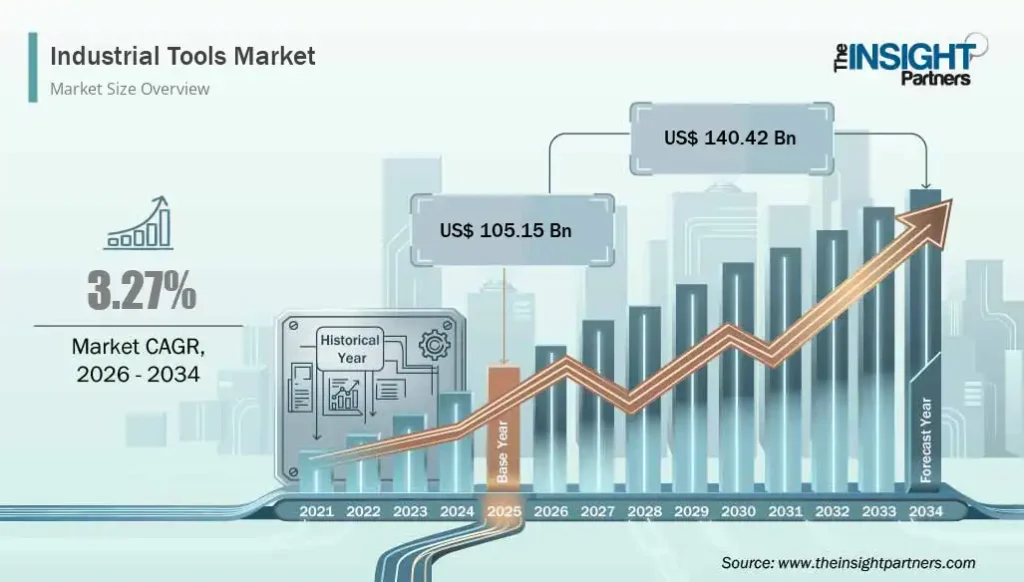
The global industrial tools market is experiencing steady, transformative growth driven by accelerating automation, robust infrastructure development, and widespread modern industrialization across emerging and developed economies. According to recent market analysis, the global Industrial Tools Market size is expected to reach US$ 140.42 Billion by 2034, expanding from US$ 105.15 Billion in 2025. The market is anticipated to register a compound annual growth rate (CAGR) of 3.27% during the forecast period 2026–2034.
Market Overview and Key Growth Drivers
Industrial tools encompassing hand tools, power tools, hydraulic equipment, pneumatic tools, and precision measurement instruments form the structural backbone of global manufacturing, automotive assembly, construction, aerospace, and energy operations. The ongoing shift toward Industry 4.0 standards is redefining equipment specifications, prompting industrial operators to upgrade legacy tool inventories to smart, connected, and ergonomically optimized equipment.
Key factors propelling market expansion include:
-
Automation & Industry 4.0 Integration: The integration of IoT sensors and smart diagnostics into high-torque power tools allows real-time data tracking, predictive maintenance, and enhanced quality control across automotive and aerospace assembly lines.
-
Cordless & Battery Innovations: Advanced lithium-ion and solid-state battery technologies have dramatically improved operating runtimes, power-to-weight ratios, and safety, accelerating the transition from traditional pneumatic and corded tools to high-performance cordless platforms.
-
Infrastructure Investment: Increased public and private expenditure on renewable energy installations, commercial real estate, urban transportation networks, and industrial facility modernization continues to drive sustained demand for heavy-duty industrial tools worldwide.
-
Safety & Ergonomic Focus: Rigorous occupational safety regulations globally have spurred tool manufacturers to prioritize vibration reduction, noise dampening, lightweight composite materials, and enhanced user safety features.
Get a PDF Sample- https://www.theinsightpartners.com/sample/TIPMC00002516
Regional Insights
North America and Europe continue to maintain substantial market shares, underpinned by advanced manufacturing facilities, stringent workplace safety regulations, and rapid adoption of automated assembly systems. Meanwhile, the Asia-Pacific region is projected to register the fastest growth during the forecast period. Rapid urban development, expanding automotive hubs, and heavy industrial investment across countries such as China, India, and Southeast Asian nations are generating unprecedented demand for both industrial hand tools and specialized power equipment.
Competitive Landscape and Key Industry Players
The industrial tools market remains highly competitive, characterized by constant product innovation, strategic acquisitions, and extensive distribution network expansions. Leading manufacturers are investing heavily in research and development to introduce lightweight, high-durability, and energy-efficient tools engineered for demanding industrial environments.
Prominent players operating in the global industrial tools market include:
-
Stanley Black & Decker, Inc.
-
Robert Bosch GmbH
-
Techtronic Industries, Inc. (TTI)
-
Makita, Inc.
-
Atlas Copco AB
-
Apex Tool Group
-
Koki Holdings, Co., Ltd.
-
IRWIN Tools
-
Channellock, Inc.
-
Akar Tools Limited
These key market participants are focused on broadening their smart tool ecosystems, enhancing battery compatibility across multi-tool fleets, and strengthening direct-to-enterprise service models to retain market leadership.
Future Outlook (2026–2034)
Looking ahead, the industrial tools market is set to undergo significant technological convergence over the next decade. Future market growth will be heavily shaped by digital connectivity, sustainability initiatives, and customized industrial tooling solutions tailored for automated manufacturing cells.
Related Reports-
Riveting Tools Market Size, Growth & Demand by 2034
Carbide Tools Market Size, Share & Demand by 2034
About The Insight Partners
The Insight Partners is a leading market research and consulting firm delivering actionable insights through in-depth industry analysis and strategic intelligence. The firm supports clients across various industries in making informed business decisions by providing comprehensive market forecasts, competitive assessments, and growth opportunities.
Contact Us:
If you have any queries about this report or if you would like further information, please contact us:
Contact Person: Ankit Mathur
E-mail: sales@theinsightpartners.com
Phone: +1-646-491-9876
Also Available in : Korean| German| Japanese| French| Chinese| Italian| Spanish

